

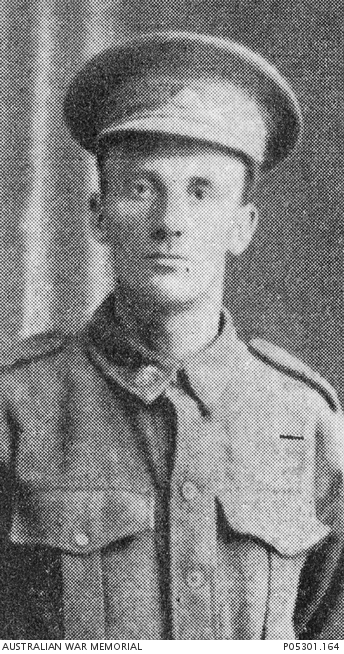
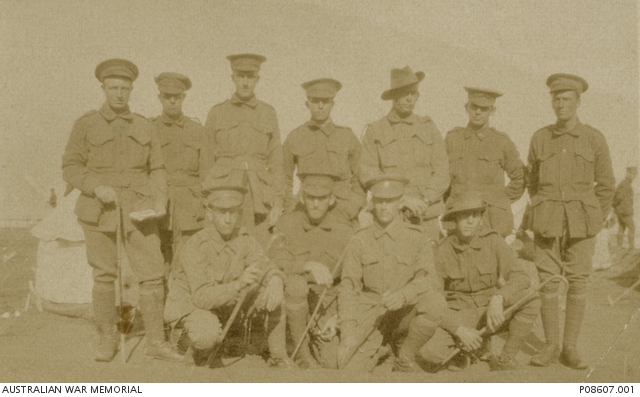
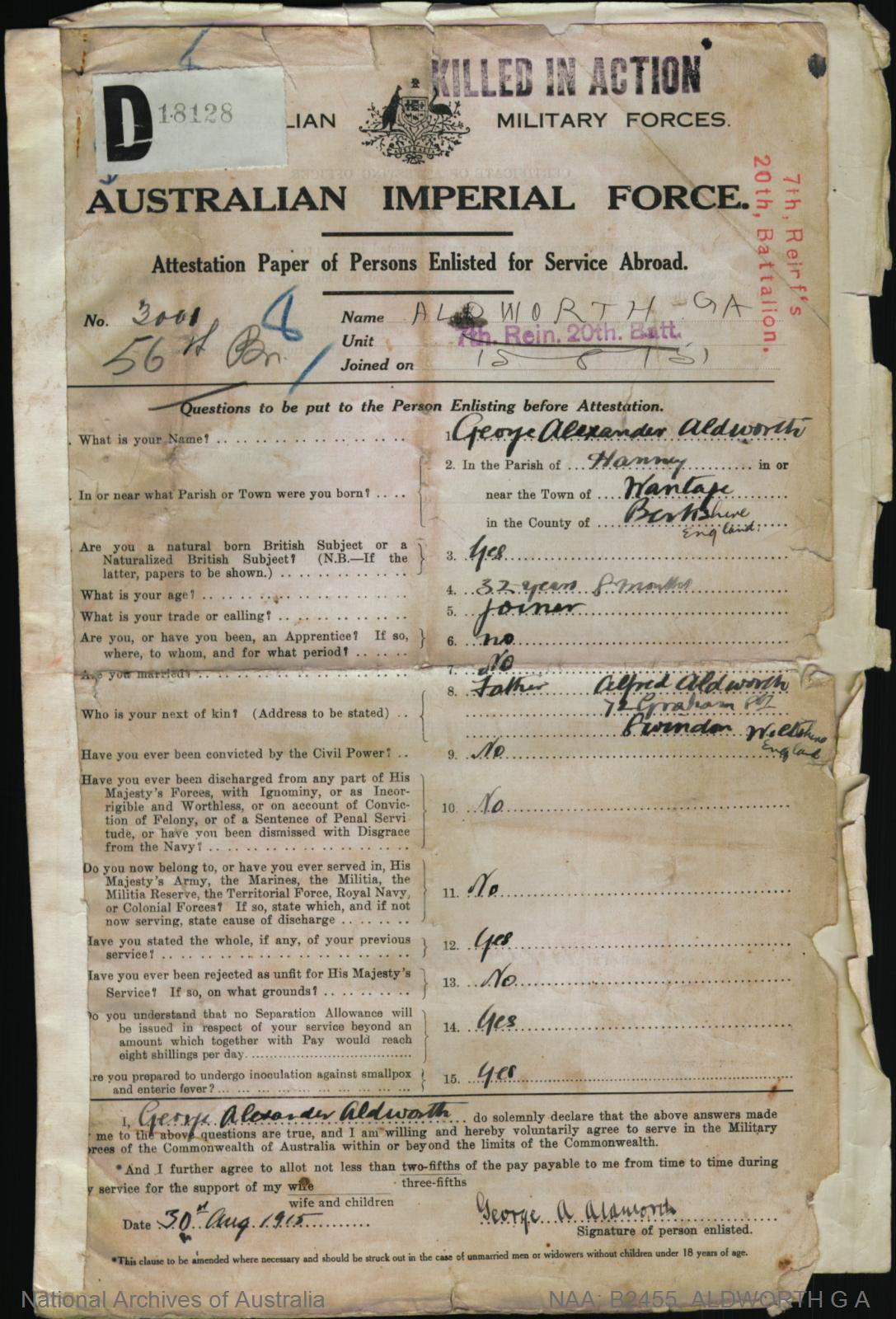
In September 1916 Sydney’s Daily Telegraph reported, “Private George Alexander Aldworth, who has been reported as killed in action in France, was a native of Wantage in England, and arrived in Australia at the end of 1911, when he settled at Rockdale. He immediately entered into local affairs, and took a keen interest in Soccer football, being instrumental in introducing the game into the district. He was a founder and first captain of the local club, and himself a player of no mean calibre. He also identified himself with the local church, charitable, and patriotic objects, and was widely known and respected throughout the district. He had distinct literary abilities, and articles and poems from his pen have appeared in print at various times.”
George Aldworth enlisted in August 1915 and was killed in action in Armentieres, France, on 26 July 1916.
On 14 October 1916 The St. George Call reported, “Pte. G. Aldworth, who was a stretcher bearer, met his death from a high explosive shell, while in a dug out. One shell had wounded a couple of soldiers, and he with others, had immediately rushed with assistance, when another shell, bursting over the same spot killed poor George, along with other heroes. George Aldworth was thought well of by all the Parishioners of St. Paul’s, and was a great favourite of the children and choir boys and has composed a children’s hymn. Much sympathy is felt for the bereaved parents. A memorial was installed in the chancel of St Paul’s church Kogarah where Aldworth was a member of the choir.”
Aldworth’s literary talents were demonstrated in his correspondence to the local newspaper documenting his thoughts, feelings and observations as he traveled to the Western Front via Egypt and the bucolic fields of France to his untimely death.
The St. George Call, 6 May 1916
FROM THE FRONT.
The following letter has been received from Pte. G. A. Aldworth, of the B Co. 56th Battalion, now stationed at Tel-el-Kebir, and describes that place: —
A railway line, a canal, a narrow oasis, all running eastward. A few native dwellings, mud coloured, squalid and low, scattered among the palms. Arab dhows, tall in the mast, passing with slow gracefulness, down the canal. Squares of freshly turned earth, breaking up the green, such wonderful green too, framed in yellow desert sand. The desert wastes roll down in long undulations from the north, as if to swallow the emerald strip, and link up with the sand streak away northward. The railway line, however, seems to be an impassable barrier, for there the desert’s progress is abruptly stayed. A square walled in garden of God, where the yew tree and cypress mingle their sombre hues with those of the native palms, shading the graves of Britain’s heroes.
In the fields, men, asses, camels, women and children (this seems to be the order of importance) working. Such is Tel-el-Kebir to-day. It was the same before the Australian invasion, before the men from ‘down under’ pitched their tents upon the desert sands, before the silent wastes were made to ring with the shouted word of command. When war is ended, Tel-el-Kebir will probably remain the same, and will jog along with the same type of inhabitant, slow-minded and without ambition, with customs and conditions unaltered. The addition of a few Australian adjectives to the native vocabulary, will probably be all that the future tourist will have to remind him, that the Kangaroos have passed this way.
‘Tis Sunday morning. Church parades are ending. Three bands are saving His Majesty in different spots of the camp, with commendable vigor. At last everything is over and we are free. In the early afternoon we join one of the parties, who set out for a desert ramble. We go in a nor-easterly direction, and less than half an hour brings us to the battleground of 1882. The trenches cover an extensive elevation from which the desert slopes on all sides. It is a lovely day— a Sydney summer’s day, in fact. The heat is vibrating above the sand and pebble patches. Away eastward we descry what seems to be a placid lake. There are islands in the lake. The reflection of trees in the water makes it look enticing. As we watch, it gradually takes a new form, becoming a river, changing again later into a series of small pools. Soon, no trace of the phantom lake remains. In its place stretch the arid, merciless sands. The desert pebbles are of more than ordinary interest. Some might be petrified bird’s eggs, they are so alike. Others are composed of thin layers of varying hue, and are wonderfully rounded. The sky is not devoid of cloud to-day. Therefore, the far-flung glare is relieved by passing patches of shade. We rest awhile upon an embankment, and from our position trace the rough outline of trench, gun-pit and mound. Memories of visits paid to similar fortifications, situated on the southern hills of England, come to mind— hill-forts, which to-day are silent witnesses of unrecorded struggles away back in the early history of the Empire. Protruding, here and there, from the sand, are the bleached remains of some, who fell thirty-three years ago. We again move on, keeping watchful eyes upon the pebbles underfoot. We are not unrewarded, for the desert yields us two battered cartridges and a rusty key. Later, we cross the railway line, and visit the little neglected cemetery in the oasis. We read the inscriptions in silence, for ’tis a sacred and historic place. Rumour says it is the spot where a British square was broken for the only time in history. Many stones, covered with names, are there. There is also a slab of wood ‘To one unknown.’ We go thoughtfully away, A chill chill wind has started to blow along the desert, the glare is slowly softening into grey. By and by, the blue will come, and the deepening colour will accentuate the swelling rises. The sands will lose their flatness, and the desert will roll away into the night, a stretch of shadowy hill and dale, silent, mysterious.
The St. George Call, 16 September 1916
FROM THE FRONT.
Private George A. Aldworth, of the 56th Battalion in journeying through France on his way to the front, gives the following description of the delightful country. We regret to announce that since sending this letter for publication, Pte. Aldworth has been killed in action, and is now at rest in the country of which he so favourably writes : —
“Thy cornfields green, and sunny vines. O pleasant land of France.” We repeated the lines automatically and often, in the old schoolroom, in the old days. They meant nothing to us then. It is otherwise now. We have had many experiences, and have seen much since the day we left the sunny home shores to aid the mother land. After a day’s wait outside we entered the harbour and soon the work of disembarkation began. We entrained immediately and moved off without visiting the city. Very soon the train was plunging through a series of tunnels, which lead through the rocky hills to the country beyond. Looking back, as we occasionally emerged from the pitchy black underground, we got wonderful pictures of the city, the Mediterranean, and the fine rugged coast scenery. A slight haze softened the outlines of the mountains behind the town, and the boys were loud in praise of the glorious view. Again the deafening roar of the train in the darkness and when we again saw the sun Marseilles had passed from view. For about eight hours we made good progress, stopping for tea at a place which strangely enough was called Orange. The train had taken us through the most fertile, picturesque country we had ever seen. A country indeed worth fighting for— either to possess or, to retain. So far as the eye could reach, the vineyards and wheat fields spread. Hardly a yard of ground which was not under cultivation. The entire land was, like a vast garden, so thorough, are the French peasants in their work. And the love of the beautiful which is natural to our Ally, finds expression in the way they lay out their fields and road ways. The vines, and the corn, the carefully tended vegetable gardens, mingle beautifully with the long avenues of poplar and lime trees, which shade the white neatly trimmed roads. Scores of villages and small towns were passed, so dainty looking were the little red and white homes which, like newly born chicks, cluster closely round the grey old churches. What a warm reception from the inhabitants too, as we continued our journey. Scarcely a man, woman or child but waved a hand or if the train stopped, came with haste to wish us good luck. Many women were in black and there was a wistful look and a tear occasionally, mingled with the good wish. One old lady of very great age, we saw, who was feebly shaking one hand to us while she supported it with the other. The men generally were in uniform— they had probably been sent from the firing line to aid the harvesters,— the reaping season having just commenced. A very delightful time could be spent visiting the many churches we saw. Some were very fine edifices — others interesting because of their quaintness. Especially so, in the latter sense, was the Church of Arles, where also is a railway works. The town of Farascon possesses a couple of very fine castles, one of which might almost be a .replica of the famous Bastille. The women seem to have taken up their tasks splendidly, which are, for a time, left them, to perform. We saw them everywhere, in the fields, even using the scythe, also riding upon the horse rake and reaping machine. We passed Lyons in the early dawn of’ the next day, obtaining a confused picture of fog on a river, a couple of imposing bridges, and some fine streets. The, second day was like the first, mile after mile of vineyards, more villages, more “bon voyage” from the people, pretty winding lanes, leafy fairy lands, busy scenes in the fields. Here a sturdy blooming lass, deftly using a hoe, thinking no doubt of her Denis away up north. There a sad-eyed dame, pushing to market a heavy load of cherries, strawberries, currants, carrots, and cauliflowers, together with the choicest roses and dahlias, etc. She paused awhile near us, to have a ‘ blow,’ brush back a few strands of grey hair, and to wave her hand to the “Howstraityong!” Then on again with her load of produce and perhaps her load of sorrow. Unfortunately, we did not see Paris, having left it on one side in the early hours of next morning. The vineyards also had not been able to keep up with us, and we now looked out upon country almost entirely ‘devoted to agriculture and dairy farming. Naturally enough, we now looked out for signs of warfare. Slowing down into the station of Criel, we stopped alongside a hospital train which had just come in from the firing line. We gave a very hearty cheer for the plucky Frenchmen and those who could, thanked us, either in mixed language, or by eloquent looks and shoulder shrugs. We also struck against a train load of men bound for the front, and they greeted us like brothers. After our great experience of the beauteous country, it was with emotions of pride and brotherliness that we responded, showering upon them all our cigarettes, matches, etc., things we had eagerly rushed to procure an hour previously. Upon this day we saw many families on the way to Church, the cows were idly lying in the meadows. There was the song of the lark, the blackbird, and the thrush. The swallow skimmed the mirror-like surface of the river, while here and there in the shade of the willows, sat ancient disciples. Very little, after all, to point to the fact, that away behind the river, the willows and the meadows, Earth’s sublimest tragedy was being enacted. Towards evening of the second day we once more came in sight of the ocean. We had passed one or two camps, where troops were resting. Like the people to whom we had spoken en route, we found the soldiers cheerful and, confident of ultimate success. Just before dawn on the following day we arrived at our journey’s end. Sixty two hours in the train.
The behaviour of the men was first class; everybody, especially the women folk, being treated with a courtesy that was good to see. We are now scattered through a very quaint old village — in nearly every respect like an English one— living in the barns attaching to tumble-down farm houses. I write this in an old stable. It is wonderfully peaceful. From the meadows comes the not unmusical rattle of the reaping machine. There is a cackle of hens outside. A pair of swallows comes in with fluttering wings and chirpings, ‘ to work upon a mud nest on a beam two feet above my head. Only now and then away eastward, there is the long dull roll of artillery, the roar of a heavy gun, and the sound of tramping men as they make their way through the leafy winding lanes. Above all, and better than all, are the outpourings of a lark. From out the blue sky comes the song to break in golden rain upon the earth. Foolishly, perhaps, I allow myself to dream. A dream of warfare ended—of a humanity made regenerate through war— gone forever the hypocrisy, the lust, the selfishness. Only a desire, lark like, to soar high in thankfulness to the Benign Influence which gives to all the chance to live in peace and good will in a paradise of which beautiful France is only a part. A foolish dream ? Perhaps! “Fall in, with gas helmets on!” rings out the order, and so I go away to be “gassed.” The lark sings to deaf ears now, and the swallows have the stables to themselves.