

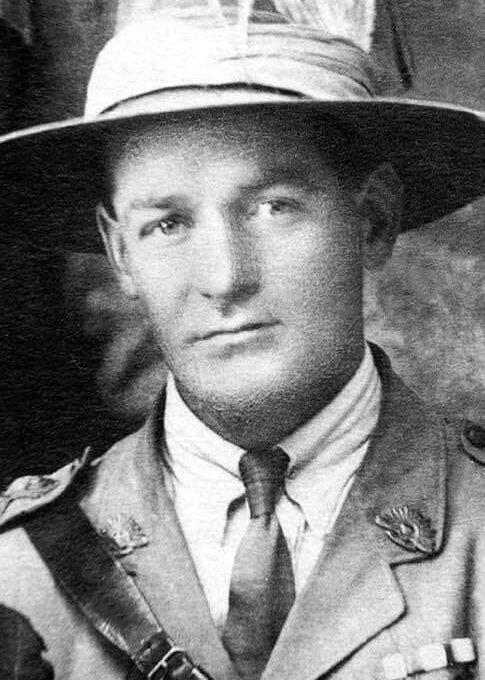
Fred Evans arrived in Blackstone in 1887 as a toddler when his father Edward joined an influx of Welsh miners to region. The next year Blackstone Rovers were formed by members of the local volunteer military corps, many of whom were Welsh miners. Rovers, mining and the military would become major parts of Evan’s life.
He was reported as playing for Rovers as early as 1900, when they won the youth premiership, as remembered by his teammate Bill Halls in the Queensland Times on 1 May 1948. Another former Rovers player, Gib Reason, remembered Evans as part of a Rovers premiership winning side in 1907, beating Dinmore Bush Rats in extra time at the Gabba in a replay after three previous games finals ended in draws.
The reminiscence of this game came in the Queensland Times on 18 January 1947 and was spurred by a photo of the winning team. While the photo still exists, newspaper reports from 1907, which gave decent coverage to soccer, do not mention any final between Rovers and Bush Rats.
Success did come in 1912 when Evans captained Rovers to the Challenge Cup. The same year he was selected for the Queensland state side to play New South Wales in a home series, earning two caps in a losing series. After the war they won the West Moreton Soccer Football Premiership in 1919. In all, Evans played for Rovers until the early 1920s, with his soccer career only interrupted by his war service.
Mining, on the other hand, was the focus for much of his professional life. Evans followed his father Edward into mining after he completed school, but soon came to face the dangers of the occupation. Edward died nine days after a mining accident at Blackheath Colliery on 10 February 1908. Evans was working further up the tunnel when he heard the explosion which fatally injured his father. He was himself injured in a mining accident at Fernie Creek Colliery in 1909, which killed two men, including former Blackstone Rovers player Joseph Marsh.
Around the same time, Evans joined the 13th Australian Light Horse Regiment, which was part of the Queensland Mounted Infantry (QMI). After a restructure early the next decade he was moved to the 2nd Light Horse. His father, Edward, had been in the military, and had left Blackstone to fight in the Boer War, having previously served in the region with the British Forces before emigrating from England.
Evans had been in the QMI for over seven years of home service before he enlisted in March 1915, and had risen to the ranks of 2nd Lieutenant. He arrived at Gallipoli at the start of October, but there are no records of his time there. The 2nd Light Horse spent most of the war after Gallipoli in Egypt, Syria and Palestine but it is hard to determine the particulars of his active service. Evans’ time in 1916 and 1917 was interspersed with training, where he qualified from Lewis Gun and Hotchkiss Gun training, Cavalry School and passed the 3rd Topographical Course with a mark of 79%.
He also spent some time with the 1st Light Horse. It was with the 1st Light Horse that Evans was recommended for the Military Cross on 17 June 1917, which was approved at the end of the year. The recommendation stated:
On the 11th May, 1917, he was specially selected to make a reconnaissance of an enemy work under construction near Wadi IMLEIH. Taking with him 4 men, Lieutenant Evans, showing great dash, succeeded in actually entering the work in face of strong enemy opposition. During the reconnaissance he was attacked by 2 troops of enemy cavalry.
Evans was subsequently promoted to Captain. In a later recommendation for promotion, shortly before his discharge, it was noted that Evans was “a capable conscientious and vigorous officer who has done good work in the field. Professional knowledge, discipline, leadership and capacity for training ground. Not suitable for staff work.”
Evans returned to Australia in mid-1919 to family life. He had married Edith Davies in November 1913, and the next year their first child and only son was born. A daughter was born after Evans enlisted, while four more daughters were born after the war, though one, Dulcie, died in infancy in 1920.
After living in Blackstone for a few years, the couple moved to Thagoona, west of Ipswich by 1925. Here Evans worked as the under-manager of Caledonian Colliery at nearby Walloon. This coincided with the formation of Caledonian soccer club, the first club in Walloon in 9 years, and the Light Horse team in neighbouring Rosewood, though there is no evidence either way whether Evans had any relationship with these lower division clubs. Evans later became a mining inspector.
During the Second World War he was an Instructor for the Volunteer Defence Corps. He passed away in 1959. Edith lived until 1986.
(With thanks to Jane Schy of the Rosewood History Group, whose article on Fred Evans added much background for this piece. Most importantly her piece included a scan of the recommendation for awarding for the Military Cross, containing the reason for the award. This is missing from Evan’s military record in the National Archives.)