


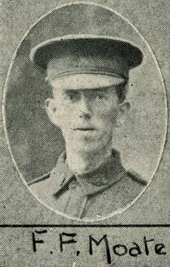
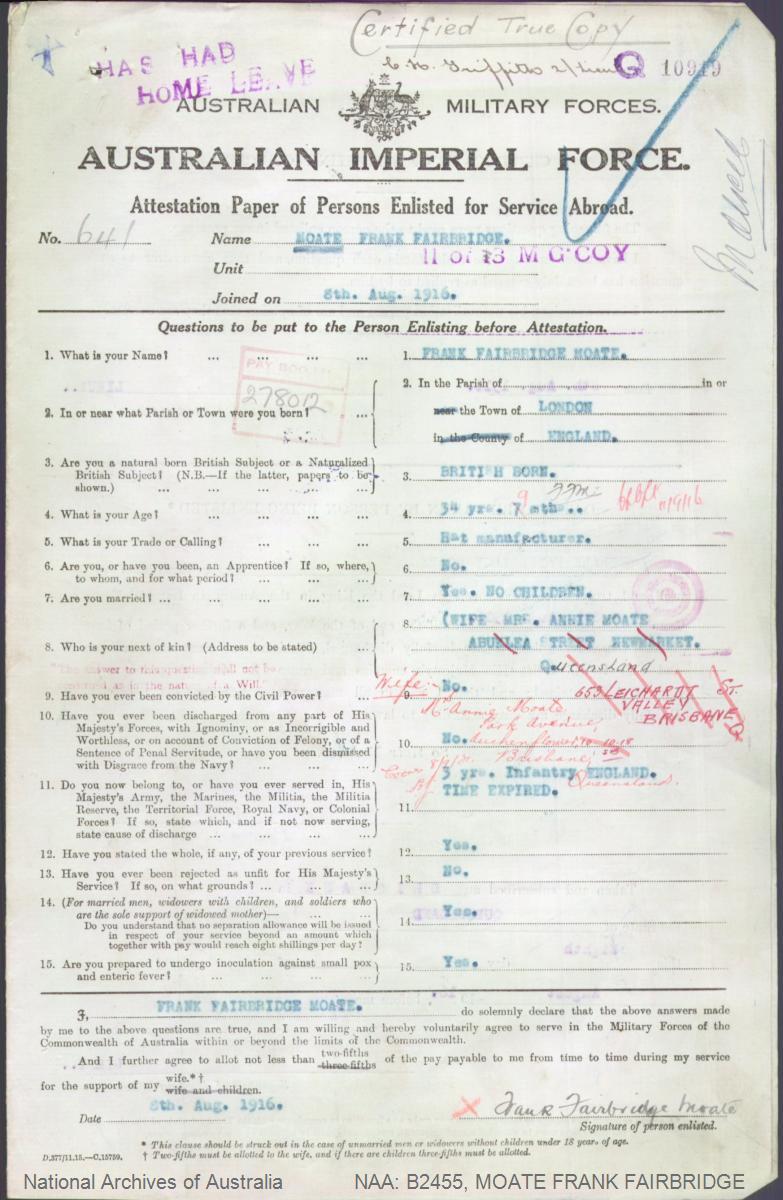
Frank Moate was born in London in 1882 and moved to Queensland in 1901. Brisbane football was in a perilous state at the time, with no teams taking the field in 1900 while a reformed Eskgrove was forced to play in the Ipswich competition in 1902.
Moate was seen playing for Eskgrove from 1903. His form over the next few seasons saw him selected for the Brisbane representative team against Ipswich (twice), and HMS Mildura. When he stopped playing ahead of the 1906 season, the Saturday Observer of 7 April called Moate a “top-notcher”. The paper hoped Moate would reconsider, opining, “it is first-class men like these who build up the game, and it is them the younger players take for a model.”
The newspaper got their wish when Moates returned to the pitch in 1907 for Milton, where he was last seen playing in 1909.
Moate married Annie Paxton in March 1910. They had no children before he enlisted in August 1916. At the time of his enlistment, he was a section manager at Alex Stewart and Son’s hat factory in the Valley, Brisbane. The Brisbane Courier of 7 September 1916 stated the factory employees presented Moate with a gold wristlet watch, money belt and wallet, and “spoke in admiration of that gentlemen’s patriotism in enlisting, and wished him godspeed and a safe return.”
He embarked from Melbourne in May 1917, arriving in England two months later. Here he undertook machine gun and other training until June 1918, when he was sent to France with the 3rd Battalion of the Australian Machine Gun Corps.
Moate was killed in action in late September, less than two months before armistice and buried in the Roisel Communal Cemetery. Annie was sent Moate’s personal effects after the war, which came to 3 wallets, photos, cards, a letter and a coin. At the time she was living in Newmarket, Brisbane. The Queensland Ladies’ Kennel Club, of which she was honorary secretary, marked her husband’s death at a meeting in November 1918.
Victoria Barracks in Melbourne put out a call for next of kin in newspapers in 1921. The Telegraph of 15 October 1915 carried the following: “The military authorities desire the next of kin of the following deceased soldiers to communicate with the Officer in Charge, Base Records, Victoria Barracks, Melbourne, at the earliest possible moment.” Among the lengthy list was “F. F. Moate, 3/M.G. Battalion”. In September 1921, Annie wrote to the Base Records in Brisbane, having seen one of these notices printed in the Courier. She included her updated address, having moved to Park Avenue, Auchenflower to live with her brother-in-law. As a result of her letter, Annie received Moate’s Victory Medal in 1923. This was followed in 1926 by his Memorial Scroll and King’s Message, to which she wrote on the return receipt slip, “thank you. It will be very highly prized.” Annie would marry Ralph Hood in 1926. She died in May 1964.