
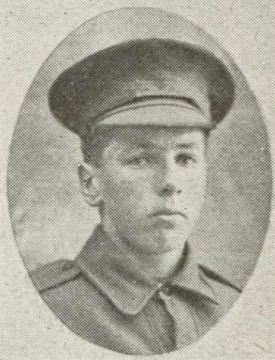
Frank Shirra was a Scottish-born goalkeeper who played in Queensland before and after the war. He was a Queensland schoolboy representative and later played for Natives before enlisting. After returning from Europe, Frank played for Thistle in Brisbane and Norman Park in Cairns. Shi
rra was born in Falkirk, Scotland and emigrated to Australia as a child. He attended East Brisbane school as early as 1910, and by 1912 was playing for their soccer team. His form that year saw him selected for the Brisbane schoolboys’ representative team which played a nil-all draw against the visiting New South Wales boys. The Queensland Times of 12 August praised his performance between the sticks, claiming, “his great presence of mind, saved ‘metropolis’ on several occasions when in exceedingly tight corners, for which he was vociferously applauded.” Shirra was subsequently selected for the full Queensland schoolboys’ team for the official interstate match, helping his side beat their southern opponents 1-nil.
He disappeared from the records for the next four years, at a time when schools’ soccer received little coverage other than the publication of fixtures and results. Shirra reappeared playing in 1916. Natives played in the junior (lower-league adult) competition which ran to allow under 21s too young to enlist without parental permission and those rejected for service to play. Senior (top-tier) football had been suspended by the Queensland British Football Association at the start of 1916 to encourage players to enlist. The association also organised representative friendlies throughout the season. In one such game, Shirra was selected for the overseas-born Chummies against the locally born Colonials.
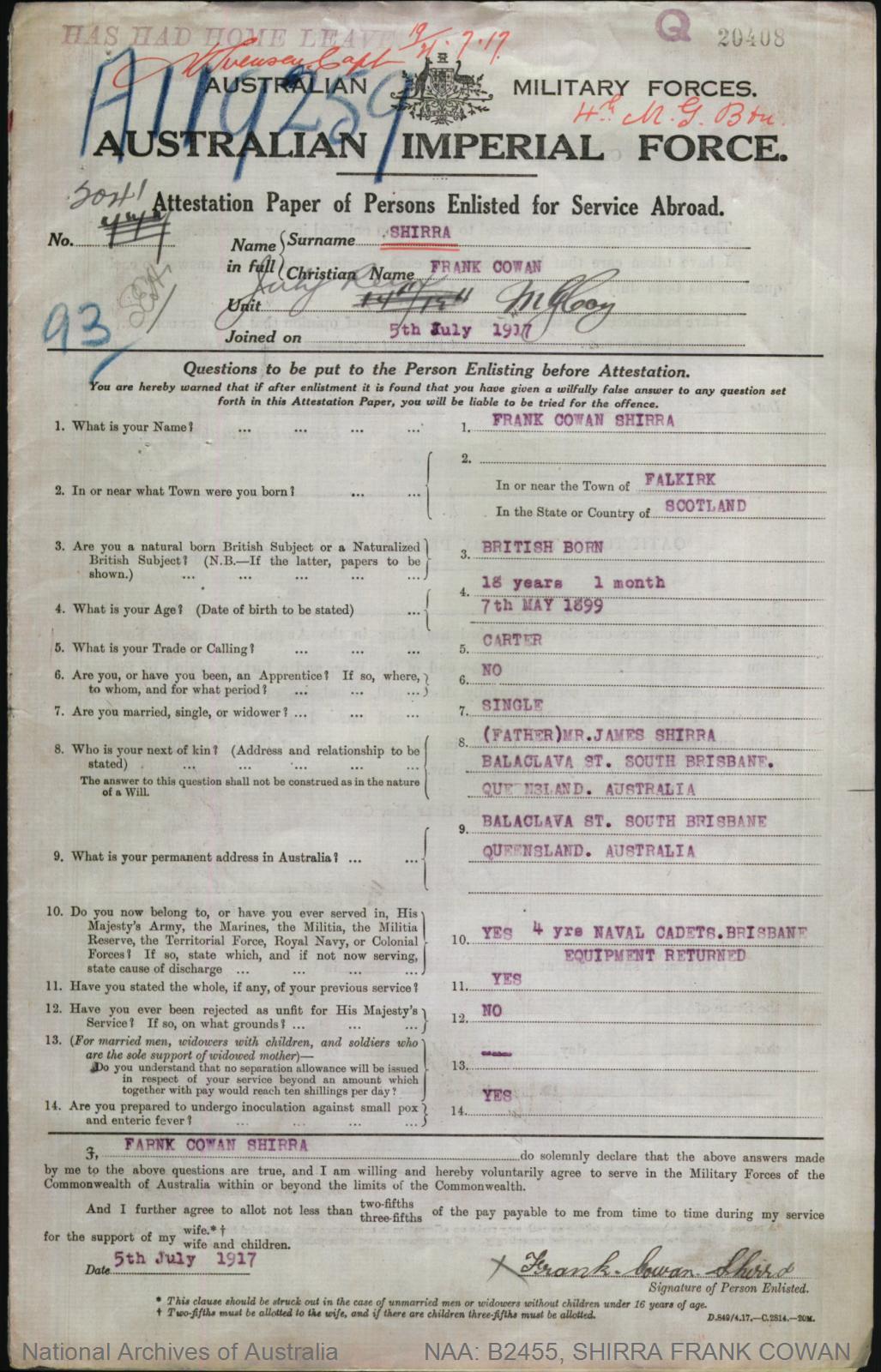
Shirra enlisted at the age of 18 in July 1917. His enlistment papers stated he was living in Balaclava Street, South and had completed 4 years as a Naval cadet. At the time of his enlistment, Shirra was working as a carter. He was presented with a watch and a money belt by his employer, Mr A. J. Kirby and co-workers at the end of July. Shirra was the seventh of Kirby’s staff to enlist. He was also a member of the Mowbraytown Presbyterian Church which was in East Brisbane. Shirra later appeared on the church’s honour board, as well as a small booklet produced by the church in 1919 to honour the soldiers and munition workers from their community.
Shirra left Australia in November 1917 and arrived straight to hospital in Southhampton suffering from measles. After recovering, he was allocated to the 47th battalion and before being moved to the Australian Machine Gun Corp. He was marched into Camiers, France in June, but his active service lasted only weeks. Shirra received a gunshot wound to the left arm in August and remained in hospital until after armistice. Despite this, he was quickly back in hospital after suffering from influenza.
Shirra recovered to return to Australia in March 1919. He did not reappear in Brisbane soccer until 1923 when he played for Thistle. Shirra’s goalkeeping helped Thistle win the Premiership and saw him selected as the backup keeper for the Queensland representative side against New South Wales.
He played on with Thistle in 1924 before moving to Cairns where he played for the Norman Park club for the first part of the 1925 season. His return to Brisbane and Thistle in late May was widely reported, though some publications wrongly attributed him as “J. Shirra”, despite mentioning he was Thistle’s keeper from 1923. Frank stayed with Thistle in 1926, after which it appears his football career ended.
Shirra married Gertrude Orth in 1928, and couple had three children. They remained in Brisbane for almost 3 decades before moving to the United States around 1956, where they lived in Utah.
Shirra died in Ogden, Utah in 1981.