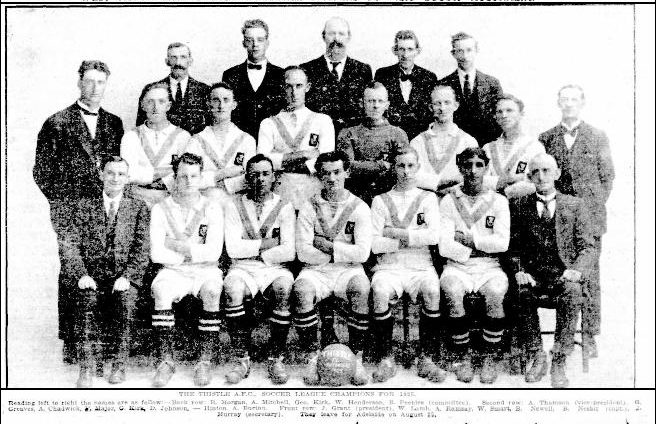


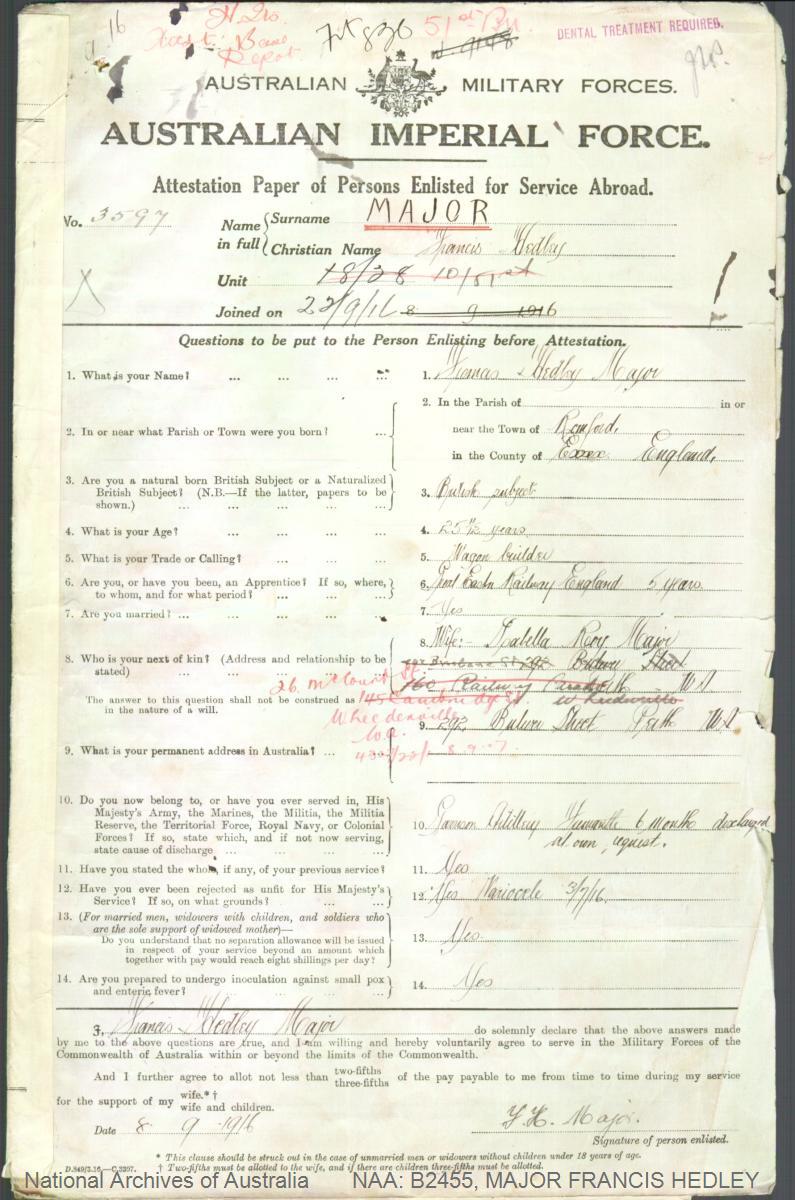
Francis Major is regarded as one of the finest players of the pre-World War 1 era in Western Australia. Born in Chadwell, England, and raised in Romford, he developed his game as a defender with London club Leytonstone while working as a wagon builder with the Great Eastern Railway.
Francis Major arrived in Perth in mid-1911 and a few weeks later commenced employment with the Western Australian Government Railways, again as a wagon builder. Around the same time he joined Rangers, who claimed the Division One title by way of a controversial play-off victory over Austral after the two teams ended the regular season on level points.
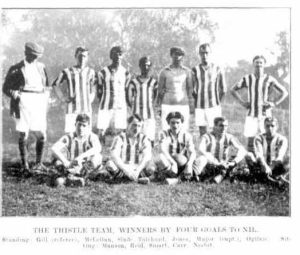
For the following season Francis Major joined Thistle, whose player group was drawn from the WA Government Railways workshops. Named team captain, he was praised for allowing new club Caledonian to substitute an injured player when they met mid-season. Thistle went on to win Division Two as well as the prestigious Charity Cup.
Francis Major was prominent in the middle of the park but also stepped in at the back and in goal as Thistle dominated the 1914 and 1915 season. Under his leadership the Jags won back-to-back Division One titles, the Challenge Cup and Shield, the Charity Cup and successive Wanderers Cups. He also had the honour of captaining England in the 1914 international series.
In February 1914, Francis Major married Isabella Macauley and over the next four years they welcomed three children to the family home on Bulwer Street, Perth. He served six months with the Royal Australian Garrison Artillery in Fremantle before being discharged at his own request, after which he enlisted in the 51st Battalion.
After four months of training in Codford, England, Francis Major was deployed to France. He suffered a shotgun wound to left hand in the Allied counter-attack at Villers-Bretonneux in late April 1918 and was hospitalised at 20th General Hospital in Camiers and later moved to the Australian Convalescent Depot in Havre. In July of that year he was granted three months leave with pay to work in London.
Francis Major returned to Perth in October 1919 and the following month resumed working with WA Government Railways. A lengthy hiatus from football ended in 1925 when he again donned the colours of Thistle, helping the club to the Division One title and travelling to Adelaide for a post-season, three-game visit. At seasons end, he retired from playing.
Francis Major remained actively involved in the game after hanging up his playing boots. He was a referee for four seasons, which included taking the whistle for the June 1927 friendly between Western Australia and China, and for a time was vice-chairman of the Referee’s Association. He was also a member of the British Football Association of WA’s six-man publicity committee.
In May 1933, Francis Major was appointed School Advocate with the newly formed West Australian Soccer Association. His mandate “to foster and promote the game amongst schoolboy players” proved extraordinary successful with about 40 schools committing to adopt the round ball code. Unfortunately, he left the position the following year and, consequently, school participation slowly declined.
Living in Mt Lawley, Francis Major remained employed by WA Government Railways through to retirement in 1955. During that time he held the positions of car and wagon inspector and liaison officer. In April 1944 he suffered a workplace injury which resulted in the partial loss of the sight in his right eye.
Francis Major passed away on 7 February, 1965, at the age of 74.