

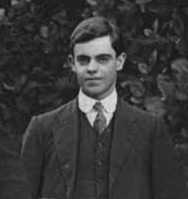
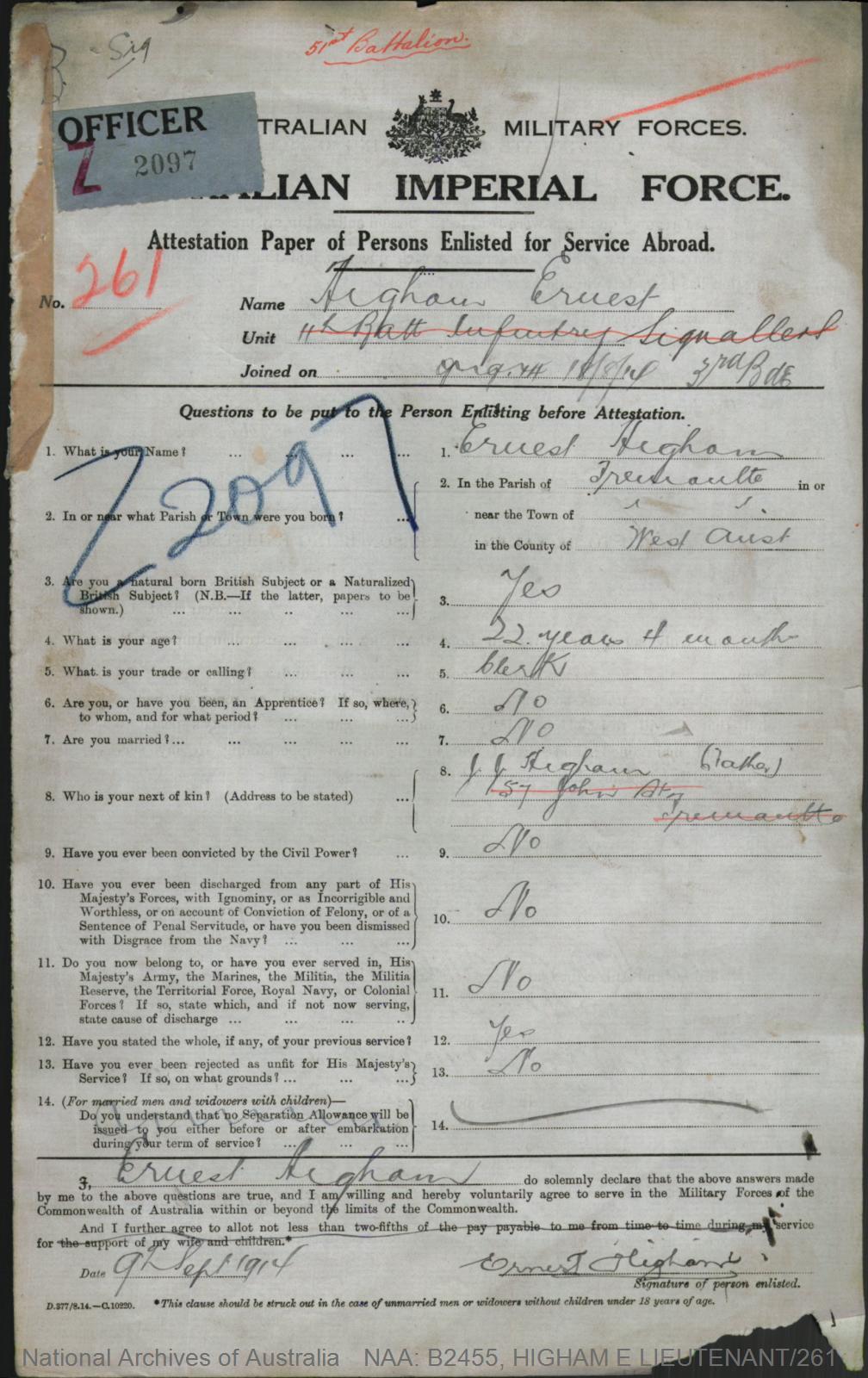
Before the war, locally born Ernest ‘Ernie’ Higham was regarded as one of Fremantle’s best defenders. He enlisted as a Private with the 11th Battalion and landed at Gallipoli on the morning of 25 April 1915. According to a letter he wrote from Malta to his father, he fought until the afternoon until he was hit in the neck and evacuated. He was returned to his unit in Gallipoli and served there until the end of the failed campaign. By the end of 1916 he had moved from the Middle East to the Western Front and promoted through the ranks to Lieutenant. In 1917 he attended Musketry School in England and passed with First Class honours. On 16 September 1917 he joined the 51st Battalion in France and was severely wounded in action with a gunshot wound to the head. Lieutenant Higham recovered and was back with his unit as 1917 was drawing to a close. Unfortunately, Higham did not survive the war; on 26 April 1918 he was wounded by a shell which hit his chest, leg, forearm and hand. He passed away in a field hospital the following day.
Ernest Higham’s letter as published in Perth’s Daily News on 1 June 1915:
Mr J. J. Higham, of Fremantle, has received a letter from his son Ernest, who is a private in the Australian Expeditionary Force in the Dardanelles. Peculiarly enough, he was wounded on the first day, and yet his wound was not reported. He writes from Malta as follows: —
‘Just a few lines to let you know that I am all right, and a little of what we are doing. After leaving Cairo on the 1st of March, we went straight to Mudros Bay, in the Island of Lemnos, on board the Suffolk, We stayed there for eight solid weeks, doing next door to nothing. We used to go ashore for a march as often as possible, but as we had to row ashore, the rough weather often kept us on board. We did a fair amount of swimming off the shlp. It is a beautiful harbour and reminded me somewhat of Albany harbor. Though not quite so big, the water is far deeper, and would take boats of deep draught over practically its whole area.
On the 24th of April I, with some more signallers and two companies of the 11th, left on board H.M.S. London, for Gallipoli, where we landed first thing next morning. We were in the first line to land. We left the London in rowing boats, towed by steamboat, at 8.30 a.m., and were cast off to row the last couple of hundred yards. Just as we cast off there was one single shot as the sentry spotted us, and a few seconds later the shot came hot and strong but we pulled on and scrambled out on to the beach and under the shelter of the bush and sand humps. We were now at the foot of some very steep hills, at the top of which the Turks were strongly entrenched. We crept slowly through the bushes without firing a shot. When we got up a bit the enemy, with the exception of odd snipers got well away, and these few hid in the bushes and shot anybody who was exposed to them. After shooting a man of a bunch of our men, they would throw down their arms and cry for mercy, and of course they got it. I lasted until sometime in the afternoon when I got hit in the neck, and my jaw grazed by some splinters of shrapnel. It knocked my left arm out of action for a bit, and made my neck stiff, but everything is O.K. again now, and I will be back in the line in a few days.
We are going direct from here. From Gallipoli we were returned to Alexandria, but they sent us on to here. I think the action was in every way successful, and we ought to soon have the Dardanelles clear, We landed just south of the opening of the Gulf of Saros, and right across the Peninsula from the Narrows.’