Blackstone Rovers won the Challenge Cup in 1912 undefeated. The club held a social to celebrate their success in early 1913. John Stanfell Clowes, head of Blackstone State School, presented the medals. During his speech, paraphrased in the Queensland Times on 29 January, he stated that his pride at the team’s success was “eight of the 14 players were ‘his boys’, and had begun to play football, when quite little fellows, at his school, first with a rag football, and, later (when funds would permit), with a proper football.”
Eric John ‘Jack’ Clowes was John’s actual boy. He had been born when his father had been in charge of Claremont State School prior to relocating to Blackstone. Clowes was in his early 20s when he helped Rovers win the Challenge Cup and receive his medal from his proud father. He was also active in cricket, playing for the St Paul’s club in Ipswich.
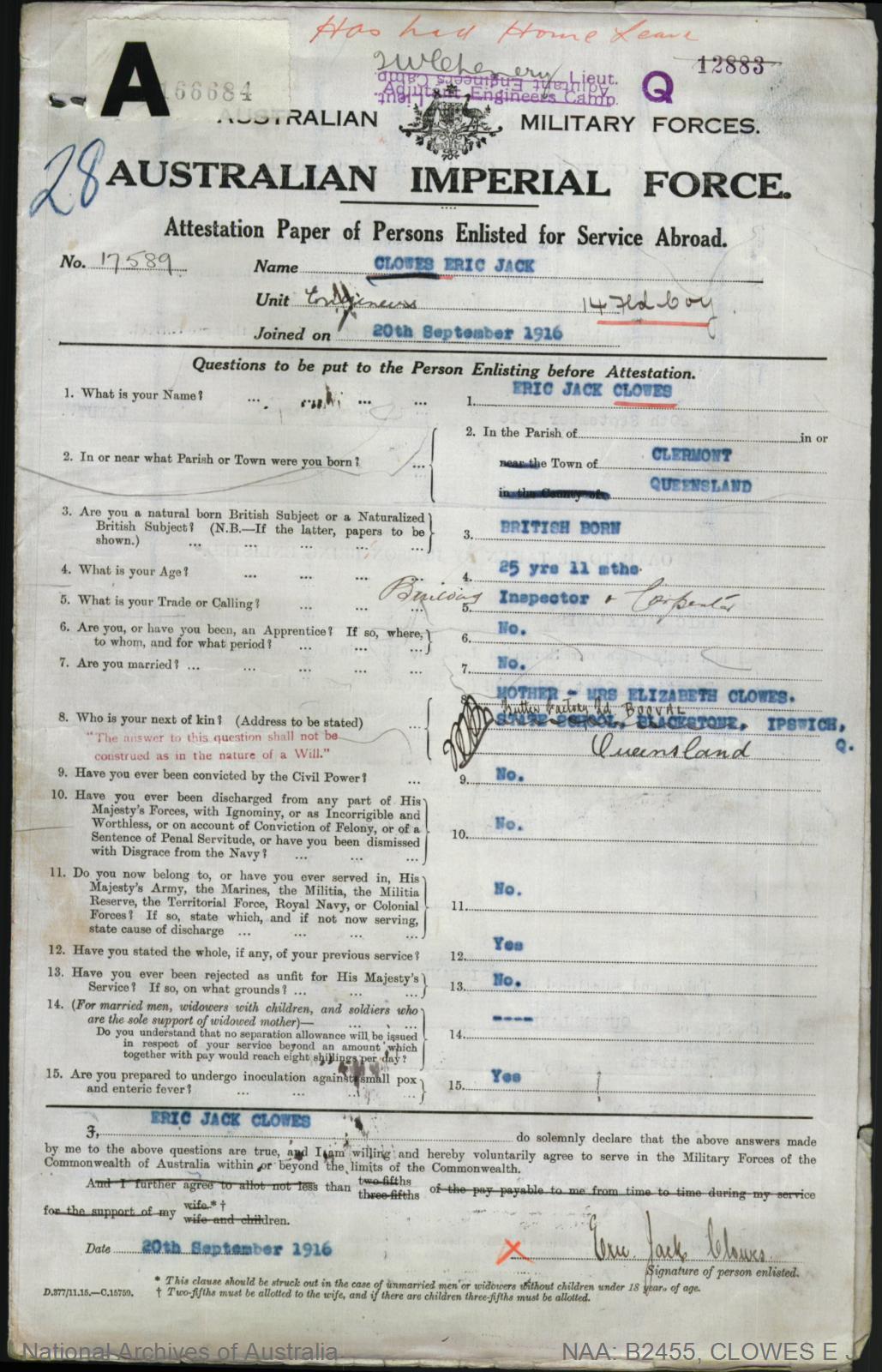
Clowes was 25 when he enlisted in September 1916, before departing from Australia the following May. Before enlisting, Clowes worked as a building inspector and carpenter, which probably explains why he was attached to the 14th Field Company Engineers. The unit’s duties included road and bridge construction, building dugouts, gun platforms, command posts and signalling infrastructure, plus building and breaching battlefield obstacles.
He reached France in November 1917, and with the exception of some illness in early 1918, seems to have had a relatively uninterrupted war. Clowes was on leave when armistice came, though returned to France before being sent back to Australia in 1919.
Back in Australia, Clowes married Agnes Raindle Christie in November 1919. Their son, John appeared in 1924. The family were living in Enoggera by the mid-1920s. Clowes kept busy. He was a member of the Enoggera golf team in the 1930s and later secretary of the Keperra Golf Club. He also was involved in cricket and tennis clubs and was a member of the Enoggera sub-branch of the Returned Sailors and Soldiers’ Imperial League of Australia.
Clowes died in 1962, three years after Agnes.