
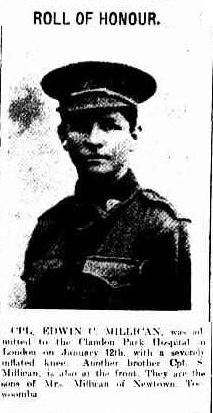
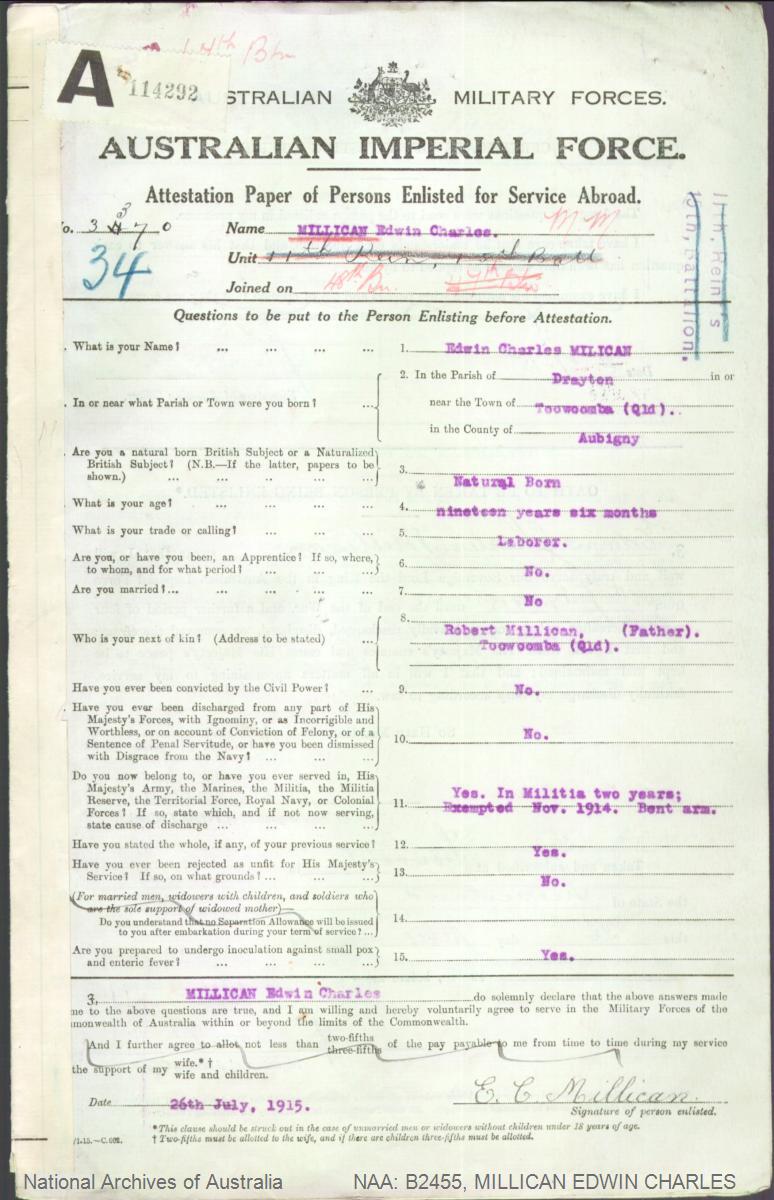
Charles Millican was captain of the Allies soccer club in Toowoomba when he enlisted in July 1915. According to The Toowoomba Chronicle of 31 July 1915, Millican was thrown a farewell by his employer, Breheny and Co brewery, at which the Allies club gave him a token of their appreciation. Millican was one of five living brothers, of which older brothers Sydney and Victoria-based Thomas also enlisted. Two of the brothers played soccer together for Western Suburbs’ thirds team in 1913, but only Sydney can be clearly identified. The youngest brother, Victor, played for Cadets in the youth competition in 1918.
Charles Millican had spent 2 years with the local militia until late 1914 when he was exempted for having a bent arm. He was 19 when he enlisted and was sent to training at Enoggera. Here, he and O.P Fraser wrote a letter to the Chronicle, published on 20 September, requesting a kettle drum be forwarded to them. The letter gave a brief snapshot of the social life of the camp:
Camp life is first class, getting better every day; we have cricket teams, football, boxing, and all sort of sport of a Saturday afternoon, sporting requirements to suit and please every different liker of sport. If you are not anxious about cricket, etc., you are at liberty to go to picnics etc., so conclusively every living person is provided for at Fraser’s Camp. A good few Toowoomba lads arrived here last week; old identity was Wally Lewis, well known in the railway sheds at Toowoomba. There are others, including Ernie Davies, J. Coates, G. Ogilvie and W. Head. Charles Millican is looking well and “as fat as mud”.
Millican was assigned to the 47th Battalion. After a period in Alexandria, he departed for France in June 1916. Promoted to Corporal by the end of the year, his war was interrupted in January 1917 by issues with his knee. After a period of rehabilitation in England, Millican rejoined the fray in March. He was recommended for the Military Medal in June 1917, though his records do not list the duty for which he was awarded. A year later he was transferred to the 48th Battalion, by which time he had been promoted to Sergeant. He was on leave shortly before armistice when he fell ill and was sent to Weymouth, England.
Millican’s military record amounts to a mere 16 pages. More lines are spent on a minor disciplinary breach of failing to take roll call of prisoners at the start of a guard shift (leading to a loss of a day’s pay) than the duty which earned him his Military Medal. It ends with his departure back to Australia in early 1919.
Strangely, the only Millican who appeared on the Toowoomba British Football Association Honour Board unveiled in May 1918 was another brother, William. There is no clear evidence William contributed to either local soccer or the war effort, though the possibility cannot be discounted. It is possible he played for Western Suburbs in 1913.
Charles returned to Toowoomba soccer with the Cities club in 1919 but mostly turned to boxing. He had been seen boxing as early as 1913 but was more regularly associated with the sport after the war, heading as far west as Chinchilla to compete. The Darling Downs Gazette of 21 October 1919 listed Millican among the winners of a boxing meet thusly: “Bantamweight – C. Millican (Toowoomba. A returned soldier and possessor of the M.M.)”
Millican lived with his parents much of the 1920s during which time he worked as a labourer. He volunteered again for the second war in October 1939 and regained the rank of Corporal. He undertook some form of Home Service in Brisbane until he was discharged at his own request in August 1940.
He did not marry until 1943, when he wed Margaret Watt, who was the same age and had similarly never wed. Electoral rolls show the couple later went to work as fettlers in Kilkivan and Gayndah before retiring to what is now known as Hervey Bay.
Charles Millican died in September 1979.