
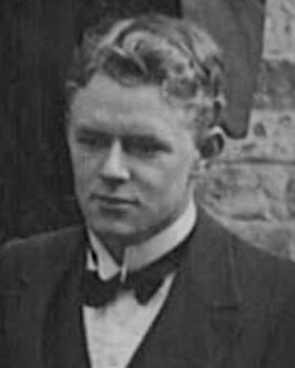
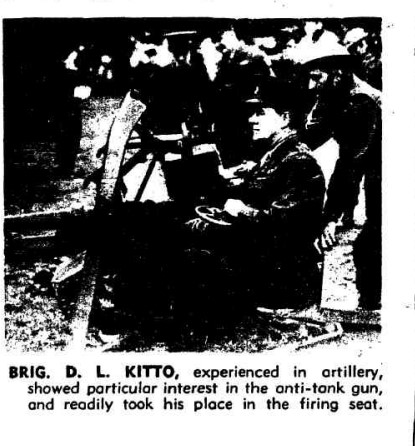
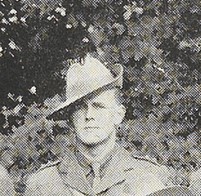
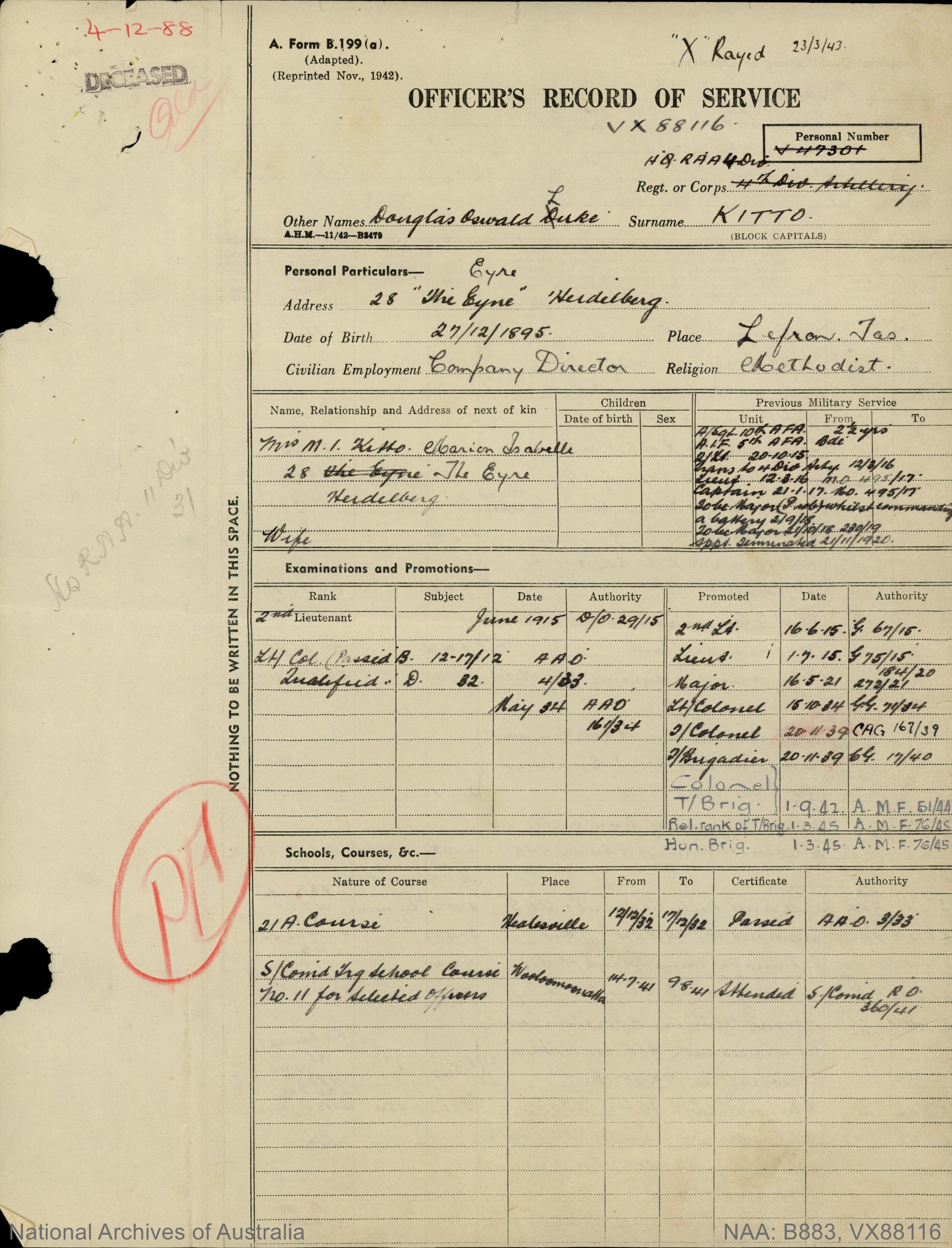
Douglas Luke Oswald Kitto was born in Lefroy, Tasmania on 27 December 1895, the son of Thomas Luke and Elizabeth Kitto. His father and grandfather, both called Thomas Luke Kitto, were mine managers and prospectors working across Tasmania and Victoria throughout their lives. Thomas Kitto Junior continued the family tradition, seeking new mining possibilities across Tasmania, which led to Douglas living in remote towns including Lefroy, Mathinna and Queenstown in his younger years.
After passing his university exams in 1911, Douglas moved to Hobart the following year and joined the YMCA club, which played in the second division “Nurse Cup” competition. This club became Corinthians in 1913, where he joined the committee, and made his senior team debut in the 1913 Falkinder Cup final, which Corinthians won.
After another season with the champions Corinthians, where Douglas played primarily at half-back, Douglas moved to Launceston in 1915. He became a bank clerk with the Commonwealth Bank and joined the Tamar soccer club.
As the Northern Tasmanian season was ending, Douglas formally enlisted on the 7 June 1915. Douglas lists three years of prior military experience on his enlistment papers, although as revealed in William Ellis Cox’s diaries, Doulgas was not a model soldier prior to the outbreak of war. His prior experience did allow him however to undertake further tests and examinations prior to departure from Tasmania to achieve a higher rank. He departed on 22 November 1915 aboard the Persic as a 2nd Lieutenant in the 6th Field Artillery Brigade. His fellow 2nd Lieutenant upon departure was William Ellis Cox, whose son would become Governor of Tasmania in the 2000s.
After a short time in Egypt, Douglas was transferred to the western front and to the 40th Battery of the 4th Division Artillery, where he was promoted to Lieutenant in March 1916. Over the next two-and-a-half years, Douglas was wounded in action 5 times, and sought medical assistance for illnesses another 2 times. He received gun shot wounds to the scalp, right hand, right arm and shrapnel wounds across his body.
In December 1917, he was mentioned in despatches by Sir Douglas Haig and in July 1918, he was awarded the Military Cross for his actions in battle on the 4th April 1918, which saw him receive his fourth wounding of the war and resulted in three weeks spent in military hospital. His military cross was awarded as follows;
Captain Douglas Oswald Luke Kitto For conspicuous gallantry and devotion to duty near Albert on 4th April 1918. In order to assist the 48th battalion who were suffering from hostile enfilade fire from the left, Captain D.O.L. Kitto went forward to check the locations of the enemy machine-guns and trench mortars and to observe the fire of his battery. He undertook this work in full daylight and on a forward slope exposed to enemy fire. In doing so, he was wounded in the head but not before he had proved to the Infantry that the gunners were willing to take any risks to assist in maintaining our forward position. His pluck and determination was noticed by the whole Battalion.
After his 5th wounding some weeks later, William Ellis Cox wrote home to his family about Douglas Kitto’s close brushes with death: In one of the last letters I got from you, you say “I see poor Kitto has been wounded again” – Well, the day after I received it ‘poor Kitto’ was wounded again – for the fifth time. He got little pieces all over him, but is not badly hit anywhere. Of course it would not be Kitto if he was not wounded in the head. Out of his 5 times, he has got hit in the head 4. It’s a wonder he’s got any head at all left. Any ordinary person would been killed long ago in the same circumstances.
After a long stay in Europe following the cessation of hostilities, Douglas returned to Tasmania via the H.M. Port Lincoln in August 1919. There is no record of Douglas resuming playing soccer, which given the severity of his injuries across the war, is no surprise. The next year, Douglas and fellow soldier Tom Roberts, were granted 2100 acres of land in Piper’s Brook, near Douglas father’s hometown of Lefroy under the soldier settlement scheme. This land was to be used to graze sheep and other animals.
By 1922, Douglas had moved to Victoria and was living in St Kilda. He married Marian Mckay in 1929 and they had a daughter, Elizabeth, born in 1933. He re-enlisted in the army in the 1930s and when World War II was declared, Douglas was now working in the hiring service and training soldiers in artillery. He attended Melbourne University, graduating with a commerce degree, and was an avid golfer.
After World War II, he ran a successful real estate agency, before passing away in December 1988, aged 92. He is buried at the Brighton General Cemetery and has a plaque in the Victorian Garden of Remembrance. In addition, Douglas is featured on the Queenstown Honour Roll, Paterson Street Methodist Church Honour Roll in Launceston and the Tasmanian Amateur Athletic Association Honour Roll, currently located in the State Library of Tasmania in Hobart.