

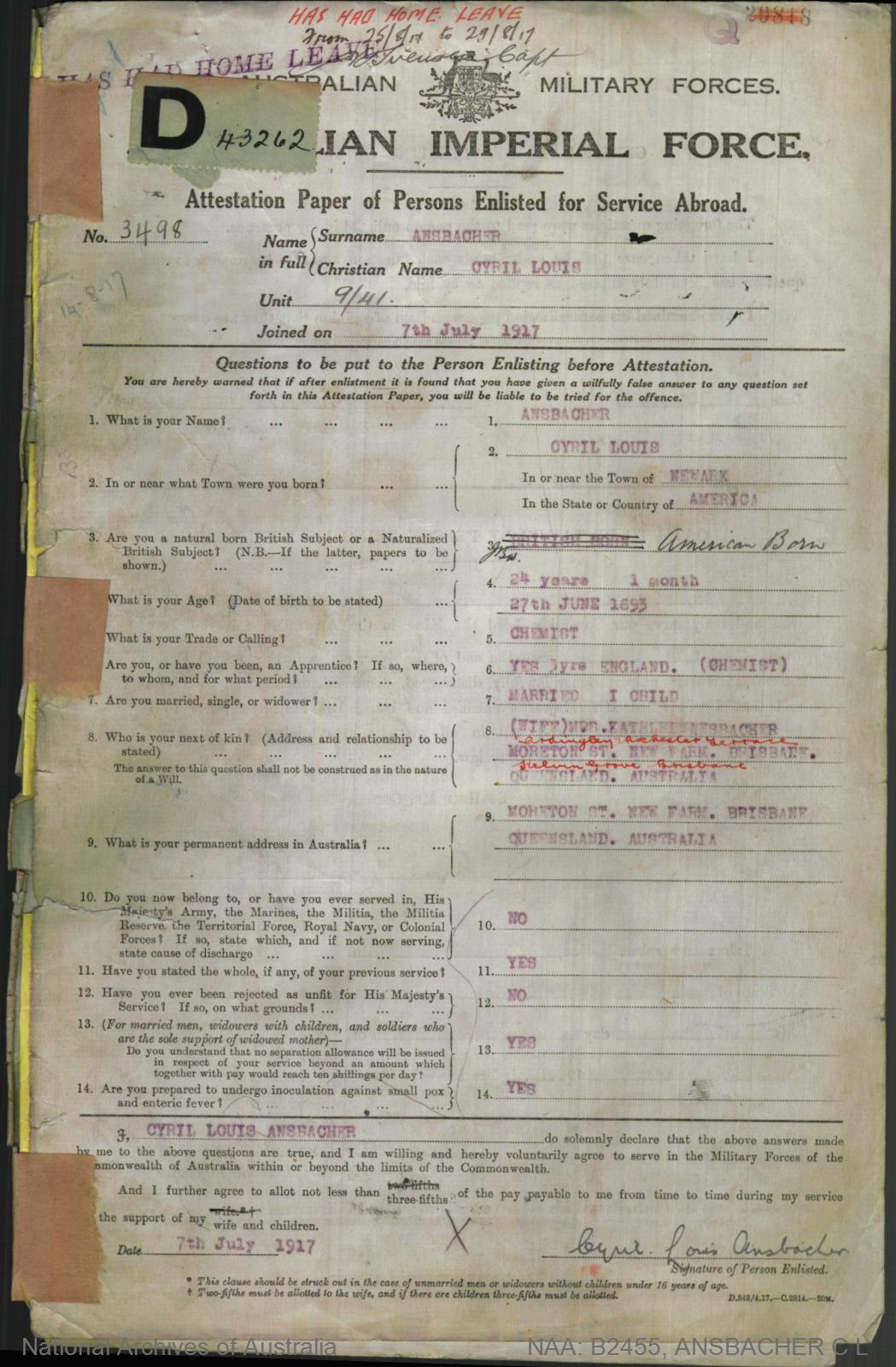
Cyril Ansbacher was a player and joint secretary for Murwillumbah United. The club had formed in June 1914 and played a number of games into 1915 at which time sport in the region was greatly affected by enlistments. He married Kathleen Scarrabelotti in November 1914, and they had a son. By the time he enlisted, the family had moved to New Farm in Brisbane.
Ansbacher enlisted in July 1917. A chemist by trade, he initially worked as a dispenser at the military hospital at Kangaroo Point, Brisbane. After 6 months he was then allocated to the 41st Battalion and departed Australia on the Ormonde in late February 1918 but died in Suez in early April. According to the Lismore newspaper Northern Star, Ansbacher died of illness. He had taken ill after leaving Melbourne in late February 1918. His military record agrees he had fallen ill on the journey to Egypt, showing he had been hospitalised with cellulitis on the ship during the journey. But his record also states he returned to active service in early April.
His record instead gives the cause of death as poisoning. His casualty form stated: “Found unconscious in tent at 5 a.m. Diagnosed as narcotic poisoning. Artificial respiration TC employed. Sent to hospital. Admitted 7:30 a.m. Unconscious. Died 8:45 am. Without recovering consciousness. Post-mortem performed.” A communique to the Department of Defence on 28 April stated that a Court of Enquiry gave the cause of the death as an overdose of a self-administered opium preparation. Kathleen, in May, wrote to the Victoria Barracks in Melbourne for more information. It seems, though, that the paperwork of the Court of Enquiry had been lost. In August the Records Office undertook its own investigation and was soon asking soldiers for statements.
Second Lieutenant L. Hart confirmed there had been a Court of Enquiry at the time. Hart had been another patient at the hospital in Suez, and remembered Ansbacher being brought in. Hart claimed to have heard the findings of the Court of Enquiry, but did not disclose these to the Base Records investigation. Captain A. E. Taylor, who treated Ansbacher in the hospital, gave the following detailed responses to Base Records.
To/ Officer in charge Records
In re Pte. Ansbruther (sic ); I gave evidence at the enquiry on the death of this soldier. I certified that there were symptoms of morphine poisoning; that I had analysed the stomach contents and found a preparation of opium present. There was also independent evidence of his having taken a preparation of opium. (Signed . ) A.E. Taylor, Captain.
The Officer i/c Records
Australian H.Q. (Egypt)
C a i r o.
Government Hospital
Suez. 21/8/1918.
ref 3498 Pte Ansbacher C. L . , 41st B’n. “Deceased”
Patient named above admitted from Transport Ormonde at 7. 50 a.m. He was in a very serious condition, deeply unconscious, with very small pupils, no reflexes, cyanosed and had occasional short spells of voluntary shallow breathing, but had to be continuously under artificial respiration. It was reported that his stomach had been washed out with permanganate solution; that several doses of strychnine had been administrated (sic) hypodermically.
His stomach was again washed out, Caffein and Arther was given hypodermically and hot coffee was administrated per rectum. Artificial respiration was continuously applied till his death at 8. 45 a.m.
Post mortem : Stomach contained a large quantity of (two handfuls) of undigested beans and other vegetable matter; duodenum and bowels, chyone, there was no smell of chlorodyne or other poison in the bowel contents.
The lungs were full of odoematous froths. The kidneys were highly inflamed and the capsules would not peel but tore off the kidney substance. The brain was normal.
The heart was healthy but for some small patches of Atheroma at the beginning of the aorta.
(Signed} A. E. Taylor, Captain. A.A.M.C.
Evidence was also provided by a Captain Frederick Butterworth who stated that Ansbacher had self-administered the opium preparation.
The new investigation concluded that Ansbacher had died of a morphine overdose. But despite the question being asked directly, it made no finding as to whether the incident was an accident or suicide.
Ansbacher was buried at the Kubri Military Hospital. He was later re-interred in the Suez Christian Military Cemetery.