

Sir – Some correspondence has been through your columns recently in reference to some public reception, in which my name has been pretty freely mentioned. No reception is desired, and by leaving my name out of this correspondence you will be conferring a great favour on—Yours sincerely, C. Fortescue
Toowoomba Chronicle, 2 January 1919.
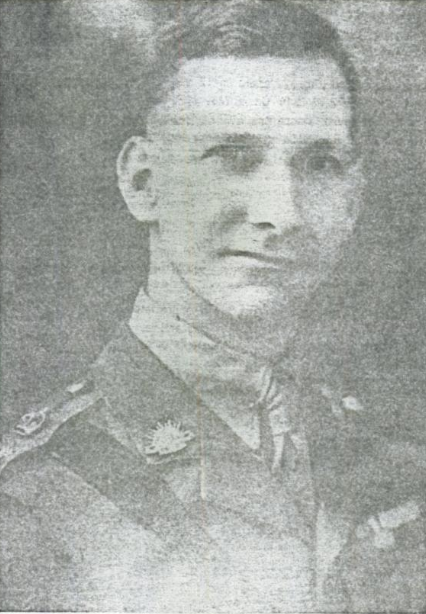
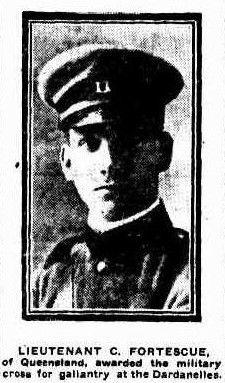
Major Charles Fortescue was among Toowoomba’s most decorated soldiers of the war. His service lasted four years, during which he won a Military Cross for service at Gallipoli, and a Distinguished Service Order for service in France.
His military file in the National Archives of Australia contains contemporary records of his feats, as well as an undated article written by R. Clark after the second war, which included information from Fortescue’s wife Rhea. Contemporary records and Clark’s article provide graphic details of the gallantry which caused the letter-writers to the Toowoomba Chronicle to demand Fortescue receive public recognition. Despite his reticence, Fortescue had the unfortunate luck to come from a well-known and well-connected local family.
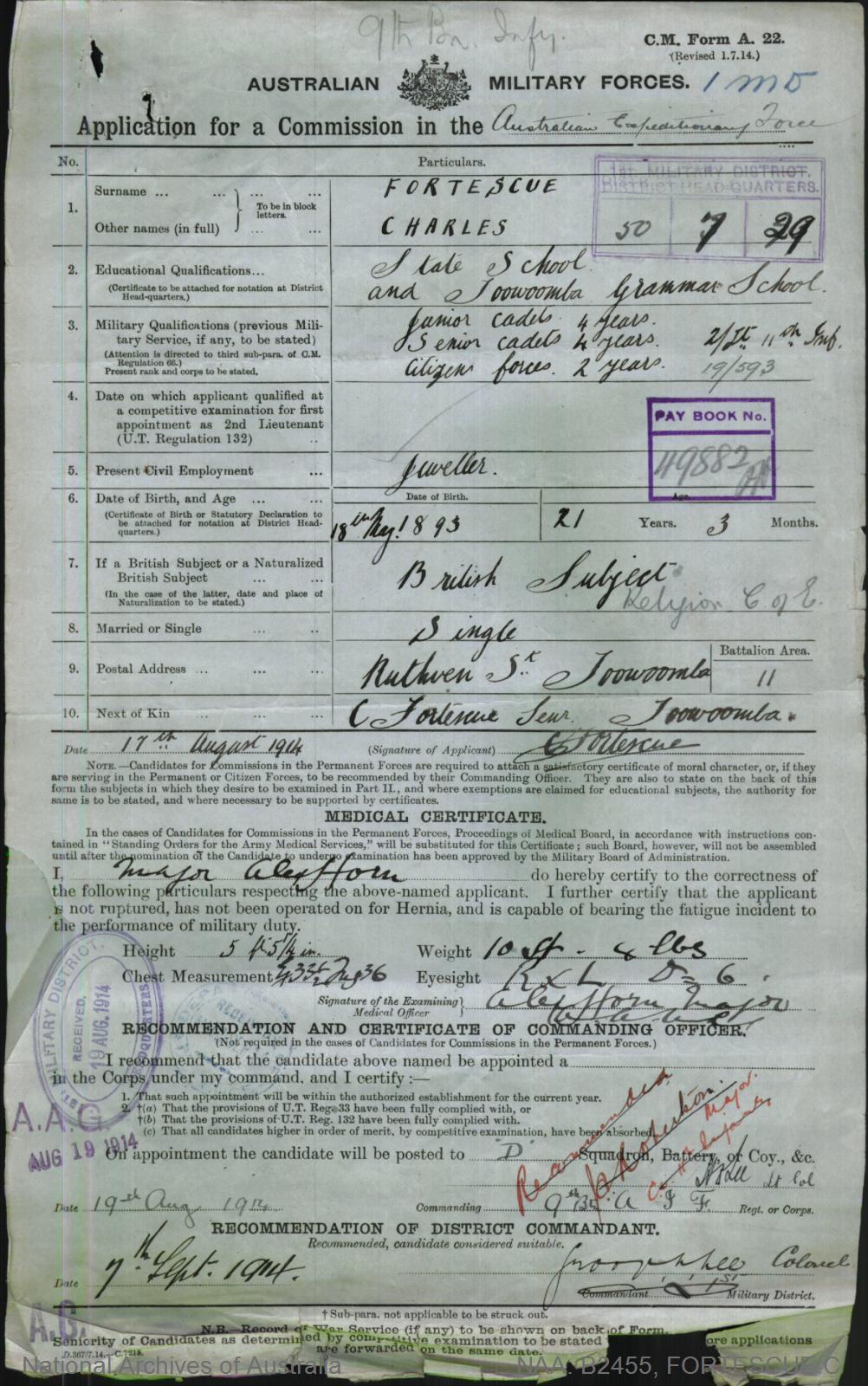
Fortescue’s father, also Charles, was a jeweller and a major supporter of soccer. Charles snr was Patron of the Toowoomba British Football Association over several seasons at the start of the decade, during which second division clubs vied for the Fortescue Cup. He was also president of the City Club in 1912. Charles snr was also involved in cycling, rifle shooting, rugby league and cricket, where he was remembered as one of the hardest hitting players in Toowoomba in his youth. Fortescue’s own sporting prowess is not recorded, only seen in competition playing the flute during his school years. He was educated at Toowoomba State and Grammar schools, graduating in 1910, whereupon he worked for his father. Sport, as recorded in the newspaper, would not feature in his story until after the war, though school sport in Toowoomba was unevenly reported in the first decade of the 1900s.
He enlisted early, aged 21, in September 1914, and was allocated to the 9th Battalion. Fortescue took across his rank of 2nd Lieutenant which he earned as a senior cadet, before being transferred to the pre-war 11th Infantry Battalion where he was in charge of a machine gun unit.
In April 1915 Fortescue took part in the landing at Gallipoli. His subsequent Military Cross was earned during and after the landing. According to the London Gazette on 3 July 1915: “From 25th to 29th April 1915, during operations near Gaba Tepe, for conspicuous gallantry. He twice led charges against the enemy and rendered good service in collecting reinforcements and organising stragglers.”
The story of the landing was one of best laid plans quickly abandoned as the structure of the invading forces broke down. It was here, Grant explains, where Fortescue earned his Military Cross. “During the confusion of the landing Lieutenant Fortescue rallied various groups of soldiers who had become separated from their units and used them to give covering fire to units who were ‘digging in’.”
According to Grant, Fortescue was wounded but remained on duty until 17 May, when he received more serious wounds. The contemporary report stated Fortescue had been shot in the lower right chest, right forearm, left thigh and right ankle which led to his evacuation. The bullet to the chest was not removed, causing “some pain on marching”, though the other injuries were not considered debilitating. It was recommended Fortescue undertake non-Infantry duties. Grant goes further stating that Fortescue received a severe shrapnel wound which “forced itself between his ribs tearing the muscles and taking off a bit of his right kidney before lodging in the spinal column.”
Fortescue would not rejoin his unit until after the Gallipoli campaign was abandoned. After rejoining his unit in Egypt, he was promoted to Captain and transferred to the 49th Battalion. He soon reached France, and it was here he was injured a second time in September 1916.
Grant quotes the contemporary letter by W. R. Birdwood which stated Fortescue’s unit had taken a second line trench from the Germans at Mouquet Farm. Despite being wounded, Fortescue reorganised his men and held the trench for two days against heavy attack before being relieved. As a result, Fortescue was promoted to Major and was awarded his Distinguished Service Order. In November, he was mentioned in despatches by Sir Douglas Haig: “For conspicuous gallantry in action. He commanded his company with the greatest courage and skill. Later, although wounded, he greatly assisted in defeating several enemy counter attacks. He showed a splendid example of coolness and initiative to his men.”
In December, Fortescue was sent to the School of Instruction for several months, returning in late March 1917. A week later he was wounded again, this time, according to Grant, by a bomb during an attack on a railway cutting at Noreuil. Fortescue recuperated in France, and was soon back with his unit, where he stayed until awarded some leave to England in mid-1918. After another period in France, Fortescue was allowed to go on leave to Australia, embarking from England a month before armistice. He was discharged in February 1919.
Fortescue returned to his father’s jewellery. He followed his father in supporting several sports, including soccer. He was elected vice-president of the Returned Soldiers soccer club in April 1919 and spent much of the next decade in and around the sport in Toowoomba. He was patron of the Caledonian club in 1924, a vice president of the Athletic soccer club in 1925, and vice-president of the Blue Star and Waratah clubs in Toowoomba in 1928. In 1930, Fortescue donated a special trophy to Athletic to be awarded at the committee’s discretion. Similarly, Willowburn awarded the Colonel Fortescue Cup to a member of the club in 1932.
Fortescue had been promoted to Lieutenant-Colonel in 1921 and spent time with the 25th Battalion and the 11th Light Horse. He retained his rank during the second war, when he formed the 1st Australian Garrison Battalion which covered the entirety of the Queensland coast, and held command positions through various restructures, though was rejected for active service.
Fortescue married at the age of 50 to Rhea Mansfield in 1943 and they had a daughter. He passed away in 1971.