
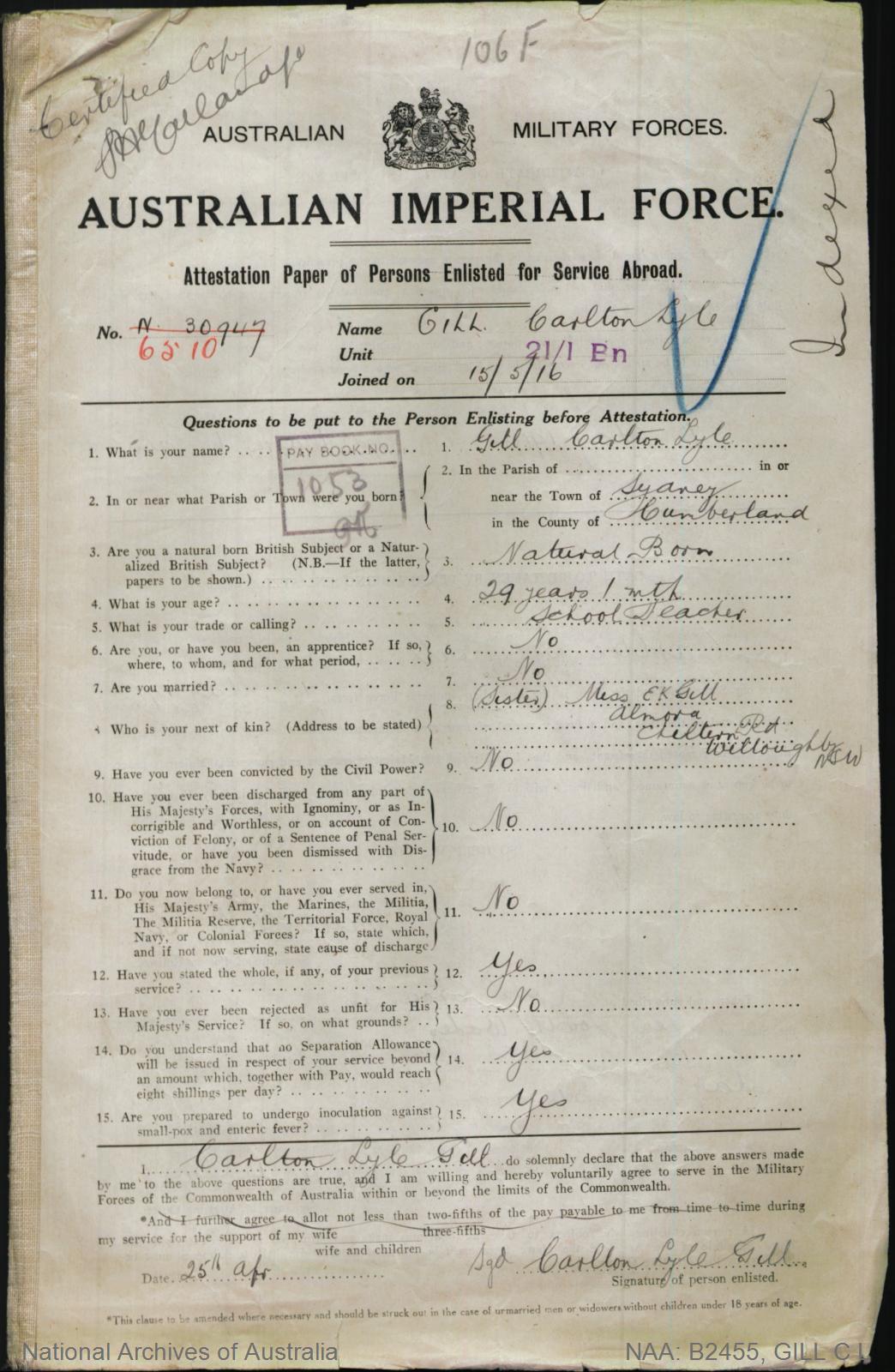
Just before Carl Gill departed for the war he was presented with a monogrammed wallet from his class, field glasses from the wider student body, a watch from his fellow teachers, and an article in the Lithgow Mercury on 8 May 1916. The farewell function featured speeches by the headmaster, the mayor, a local reverend, and a returned soldier Keith Martyn who expressed his gratitude that Gill had answered the call. The Mercury paraphrased Gill’s reply:
His term of service in Lithgow had been a pleasant one, particularly in regard to sports matters, and the aim of his work in this connection was to develop all that was best in sport, and make the school team the premiers in State ‘Soccer’ football.
Gill as 29 when he successfully enlisted at the eleventh attempt, poor vision causing him to fail the medical in the ten previous attempts. Not that he had been kicking his heels due to rejection. Gill spent the entirety of the war thus far in Lithgow, having joined the school at the start of 1914. During this time, according to the Mercury on 1 May 1916, Gill:
has been a sport in every way. He is president of the Western District Football Association, a prominent tennis player, and one of the selection committee of the Lithgow Tennis Club. In addition to this he is sports master at the district school, acts as referee in the school football matches, taches the lads to jump and pole vault, and has charge of the physical development side of the school in other ways.
Before Lithgow, Gill had taught at Broken Hill where he known for cricket but also soccer. The Sydney Arrow of 4 May 1912 reported that Gill was a leading light of soccer in Broken Hill, having helped gather together 29 players and arranged home and away games with clubs from Adelaide. The Referee, four days later, claimed Gill had organised soccer in the Broken Hill Schools.
On 28 January 1914, Referee celebrated Gill’s transfer to Lithgow as a gain for soccer in the region as the “district also suffers from somewhat lax administration.” The administration was the Western District Football Association and Gill soon became secretary and later, as the Mercury reported above, was elevated to president, a position he held until his enlistment.
Gill was allocated to the 1st Battalion on arrival at Plymouth in November 1916. He proceeded to France in February 1917 and here he fought until he was wounded at Passchendaele in October. Gill’s Medical Report stated that “shell explosion lifted him, and he came down on head. Burnt on face. G.S.W. right hand and right thigh. Since that time vision is defective.” He was evacuated to England and was attached to the 1st Battalion Depot at Hurdcott in January 1918. Gill never returned to France, seeing out the remainder of the war in support roles. He returned to Australia in early 1919.
Gill was greeted off the train on his return to Lithgow. The Mercury, on 19 March 1919 stated, “before the train arrived at Eskbank the bridge was thronging with people, mostly school boys, and when the soldier teacher at last arrived he was cheered again and again.” Members of the local town bank played, and a reception was held at the Town Hall.
Gill never returned to teach at Lithgow, instead working for the Education Department in his native Sydney in 1919. He kept involved in school soccer as organiser and referee via the PSAAA, the association which ran NSW school sports into the 1920s. But at the same time the war had a lasting effect. According to the Lithgow Mercury on 21 September 1921:
as a result of a recurrence of lung trouble, through the effects of poison gas at the war, (Gill) has been at Bodington, Wentworth Falls, for the last couple of month. … As the mountain climate appears to suit Mr. Gill, who was one of the most popular teachers Lithgow ever had, he hopes to secure a transfer to Katoomba, when he is fit to resume as a teacher.
Gill got his transfer to the Katoomba High School and remained in the Blue Mountains for many years. He married Ruby Harris in 1924. Gill became involved in the Blue Mountains Historical Society, the Katoomba Male Voice Choir, the local RSL, and was a member of the Katoomba Celebrations committee which put on events in the town. He also moved to the Primary school where he taught as late as the 1950s. Gill died in 1958.