

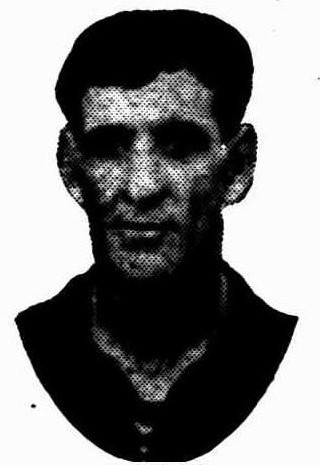
Bartholomew Nesbit is regarded as one of the finest wingers to have graced Perth’s football fields in the pre-war and interwar eras. He won seventeen trophies — a tally that includes seven league titles — and represented Western Australia in a remarkable 16-season career that came to a close with Bart in his mid-40s.
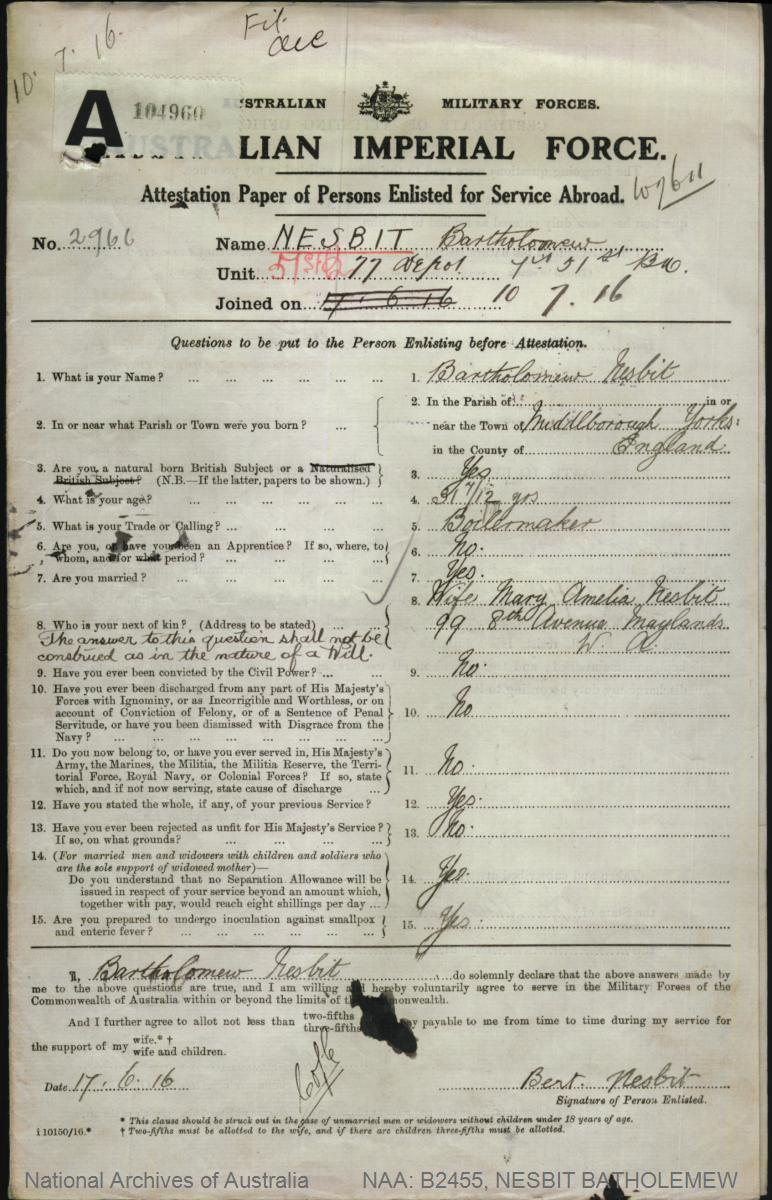
Born in Middlesbrough on 17 November 1884, he was the only child for William Nesbit and Ann Burton. The family moved to Newcastle Upon Tyne when Bart was young and by the age of 17 he’d commenced a boilermaker apprenticeship. In 1906 he married Mary Stuart and two years later they celebrated the birth of a son, Bartholomew Alexander Jnr.
Bart played football for Blyth Spartans and in mid-1911 was signed by Division Two side Blackpool. Playing in his favoured outside-left position, he debuted for the Seasiders in September and would finish the season with four goals from twelve league and cup appearances.
At season’s end Bart headed to London to board a steamship, destination Fremantle. The Western Australian Government Railways were actively recruiting skilled tradespeople from the United Kingdom for the Midland workshop and it’s quite likely this appealed to Bart, who made the journey alone. In July 1912 — just three weeks after arriving in Fremantle — Bart commenced working as a boilermaker for the railways, where he would remain though to retirement in 1949. He established himself on 8th Avenue, Maylands, and twelve months later welcomed his wife and young son to their new home.
The week before starting with the railways Bart made his debut in the forward line for the Perth football club, who would complete the season as Division Two champions. The following year he joined the Thistle club, where his teammates included several workshop colleagues. In Bart’s first season the Jags finished top of Division Two and claimed the Charity Cup. Back-to-back Division One titles followed along with the Challenge Cup & Shield, a pair of Wanderers Cups and another Charity Cup. In 1914 Bart gained selection for England in the local international series against Scotland.
Bart enlisted as a Private with the 51st Battalion in July 1916, the same day as Thistle teammate and railways co-worker Billy Smart. They embarked for England together and in February 1917, while stationed at Codford, were both found guilty of overstaying leave after walking out of the training camp at 1:00am. Bart’s punishment was to forfeit a days pay.
In April the 51st Battalion proceeded to France and then the Ypres sector in Belgium where they fought in the Battle of Messines. Bart was hospitalised in July and by the following month had been admitted to Lakenham Military Hospital in Norwich suffering trench fever. Bart was back in France by November but it was to be a short-lived stay. He was struck by trench fever again in March 1918 and headed back to England where he’d spend the rest of the year in hospital with a succession of intestinal ailments.
He returned to Australia in January 1919. The football season was about to kick-off so Bart rejoined Thistle, who lifted the Challenge Cup & Shield in 1919 and the Charity Cup twelve months later. He marked his State team debut in 1920 by scoring in a 7-0 thrashing of the visiting Australian Naval Fleet. Lured to the powerful Perth City United club, he played two seasons and collected the Division One title in 1922. Another move took him to Claremont where he was part of the side which scooped all the major trophies — Division One, the Challenge Cup & Shield and the Charity Cup. Thistle welcomed Bart back at the start of 1924, when he made two more State team appearances against the England Cricket XI and the England Amateur XI.
At the age of 41, he tasted further success by captaining the Jags to the 1925 Division One title followed by a two-game, end-of-season tour of Adelaide. Bart joined second tier Bayswater in 1926, when he played alongside his son, Alex, and long-time friend Billy Smart. He scored twice as captain in the 1927 Cronshaw Cup final win over Mundijong and twelve months later guided Bayswater to the top of Division Two. Bart was 46 when he played his final season at Thistle whom he helped win the Challenge Cup in 1930.
Bartholomew Nesbit was 70 when he passed away in Bayswater on 16 July, 1955.