


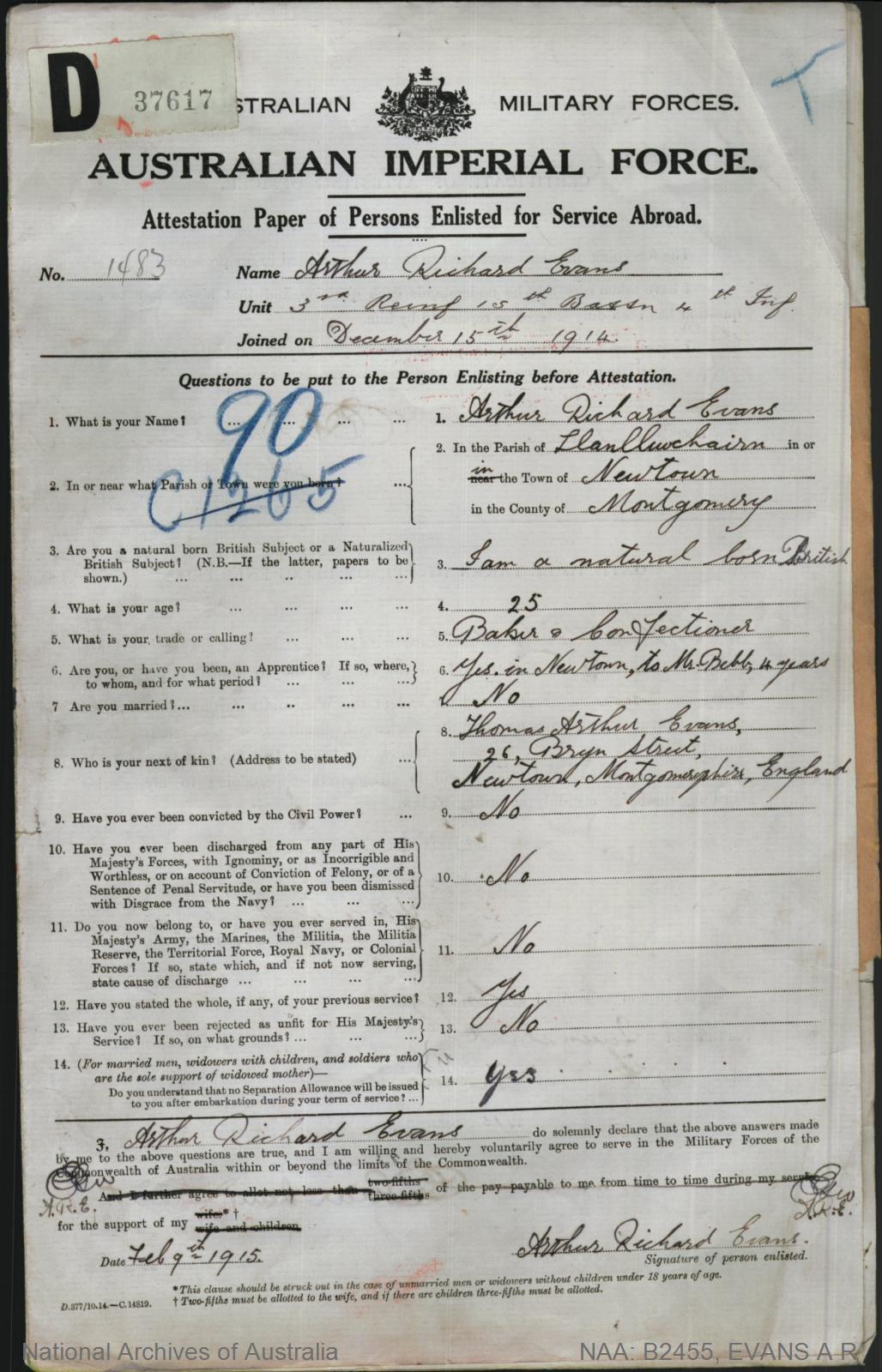
Arthur Evans was a baker and confectioner who emigrated from Wales to Queensland in 1912. He enlisted in December 1915, and a month later was seen playing soccer with his unit, as reported in the Brisbane Courier on 25 January 1915:
Second and Third Reinforcements 3rd Brigade, A.F.A. v Rag Tags. Played at Milton, and won by the Artillery by 2 to 1. S. Webber and A. R. Evans scored the goals for the winners, and J. Cown for the Rag Tags. The Artillery will be pleased to accept challenges from other teams.
Where and whether he played locally is unknown, but he was said to have had an association with Toowong Caledonians player Richard Garlick. When Evans’ Wales-based elder sister, Emily, completed his Roll of Honour form after the war, she listed Garlick in the section of “other persons to whom reference could be made by the Historian for further information.” But their association may simply be through sharing a battalion, though Garlick enlisting sometime after Evans.
Further clarification is difficult as most of Brisbane’s 60-odd soccer teams in 1914 never had line-ups printed in the newspaper. Players named Evans played in the Ipswich competition, where there was a substantial Welsh population in Blackstone, but there is no proof any of these were the confectioner.
Emily also suggested that Evans lived for at least some time in Bundaberg (as does the Virtual War Memorial Australia), where the game existed but was rarely reported.
Evans was allocated to the 15th Battalion. He departed in February and arrived to join the forces preparing for the landing at Gallipoli. His time on the peninsula was defined by influenza and diarrhoea, and it appears he didn’t leave hospital until after his unit had pulled back from Gallipoli in December 1915.
In June 1916, Evans and the 15th Battalion were sent to France. According to Emily, Evans served with some distinction during his time in France. The Roll of Honour form states:
He was presented with a card by Major General Sir H.W. Cox, K.C., M.G., C.B., CST. On his conspicuous and gallant conduct in the field, on the 8th August, 1916, when serving with the 15th Battalion in France (and also recommended for the DCM however we have heard nothing more).
This is backed up by the records of Private W. R. Chatwin who received a commendation for the same date which mentions Evans:
On the night of the 8th/9th August driving operations north west of Pozieres Private W. R. Chatwin was with Corporal A. R. Evans assisting to get Lieut. Plane who was badly wounded back to out lines and rendered valuable help in persuading the German prisoners at the point of the bayonet to carry Lt Plane in to our line. All this time the party was under heavy machine gun fire.
Evans went missing in April 1917. This led to Miss E. I. Frederick, of Lismore writing to Base Records asking about the fate of Evans and another soldier, O. R. Frederick of the 49th Battalion, who was also listed as missing. There is no indication of how either Frederick knew Evans.
As a result, a Court of Enquiry regarding Evans convened in November 1917, which declared he had been killed in action. Only one testimony from the enquiry survives in his military record from a Sergeant E. Rowe.
I saw Sgt Evans about 4 o’clock on the morning of 11 April 1917 at the hopping off place near railway line at Bullecourt. I did not see him go over as he was in a different wave to myself. I did not see him after the above occasion and cannot say what happened to him.
(Frederick, meanwhile, was found to have deserted and was arrested and sentenced to death, which was commuted to 15 years, then 2 years, then let out early and wounded late in the war.)
Evans left almost no trace of himself in Australia. His death was added to the Casualty Lists printed in the paper, but his address was given as England. No obituary was printed. Public details of his life only survive thanks to his sister Emily, and Miss Frederick.