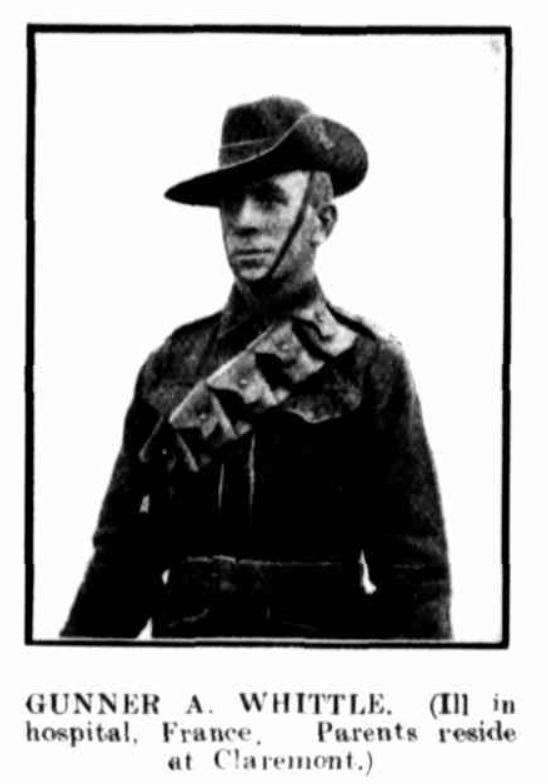
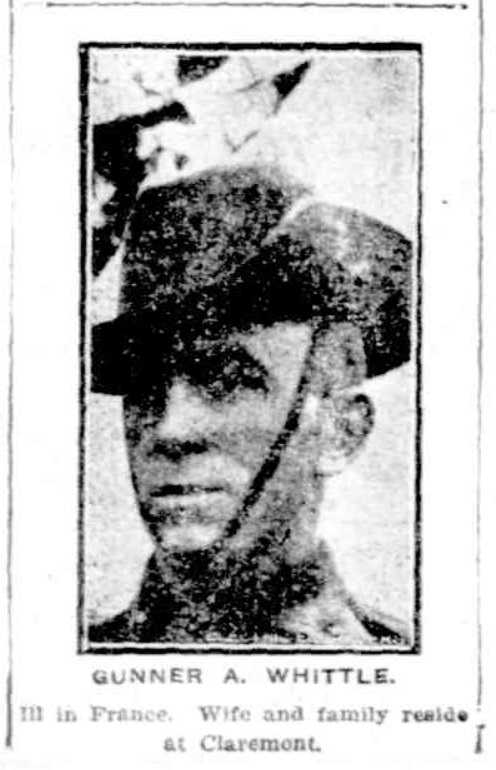
Alfred Whittle was born in Manchester, England, in about March 1891. The first-born of four children to Thomas Whittle and Elizabeth Murray, he grew up in the inner-city district of Gorton, where his father worked as a labourer.
Alfred was 15 when the Whittle family migrated to Western Australia, disembarking at Fremantle Harbour in mid-March 1906. Within a few years he had joined the Royal Australian Garrison Artillery, as a Gunner, and was posted to the Princess Royal Fortress in the southern coast port city of Albany.
It is likely Alfred was the Whittle who played for the Forts club – whose number consisted of RAGA soldiers – during the inaugural season of Albany’s British Association Football Association in 1911. Around this time Alfred met Grace Quinn and in August 1912 they married in Albany. The newlyweds would celebrate the arrival of two children, Thomas and Eileen.
Alfred relocated to Perth in 1913, possibly for work reasons. When the winter months came round he threw his lot in with the Austral club, playing in the forward line. Newspaper reports regularly featured him amongst the teams’ goalscorers and best players.
Alfred returned to Albany and in the late afternoon of December 30, 1914, he was part of a picket rounding up stray soldiers. The patrol came across Walter Morris, “who refused to go peaceably, and when force was used he pulled out a revolver and shot Whittle” through the right thigh. Morris was found guilty of unlawful shooting and sentenced to six months gaol with hard labour.
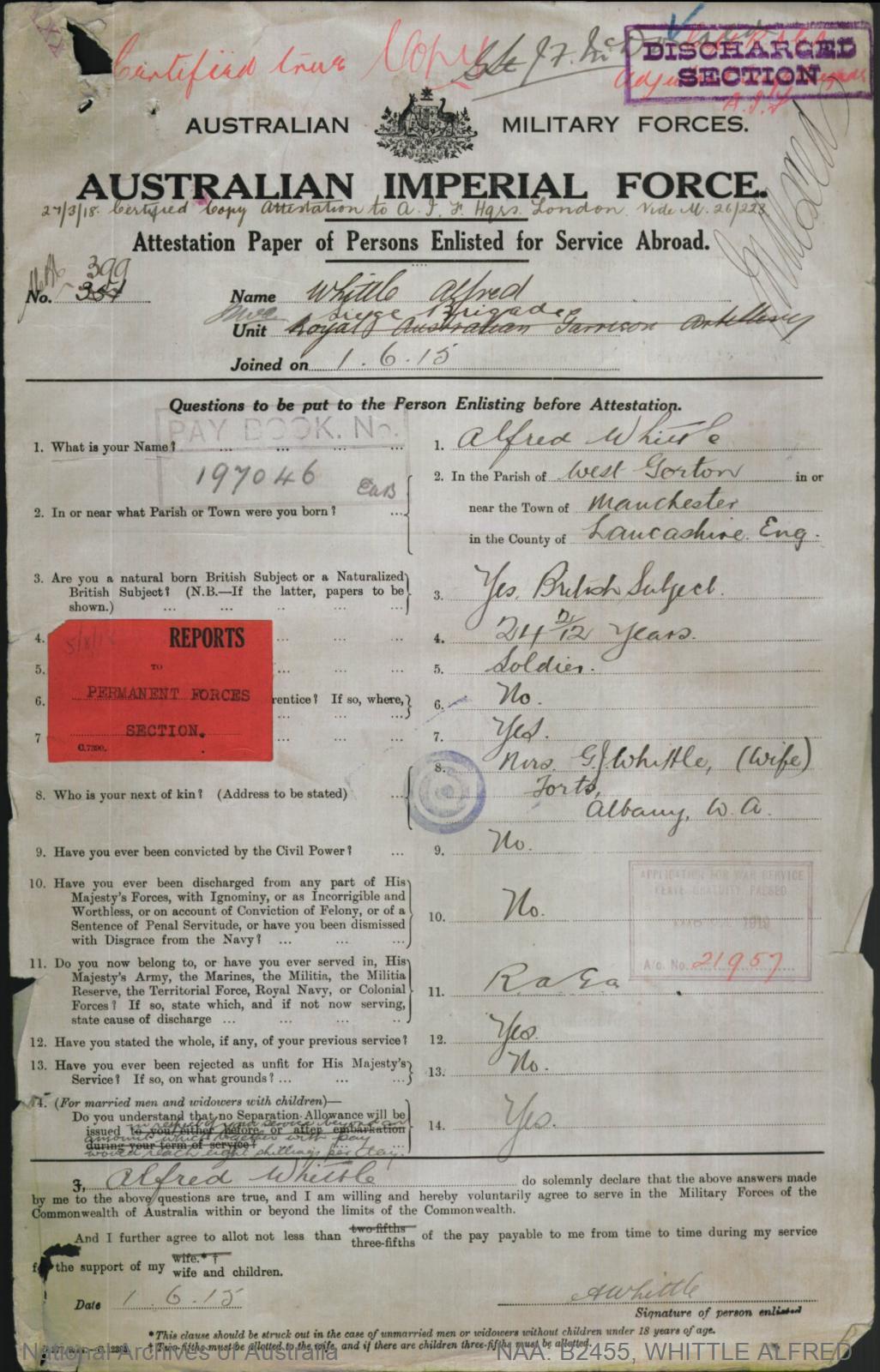
Although Australia had entered World War 1 on 5 August 1914, permanent artillerymen were not given permission to serve abroad until 1 June 1915. On that date Alfred enlisted as a Gunner with the Siege Artillery Brigade; three months later he arrived in England and spent the remainder of the year training at specialised camps in Kent, Bexhill and Somerset. The Siege Artillery Brigade became the first AIF combat unit to land in France late in February 1916.
The strain of life on the Western Front was quick to take its toll on Alfred, who was hospitalised during the year with conjunctivitis and later tuberculosis. While on leave in London during December, he was treated for venereal disease.
Soon after returning to his unit Alfred was promoted to Temporary Corporal. But by May he was back in hospital with what was eventually diagnosed as “soldier’s heart” or to use its modern day name, Post-Traumatic Stress Disorder. Alfred returned to Perth late in the year and on 25 January 1918 was discharged from military service.
Post-war, Alfred settled in Claremont and found work as a delivery driver for Aherns, a drapery and furniture retailer located in central Perth. In May 1920 he successfully petitioned for the dissolution of his marriage on the grounds of adultery; Grace had given birth to a child by another man. Alfred won custody of their two children, now aged 6 and 5 years.
The following February, Alfred was found guilty of drunk driving when in charge of a horse and sulky following an accident. His passenger, Stella Scrivener, who suffered a fractured hip and other injuries after being thrown from the vehicle, became his second wife later in the year. They initially lived in Perth and later moved to Victoria Park.
Alfred’s life was beginning to unravel and in December 1921 he was imprisoned for six months for stealing a purse containing money, a railway ticket and clothing. A second drunk driving charge followed in November 1927 after a collision with two oncoming vehicles on Mounts Bay Road. Alfred, who’d recently lost his job, was fined £25 and had his licence suspended for four months.
In early 1931 Alfred and Stella relocated to Carnarvon, where Stella had found work as a cook at nearby Manberry Station. But only 24 hours after arriving in northern coastal town, Alfred was arrested for impersonating a police officer and fined £10. He was further charged with obtaining money by false pretences from the Gascoyne Cafe and fined £50.
Back in Perth by August, Alfred was charged with vagrancy after claiming to be a theatre and hotel manager in Geraldton and promising work to two unemployed girls; he was placed on a good behaviour bond for six months. In October he was sentenced to a month imprisonment with hard labour after refusing to pay a taxi fare.
Alfred had been back on the streets barely a month when he was arrested again, this time for the despicable “assault upon a female,” the ‘female’ being a “pretty little Subiaco girl aged six years.” Unable to defend his actions, Alfred was sentenced “to six months with hard labour, little enough for a man of this type, surely” reported the local media.
Alfred was imprisoned for a fourth time in December 1933, on this occasion sentenced to 12 months for five charges of “fraudulent trickery” and two of false pretences. During the trial Stella initiated divorce proceedings on the grounds of Alfred’s misconduct – the dissolution of their marriage was granted in October 1934.
Alfred Whittle was 56 years of age when he passed away on 15 December 1948, in Bondi Junction, New South Wales.