
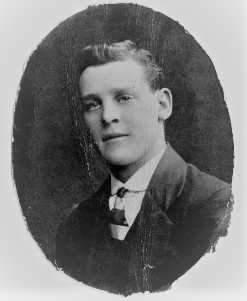
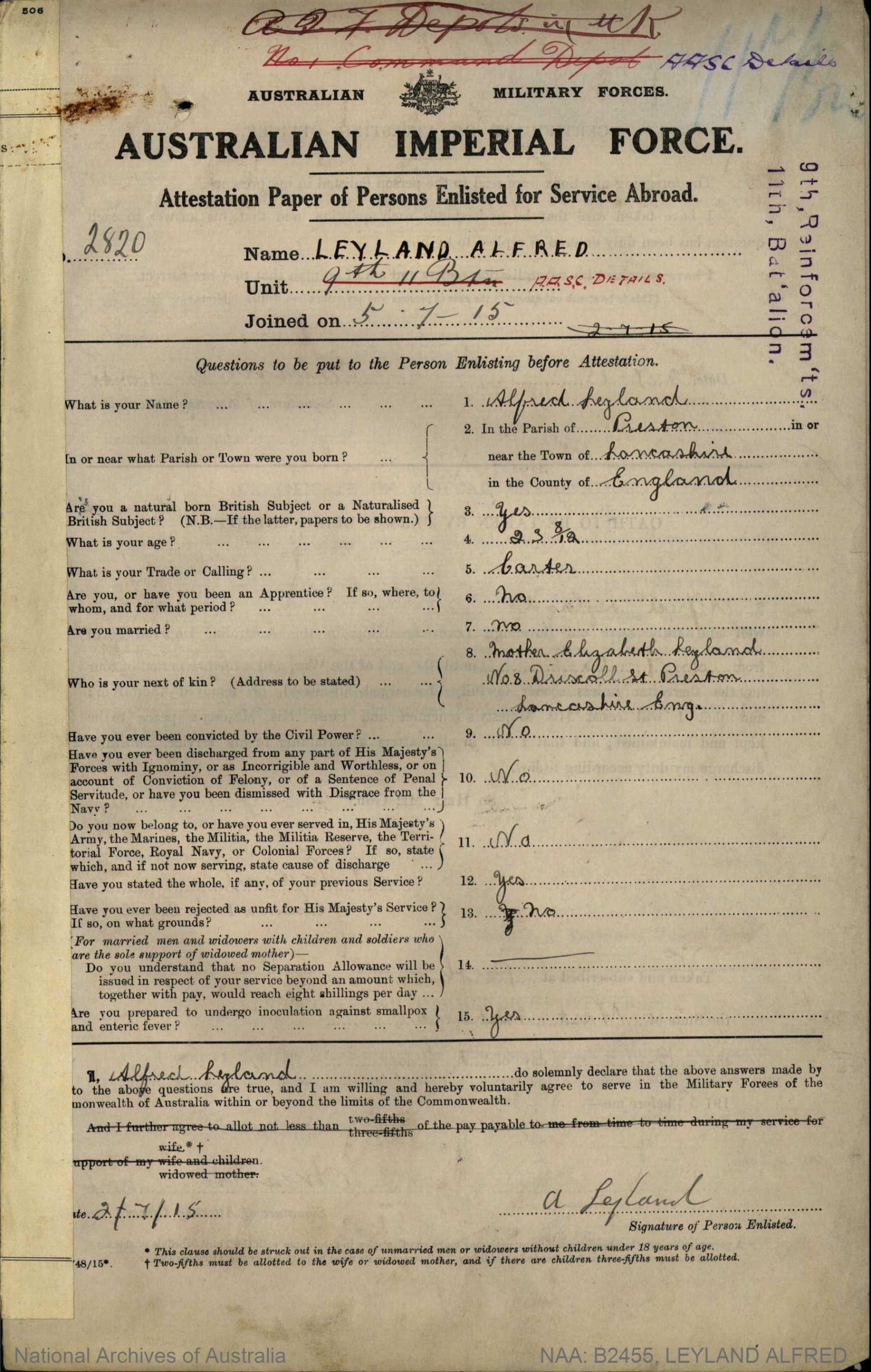
Alfred Leyland was born in Preston, England, in about 1891, one of nine children to John Leyland Jnr and Elizabeth Adams. The head of the family, John, passed away in 1904 after suffering typhoid fever leaving his wife, Elizbeth, to bring up their children up, five of who were still residing in the family home.
Alfred found work as a cotton spinner, possibly in the same mill as Elizabeth who was a cotton winder. In January 1912 he boarded a steamship in London bound for Fremantle, Western Australia, following in the footsteps of older brother Henry who had had made the same voyage with his wife eleven months earlier.
It’s likely Alfred had developed a passion for football while in his hometown, where the family home was a 20 minute walk to Deepdale Stadium, home of the fabled Preston North End club. In Perth he played two seasons for Rangers before switching to Northern Casuals while living in Padbury Street, Perth, and working as a bread carter.
In July 1915 Alfred enlisted as a Private with the 11th Battalion. Six month later he arrived in Egypt where the Australian Imperial Force trained and commemorated the first ANZAC Day before moving to the battlefields of Frances. Alfred would have got his first taste of combat at the village of Fleurbaix in May after which his battalion moved to the Somme Valley.
The 11th Battalion were involved in the intense fighting at Pozieres and nearby Mouquet Farm where the A.I.F. suffered 23,000 casualties in less than seven weeks. At the Battle of Passchendaele they participated in several major battles, including Menin Road and Broodseinde Ridge, before holding the line around the Belgian city of Ypres late in the year.
Harsh winter conditions presented the Australian troops significant challenges and toward the end of January 1917 Alfred was struck down by pleurisy. Evacuated to England, he spent time at Frensham Hill Military Hospital near Farnham where, for being absent without leave for a single day, he forfeited two days’ pay and was confined to camp for three days.
Soon after being discharged to Pernham Downs, on Salisbury Plain, in April, Alfred was classified “B.1.A.2.” (unfit for front-line duty) and assigned an administrative role at the nearby No.1 Command Depot. In April 1918 he was admonished by a superior officer and forfeited two days’ pay for being absent without leave while in Bath, where he’d self-reported to Military Police at 2:00am.
Two months later Alfred returned to France, this time to join the Australian Field Bakeries Division in Le Havre where he remained through to the end of the year. He returned to England early in 1919 and was attached to the Australian Army Service Corps, who managed the logistics of repatriating over 135,000 troops to Australia.
Alfred was back out on the football field within months of returning to Perth in early 1920, re-joining the Rangers club where he played five seasons as a forward and occasional goalkeeper. In July 1920 he gained selection — and scored the decisive goal — for an Association Select side that defeated the crew of the HMAS Encounter 3-2 in an exhibition match on Perth’s Esplanade.
In 1930 Alfred married Kitty Garrett and together they lived on Tenth Avenue, Maylands, for the next four decades. They celebrated the arrival of their only child, John in 1931. Alfred worked as a boiler cleaner through to his early 70s.
Alfred Leyland was 80 when he passed away in Perth on 20 August, 1971.