
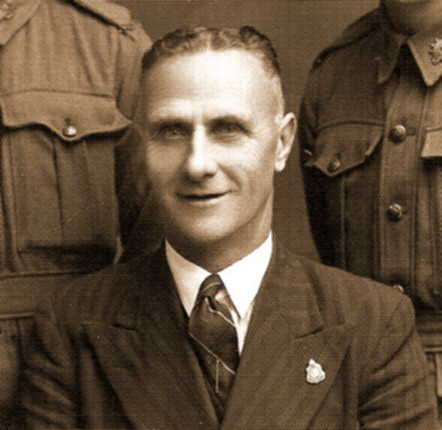
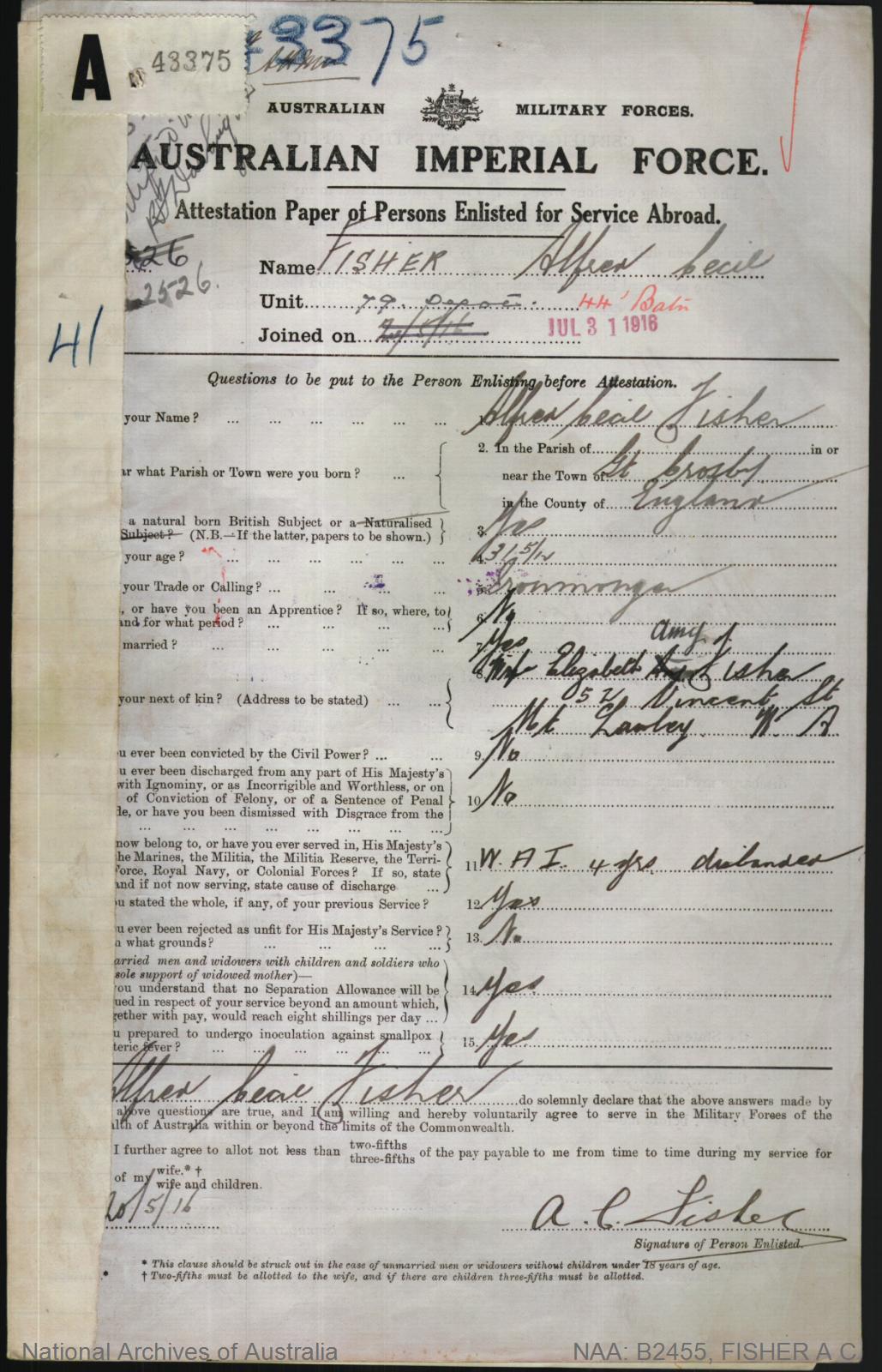
Alfred Cecil Fisher was born in Great Crosby, England, in 1885, the eldest of seven children to travelling salesman William Fisher and Phoebe McCallum. His childhood was disrupted by tragedy; his infant sister Frances died of whooping cough in 1891 and, seven years later, his father deliberately walked in front of a train, an act attributed to financial distress.
Alfred Fisher worked as a boatman in Southend, on the mouth of the Thames River, prior to emigrating to Western Australia in mid-1904.
The following year he stepped onto the football field with Civil Service, who won the Charity Cup by defeating Ex-Students 2-1 in extra-time. In the 1906 season he turned out for City United.
Alfred Fisher then moved to Rangers, where he would remain nine seasons. During that period he won the two Division One championships, in 1907 and 1911, scored in the 1907 Charity Cup final defeat of City United and lifted the Challenge Cup and Shield in 1908.
Now working as an ironmonger, he married Elizabeth Taylor in mid-1911 and a month later the newly weds welcomed the birth of their first child. In early 1916 Alfred Fisher accepted an administrative position with the British Football Association of WA, however, it wouldn’t last long. “At the last committee meeting Mr. Alf Fisher, assistant secretary, tendered his resignation, as he purposes going into camp on Monday next. In accepting the resignation, eulogistic reference was made to the good work done by Mr. Fisher during the past decade in the interest of the game,” reported the West Australian newspaper of 29 July, 1916.
Initially enlisting as a Private with the 44th Battalion, Alfred Fisher was promoted to Lance Corporal before setting sail for Europe. Only a few weeks after arriving in France he developed influenza and was evacuated to Fargo Military Hospital on Salisbury Plain, England, in February 1917. When it developed into bronchitis he was transferred to Sutton Veny Hospital, England.
Alfred Fisher had been back on the frontline little over a week when, in April 1917, he suffered a gun shot wound to the left thigh. He returned to Salisbury Plain, this time to Tidworth Military Hospital, and was eventually diagnosed with a “hernia of muscle” which led to his return to Australia in November 1917.
In April 1918, one of his brothers, Frederick, was killed at Poziers, France, while with the British Army. Another brother, William, also served in the Australian Imperial Force and in 1923 provided the razor case that formed the Soccer Ashes trophy played for between Australia and New Zealand.
Post-war, Alfred Fisher worked as an ironmonger while living with his family in North Perth. The outbreak of World War II saw him again enlist in the Australian military, this time serving in the 5th Garrison Battalion in Perth. On being discharged he worked, like his father, as a travelling salesman or, as the 1949 electoral role puts it, a “commercial traveller”.
Alfred Fisher’s wife of 55 years, Elizabeth, passed away in January 1966. Alfred Fisher was 87 when he passed away on 11 October, 1972, in Nedlands, Perth.