

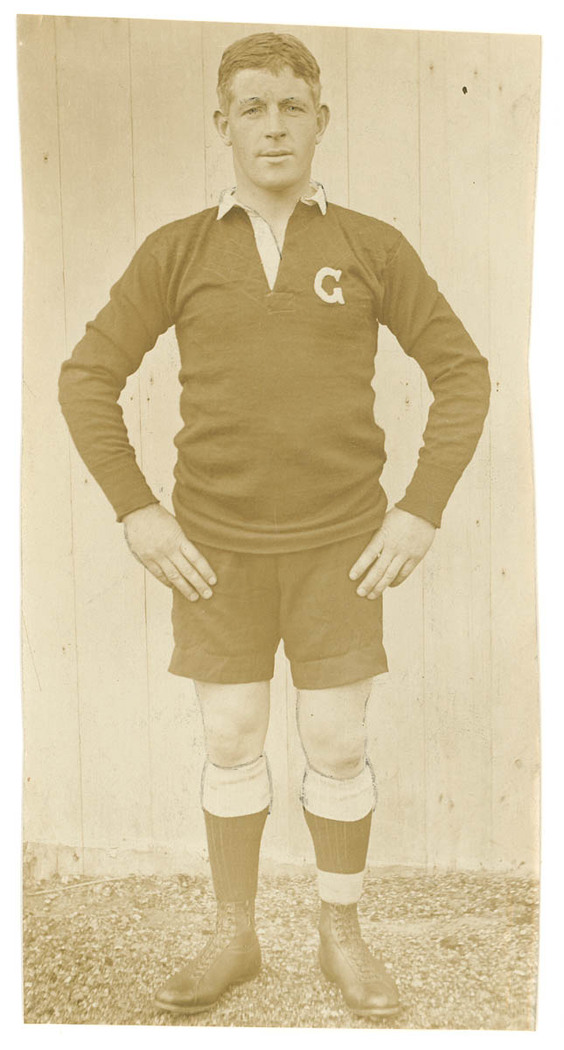
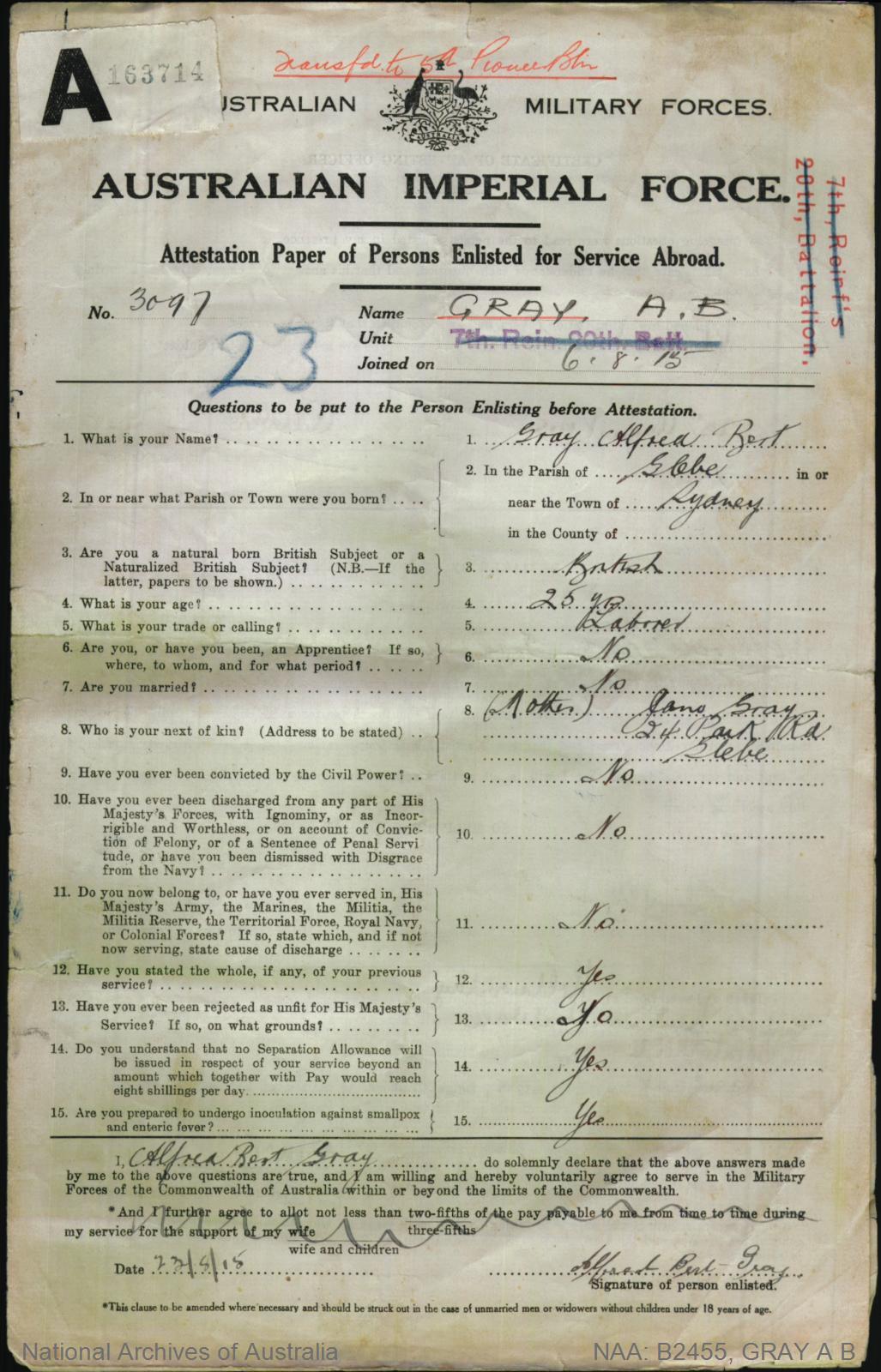
Bert Gray was listed among the 5th Pioneer Battalion soccer team which played “a team of ‘Tommies’ in the fighting zone on the western front.” The information came from a letter published in the Newcastle Morning Herald of 4 November 1916, written by Sergeant W. J Sneddon. Gray was listed in the team as a Lance-Corporal who hailed from Glebe, Sydney.
Gray was not a newcomer to the game, despite having played rugby league in the years prior to his enlistment. The Sunday Sun of 17 April 1910 lists an A. Gray as playing soccer for Glebe against Sydney. This tallies with The Rugby League News of 28 August 1920 which admitted their code had poached him from soccer around 1911, when he was 21.
Born in Glebe and still living there with his mother when he enlisted in August 1915, Gray left Australia in October and would have arrived during the chaos of the evacuation of Gallipoli. This explains why his record was empty until was transferred from the 20th Battalion to the 5th Pioneer Battalion in March 1916.
It was sometime in the ensuing months he played for the soccer team near the western front as described in Sneddon’s letter:
We kicked off at the tick of 5:30. It was a very interesting game, although it was prolonged by Fritz coming over in his air machine three times during the game, when we had to give for cover under a hedge nearby. Up till two minutes before full time the game was a draw, one all. One of the ‘Tommies’ sent names and other details of the game to two English papers, and another chap good at sketching got some of us players in different positions during the game.
Despite the Newcastle Morning Herald claiming it was made up of players from the Newcastle district, Gray was one of five Sydneysiders who played, alongside three from Newcastle, one from the South Coast, a ring-in from Barnsley and a player of unknown origin. The team had adopted the name Pioneer Tigers.
Gray was later promoted to Lance-Corporal in July, though in September he asked to revert in ranks to Private. He started 1917 ill but recovered by late February. By October his unit had been sent to Belgium, where he undertook duty for which he was later to receive recognition.
The Commonwealth Gazette No. 110 of 25 Juny 1918 mentioned Gray as earning a Meritorious Service Medal for his actions:
For meritorious service and devotion to duty. At WESTHOEK, east of YPRES, on the 12th October, 1917. This N.C.O. was engaged with his Platoon on the construction of a light railway. his Platoon Commander was wounded and there were six other casualties owing to heavy enemy shelling. Corporal GARY re-organised the party, carried on the work, and kept the men busy during the shelling, setting throughout a fine example of courage. He showed generally on his work in the YPRES Sector, September and October, 1917, a high standard of courage, his first thought was always of his work, and by his words of encouragement he inspired his men to greater efforts.
Gray was successively promoted to Lance-Sergeant and then Sergeant during 1918 and started back to Australia in mid-1919. Here he returned to Rugby League and played until his retirement in 1925.
The Evening News outlined his career on 6 May 1925, including his New South Wales representative honours before and after the war, and short international career. Gray earned four Kangaroo caps, though the newspaper stated his international career was stalled by a knee injury sustained on the tour to Great Britain. The same injury would lead to Gray’s retirement in 1925, but not before winning the 1922 Grand Final after Glebe defeated North Sydney.
The Evening News piece also claims he played soccer for New South Wales before switching codes. This cannot be verified. New South Wales seemingly did not play between a visit of Western Australia in 1909 and a series against Queensland in 1912, after he had moved to league.
Gray went on to become a rugby league selector for Australia and New South Wales. He died in 1977.