
On 1 July 1920, the “In Memoriam” section of The Toowoomba Chronicle listed the following: “JENKINS. – Inserted by his comrade Diggers, and Soccer Players, in remembrance of Alex Jenkins.” The memorial honoured the first anniversary of the death of Alex Jenkins.
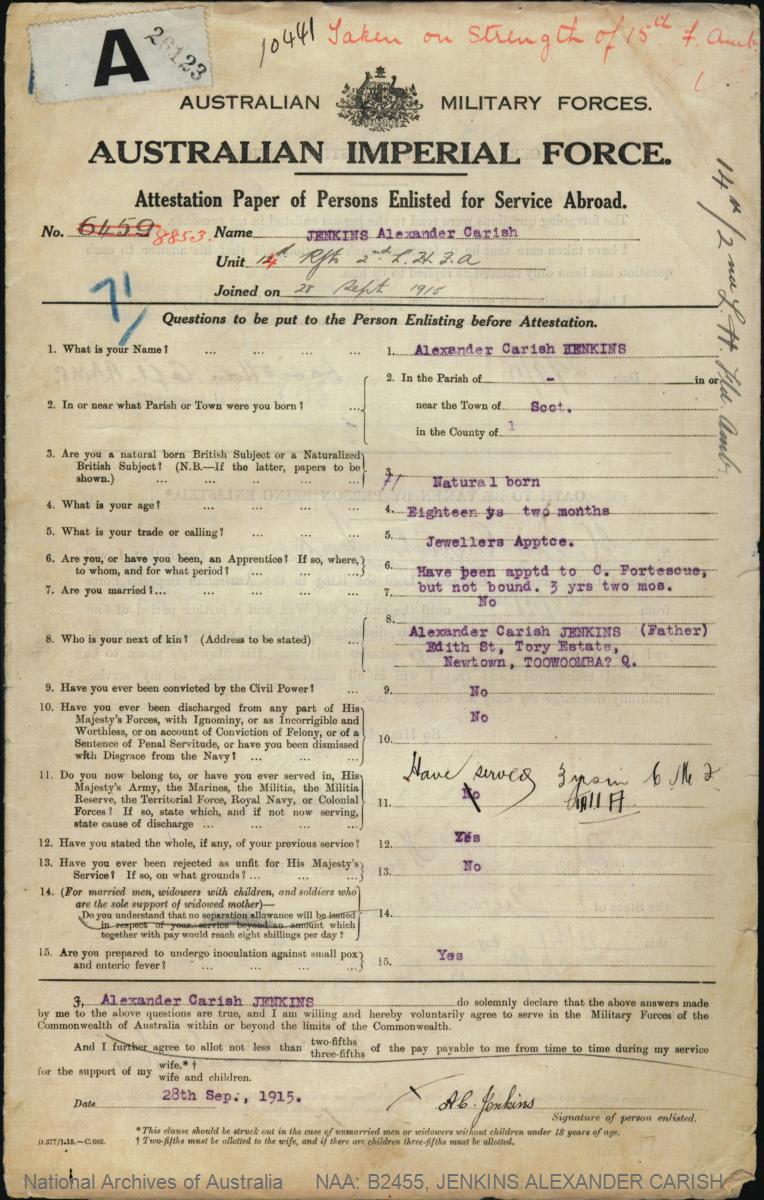
Jenkins was born in Greenock, Scotland in 1897, to his Scottish mother Mary, and his Irish father Alexander, snr. His father, it appears, was a soccerite. The Toowoomba Chronicle of 27 October 1924 reported on a banquet run by soccer club Waratahs. Here “The toast to ‘The Press’ was left in the capable hands of A. Jenkins, snr, who is an old Soccer player.” This was likely Jenkins’ father, as was the A. Jenkins seen refereeing a junior game in 1913.
Alex was also linked to soccer through his work. He was employed before the war as apprentice to jeweller Charles Fortescue, a major backer of sport in Toowoomba and who was involved in the game’s administration. Fortescue would also enlist, going on to rise to the rank of Major, winning a Military Cross.
Alex Jenkins cannot be seen playing soccer before the war, but this is not unusual as youth football received little to no coverage in the local newspapers at this time. The “In Memoriam” piece in 1920, though, firmly placed him within the local soccer community.
He enlisted at the age of 18 in September 1915, before serving in France with the 15th Field Ambulance in May 1916. His first bout of illness occurred in December, and despite rejoining his unit in February 1917 he was back in hospital within days. Jenkins was evacuated to London and started back to Australia in June, where he was discharged. Jenkins’ final medical report stated he had, “acute nephritis at present he has a large amount of albumin in his urine.” He was declared “Permanently unfit for general service and permanently unfit for Home Service.”
This was likely the condition then termed “trench nephritis”, which affected tens of thousands of soldiers and killed hundreds. Its symptoms included high blook pressure, swelling, breathing difficulties and headaches, and inflammation of the kidneys. The cause of the disease was not identified during the war, with later research suggesting it may have been caused by a hantavirus spread by rodents. Recovery was long, and relapses possible.
Jenkins did not reappear in the public record until April 1919, when he attended the inaugural meeting of the Returned Soldiers’ soccer club. Among those who formed the club was his old employer, Charles Fortescue, now one of Toowoomba’s most distinguished veterans. Jenkins scored two goals in mid-May as Returned Soldiers beat Highfields 6 nil. Sadly, Jenkins soon had a relapse of his nephritis and died on 2 July.
The Darling Downs Gazette of 4 July 1919 published a short obituary:
Alexander Garish (sic) Jenkins, the eldest son of Mr and Mrs. Alexander Jenkins, of Edith-street, Newtown, whose death was announced on Wednesday, is another victim of the great war. When he was 18 years of age and in the best of health he enlisted and went into camp on October 3, 1915. He went abroad with the 15th Field Ambulance, but the arduous duties in France during weather that was not the best severely impaired his health and he contracted nephritis. He was invalided home and reached here in July 1917. The immediate cause of death was Brights Disease. Out of respect for their dead comrade the returned soldiers of Toowoomba will today attend the funeral which is appointed to move from his late residence at 2.15 for the Town Hall and thence to the Toowoomba cemetery at 3 p.m.
(Bright’s Disease was a now obsolete name for a broad range of diseases of the kidney with similar symptoms, which included nephritis.) Jenkin’s funeral was reported separately but in great details by both the Darling Downs Gazette and Toowoomba Chronicle on 5 July. About 100 returned soldiers under the leadership of Fortescue marched and were joined by the Toowoomba Municipal Band and a long line of private vehicles. The Last Post sounded out as the coffin was lowered. According to Jenkins’ medical records, his death was officially attributed to his military service. As a result, his mother Mary was able to apply for a memorial scroll from Base Records, while Jenkins’ name is one of the 103,000 names projected by The Australian War Memorial honouring those who died in or due to the war.