

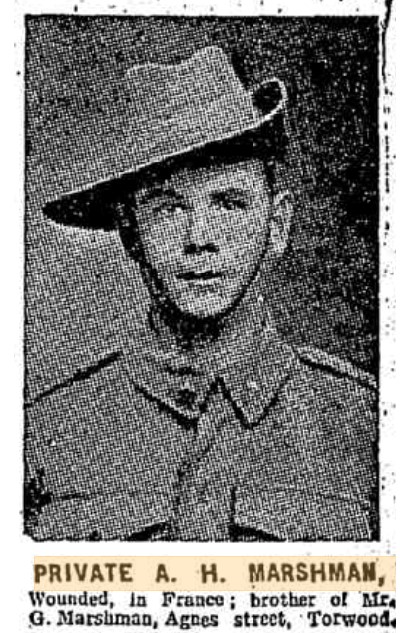
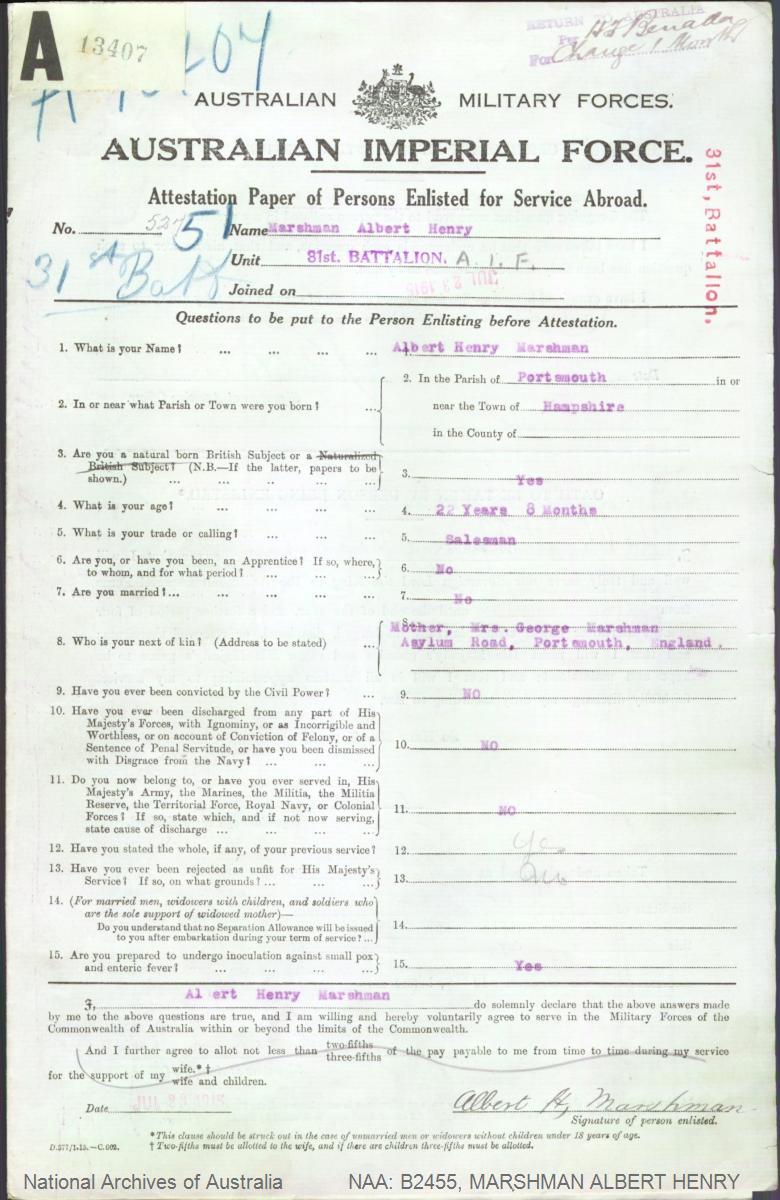
Albert Marshman appeared for an AIF Expeditionary Forces side against Brisbane City on 7 August 1915, which resulted in a 2-0 win for City. Nothing is known of Marshman’s soccer background.
Raised in Portsmouth, records suggest Marshman had arrived in Brisbane in 1913 on the Orama. We cannot determine when he played after arriving as the majority of the 60 pre-war Brisbane soccer teams received little newspaper coverage.
Marshman was a 22-year-old salesman when he enlisted in July 1915 and departed in November with the 31st Battalion. His record is otherwise slight, possibly due his arrival coinciding with the post-Gallipoli reorganisation of the units. Marshman’s war, though, was short. He received a severe gunshot wound to the arm in July 1916 and was evacuated to England. Details of how Marshman was wounded came from a letter he wrote to his brother George, who had also emigrated to Brisbane before the war. The letter appeared in The Telegraph on 7 November 1916. Marshman wrote,
I thought I was going to get through without a scratch, as I had had so many narrow escapes. We had to take two lines of German trenches. We did this easily, but somehow the Germans managed to turn water on and flood us out. I had captured six Germans and was taking them back to our own lines, when out jumped a German sergeant from a dugout. Goodness knows how he managed to stay in there. He called out in German to my prisoners, and I ducked just in time, for a bullet whizzed over my head. I pulled out a bomb, and – well those seven will not trouble England any more.
I had missed all my mates, because my company were in the fourth wave to attack the Germans, but I could not wait. I heard a whistle blow, and somebody shout out, ‘At ’em lads,’ and we went pelting over. I did not see any of my mates until after the bomb accident, and then I met two. We went on, and found that our own shells were lobbing near us as well as the Germans. It was simply hell let loose, so we stopped in a shell hole for a breather. Soon afterwards one of my mates was hit in the neck with a piece of shrapnel. I bandaged the wound, and had just tied the knot, when I was hit in the arm. I jumped in the air. When I cooled down, I found that my wounded mate had breathed his last I started back alone.
What a journey. I shall never forget it, with a smashed arm, and jumping over big holes. I took our own parapet with a bound. A doctor dressed my arm, and as there were worse cases than mine. I did not wait for a stretcher, but set off for the hospital at the back of our lines. At the hospital they operated at once. Whom should I see in the next stretcher to me in the Red Cross motor, but our own doctor with a wound like mine. He told me that I had not gone from his dugout two minutes, when over lobbed a couple of shells blowing them all out except him. If I had not walked off on my own I should not have been writing this.
I had to laugh when I came out of the operation. I took a bomb out of my pocket raving to the doctor, ‘This is not too comfortable to lie on, but, for goodness sake, don’t pull that pin out else you will blow us all to hell.’ You should have seen the look on his face — to think that he had been operating on me with a bomb in my pocket all the time. Thank God, I am all right now.
The severity of the injury saw Marshman depart for Australia in February 1917 where he was discharged. Marshman married Sarah Higginson in 1919, and the pair had a daughter. He died in 1964.