


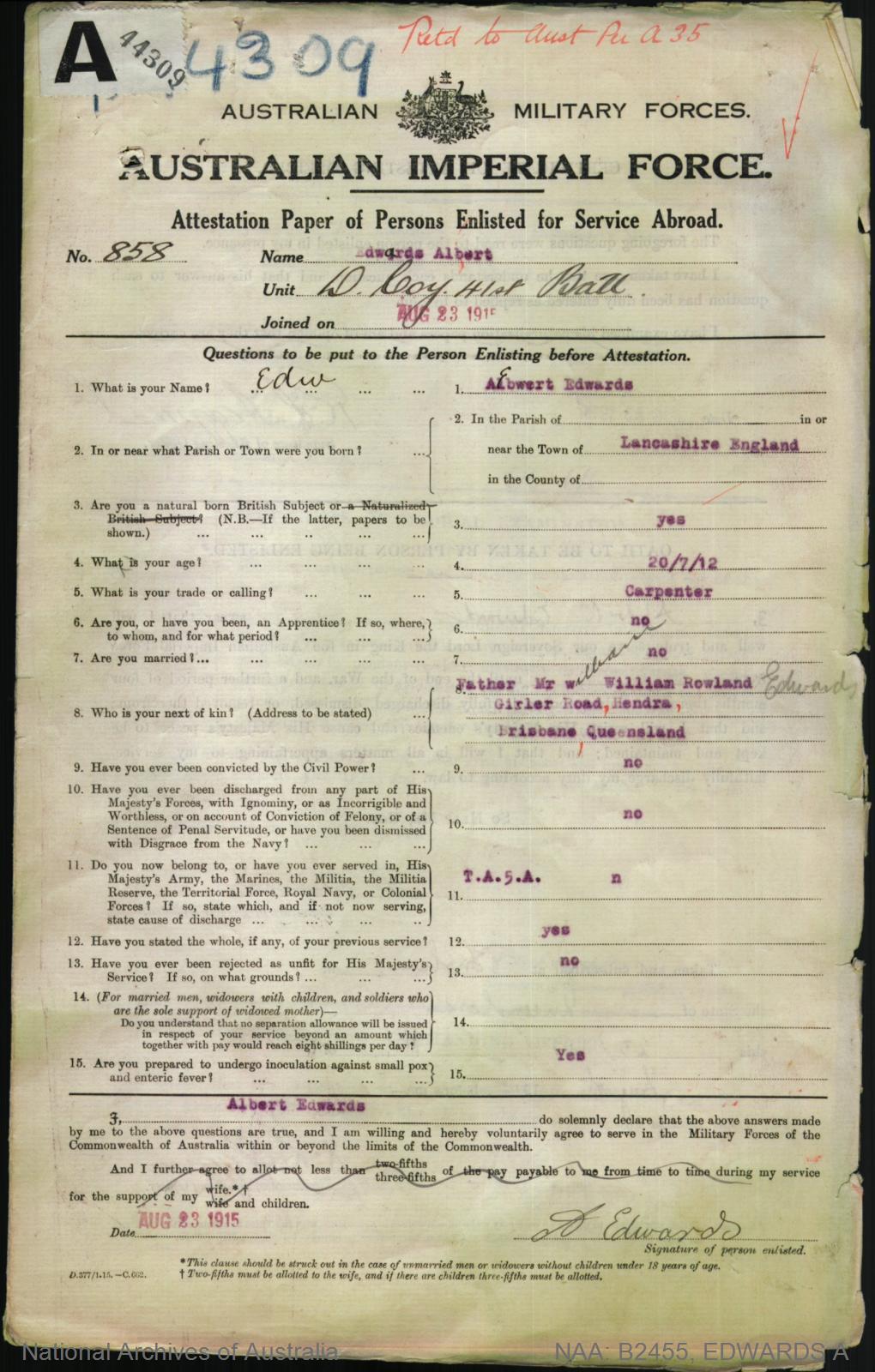
Albert Edwards and his brother John played two games for an AIF team while training at the Enoggera base in Brisbane. The brothers were from the inner-north suburb of Hendra and had played club soccer for lower-league club side Astley in the neighbouring suburb of Clayfield.
They enlisted together in August 1915. Edwards and John were selected for an Enoggera Camp XI to play Brisbane City in early October. According to the Telegraph on 1 October the AIF side purportedly included players from Nottingham Forest, Aston Villa, London Athletic, Heart of Midlothian and Belfast Celtic. By contrast, the Edwards brothers were simply listed as coming from Brisbane. Brisbane City won the game 2-0. Largely the same side were scheduled to play against the troops from the Exhibition Camp in November. Edwards was listed as a centre, with John at centre half. Neither the names of the Exhibition team nor the subsequent result were seemingly published.
The brothers were allocated to the 41st Battalion and started out for Europe in May 1916 but their wars soon diverged. While John would last the war, Albert’s would finish early but not before earning a citation for his bravery. Albert was promoted to Lance-Sergeant in 1916 before suffering from scabies just before Christmas. He spent Christmas Day in a hospital in France, which he wrote about in a letter to his parents. The letter appeared in The Brisbane Courier on 22 March 1917 and started:
We got up at 6.30 am, and had a wash and breakfast (which consisted of bread, meat, and tea). During the morning we were all moved over the road to another ward, until the huge hall (our bedroom) had been prepared for Christmas dinner. Over the road we went while a big party of Red Cross men was kept back to prepare the place. Over the road we commenced to play cards, read, and amuse ourselves any way we liked till a whistle blew, and every one was paraded downstairs, where they received a brand new suit of hospital clothing, which made each man look like a best man on a wedding day. Then we went up again, looking like a battalion in flannels. We all felt and looked real clean, the clothing being good and warm. We afterwards marched back to our old home, to find that a great change had taken place. Instead of a big open space of a dancing floor, we found it crammed with tables and forms, nicely fitted up for a great feast. The scene was one that might be expected in an orphanage on Christmas Day.”
Edwards recovered and was promoted to Sergeant in early 1917. On 10 June 1917, while fighting at Messines Ridge, Edwards’ earned a Distinguished Service Medal. The Commonwealth Gazette No 219 of 20 December 1917 stated Edwards received the medal:
For conspicuous gallantry and devotion to duty when in charge of an ammunition carrying party. Finding it impossible to take his party through a heavy barrage he carried the whole of the ammunition to the gun positions himself, passing through the barrage again and again, and thereby securing for the battalion holding the line the unhampered support of all its mortars. As a counter attack was expected his prompt action and whole hearted devotion to duty proved invaluable.
Edwards’ active duty would end mere days later. On 14 June he was gassed and evacuated to England, never to return to the front. He started back to Australia at the end of October and was formally discharged in February 1918. Edwards returned to Hendra, where he would live in or nearby for many decades. He married Grace Robson in December 1918, with a daughter born prematurely in August 1919. Details of his post-war life, though, are scarce. Edwards died in 1976.