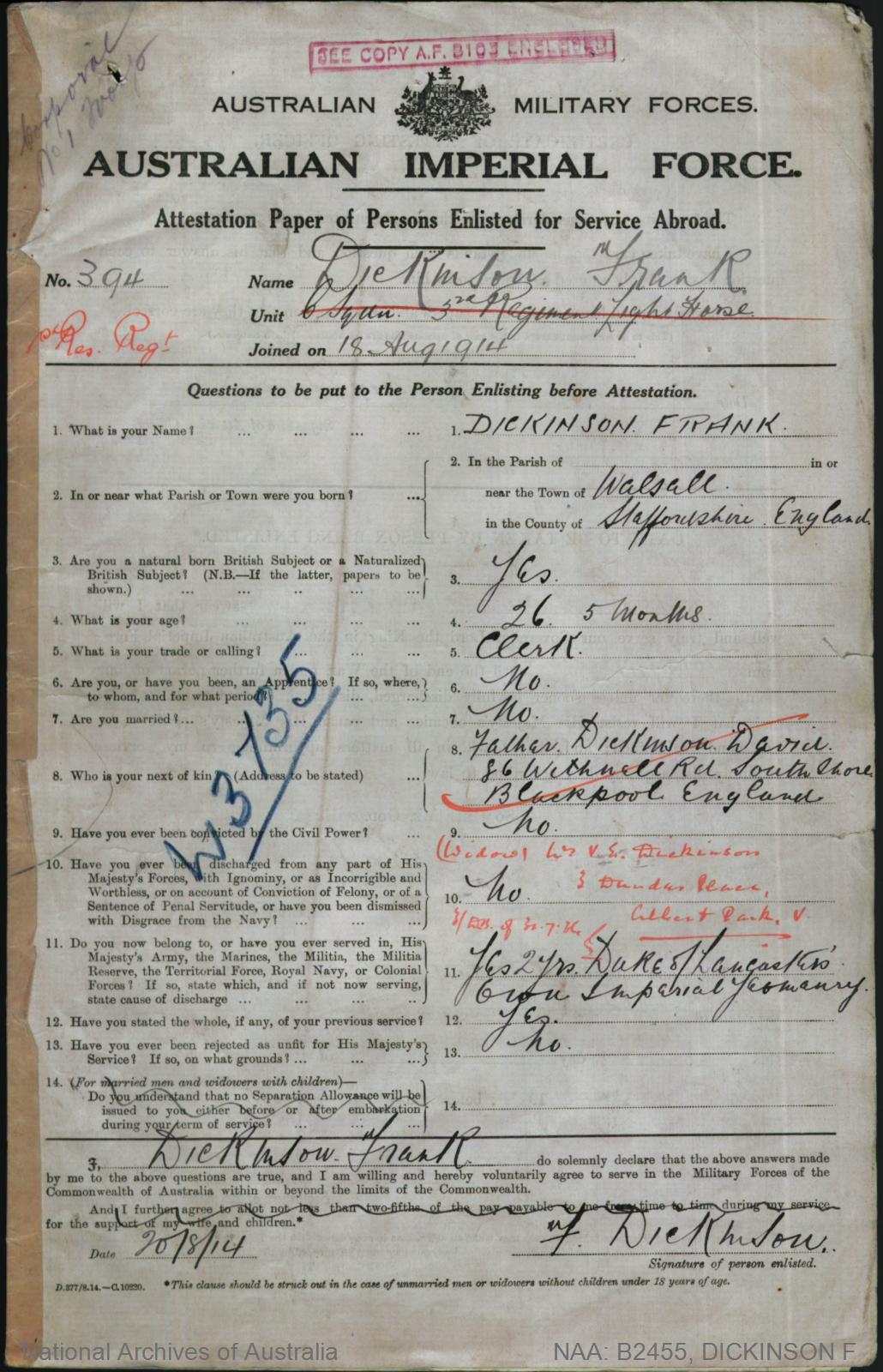
Born in the west midlands town of Walsall, Frank Dickinson made his debut for Hobart-based Corinthians in 1913, winning the state championship in that year.
Frank enlisted immediately upon the outbreak of war, joining the 3rd Light Horse Regiment, C Squadron. Frank departed aboard the HMS Geelong on 20th October 1914, the first ship to depart Hobart. The soldiers aboard this vessel, along with those aboard the HMS Katuna have subsequently been called the ‘A.I.F. Originals’. Frank saw action at Gallipoli, before being transferred to the western front, rising to the rank of Lieutenant whilst serving in the 4th Australian Divisional Ammunition Column.
Returning to Tasmania in December 1918, Frank worked in the Tasmania public service, rising to the rank of Deputy Registrar-General by 1927. Frank was a founder and inaugural assistant secretary of the ‘A.I.F. Originals’ association, who’s first reunion occurred in 1930:
A.I.F. ORIGINALS
First Reunion at Hobart
Over 200 Returned Men Present
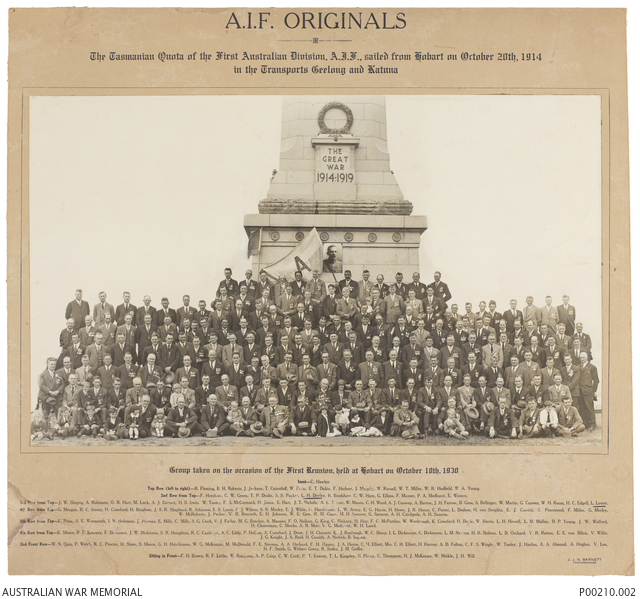
A reunion of A.I.F. originals, the first of its kind in Tasmania, and probably in the Commonwealth, was held at the R.S.A. rooms, Macquarie Street, on Saturday night, and proved a huge success. Over 200 returned men were present. The “originals” are the men who enlisted for active service when the war broke out in 1914, and were despatched overseas for active service by the Geelong and Katuna in October of that year. When Great Britain declared war against Germany and her allies an appeal was sent out for assistance from the Dominions, which was responded to by thousands of men throughout the Commonwealth, and Tasmania answered the call without hesitation. Mr. A. A. Orchard and a number of others notably Mr. Frank Dickinson, deemed it opportune to hold a reunion pf those men who left these shores, and who Were fortunate enough to return. Representatives of all the original units from all parts of Tasmania were present at the reunion
Two more Soccer Anzacs, Oscar Hart and Algernon Atherton Arnold also attended this reunion. A large photo of these 200 returned men hangs on the second floor of the Military Museum of Tasmania in Hobart.
In 1932, Frank was dismissed from his job for stealing £5 one evening in October 1931. In court, he received glowing character records from his now former employer, a local alderman on Hobart council and from fellow former soldiers. One of those soldiers, Mr Orchard, noted that in the past 12 months, Frank had been “irritable and highly strung, and he suffered from a failing memory. He felt sure that war service had affected accused.” This was corroborated by his former employer, who noted that “his nerves had been affected and it was contended that he was not properly balanced when be committed the offence.” Along with his plea of guilty, Frank was fined £20. Following this, Frank moved to Melbourne in 1932 in order to continue to be able to provide for his family.
He passed away 4 years later in 1936.