
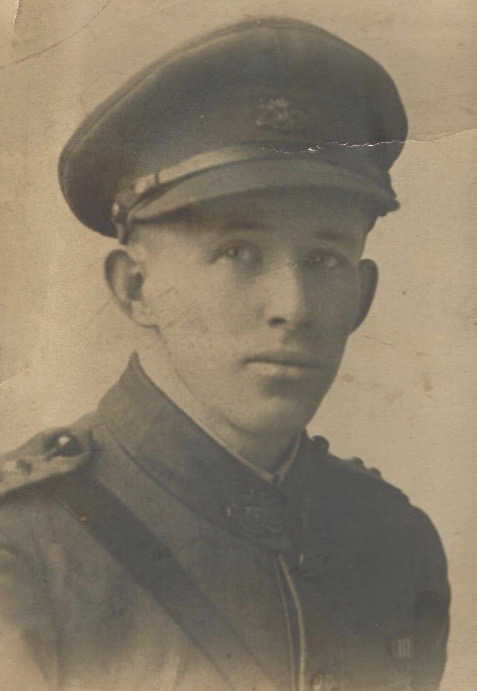
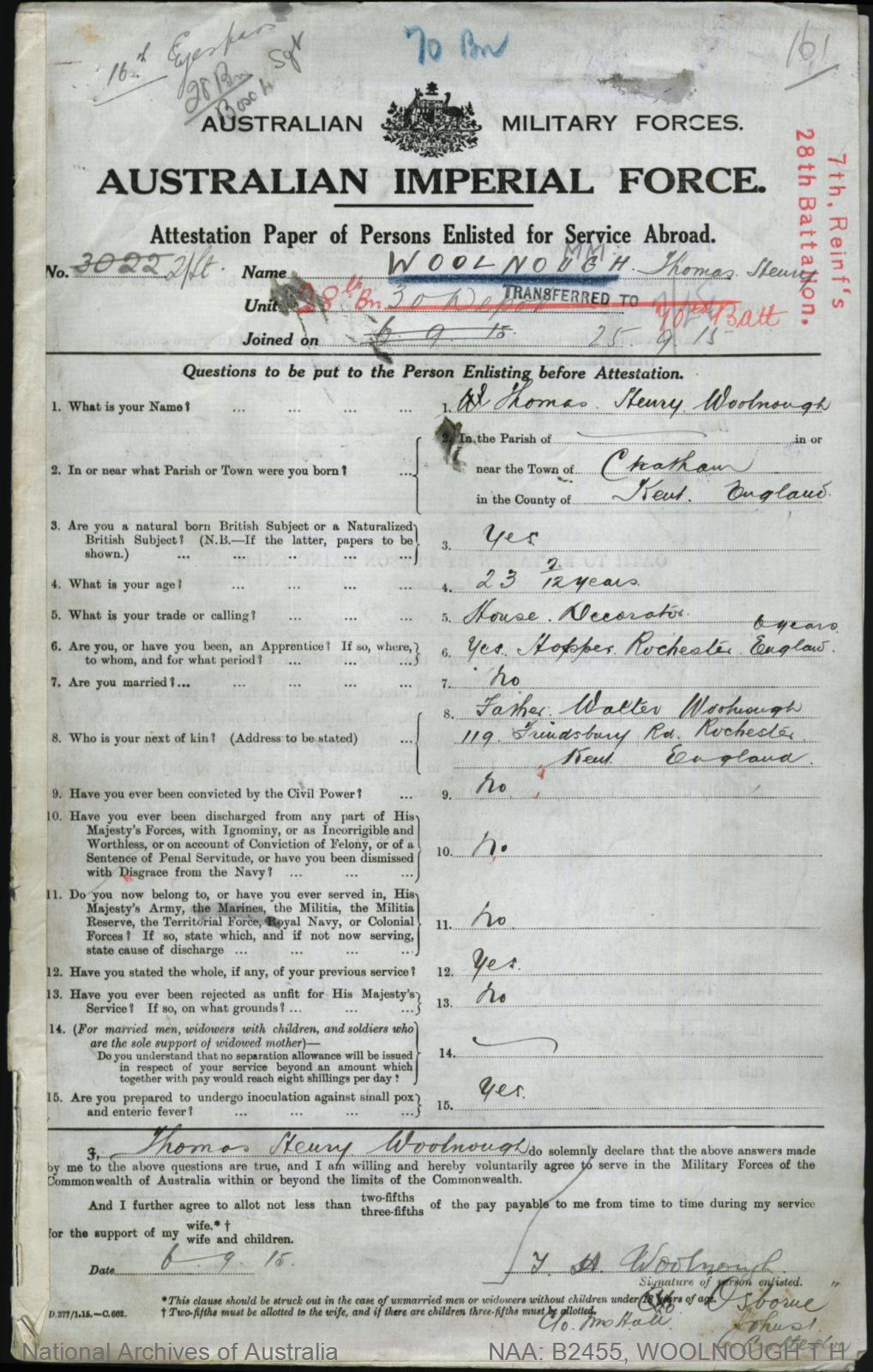
Thomas Woolnough was born in the East London district of West Ham on 27 January 1891. Within a couple years his parents, Walter Woolnough and Caroline ‘Anna’ Laws, had moved the family, which would eventually expand to 10 children, to Medway in south-east England.
Thomas arrived in Fremantle in October 1912 and soon found work as a house decorator, primarily a painter, while boarding with Mrs Hall in Cottesloe. On the weekend he played football for the Junior First league YMCA club, appearing regularly at outside-right from 1913 through to his joining the Australian Imperial Forces.
Late in September 1915, Thomas enlisted in the 28th Battalion, as a Private. Promoted to Corporal while at Blackboy Hill camp, he joined his Battalion in France in May 1916 and two months later was promoted again, to Lance Corporal. Eleven days after that appointment he suffered a bullet wound to the left leg which required minor surgery to remove the shrapnel.
The 28th Battalion were involved in fighting around Pozieres and to the east of Flers. It was during the latter battle that Thomas, who was now serving as a Corporal, suffered wounds to the forehead from an exploding bomb. After a spell in hospital, he spent his recovery at the 2nd Australian Division Base at Etaples before rejoining his unit in January 1917.
Between April and October Thomas at the School of Instruction at Canadhar Barracks in Tidworth, England, receiving advanced instruction in infantry tactics, organization and administration. Having “qualified as good”, he rejoined his battalion for the winter in Belgium and in early-to-mid 1918 was involved defending the vital rail junction at Amiens.
Thomas’s actions at Morlancourt, to the north-east of Amiens, were recognised with a Military Medal –
On the night 10/11th June, 1918, at MORLANCOURT, near ALBERT, this N.C.O. showed great coolness and daring throughout the attack. On finding that the party detailed for the work had become disorganised, he collected a party on his own initiative, and bombed up a sap to a distance of 60 yards, driving the enemy before him. He then made a block in the sap and held same against a strong party of the enemy who attempted to drive him out.
In late August the 28th Battalion were prominent in the fighting which secured the Amiens–Peronne railway bridge and the subsequent advance beyond Mont St Quentin. Their last actions were fought as part of the effort to break through the Beaurevoir Line in the first week of October.
Thomas was promoted twice more in the early months of 1919, to 2nd Lieutenant and then Lieutenant, before he took several months of leave due to the injuries sustained in the war. “Suffers from headaches after exertion with temperature at the time. Liable to pains in left knee. History of synovitis” reads a medical report on his service record.
Thomas returned to Australia in January 1920. By 1929 he was living in England where he married Ethel Reid in his childhood home of Medway. He was in his mid-40s when the first of his two children were born.
Thomas Woolnough was 83 years of age when he passed away in 1974, in Devon, England.