
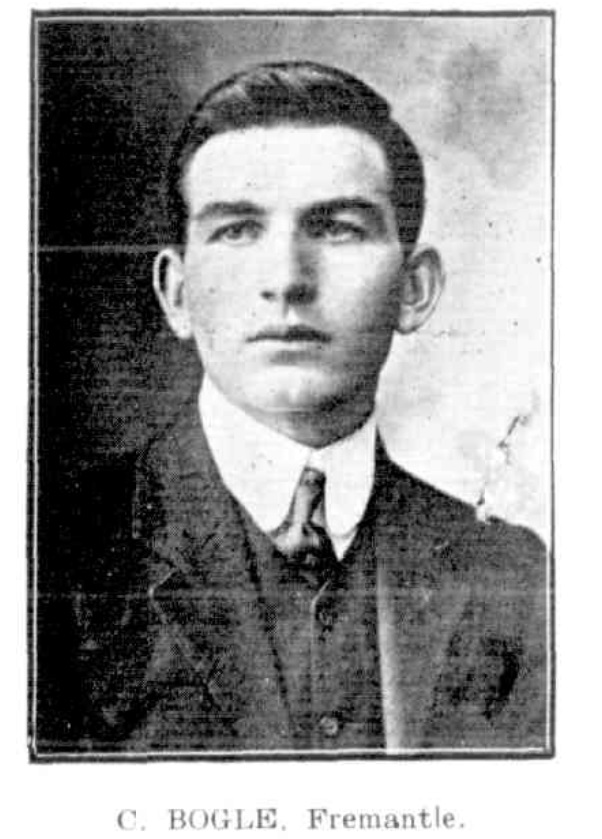
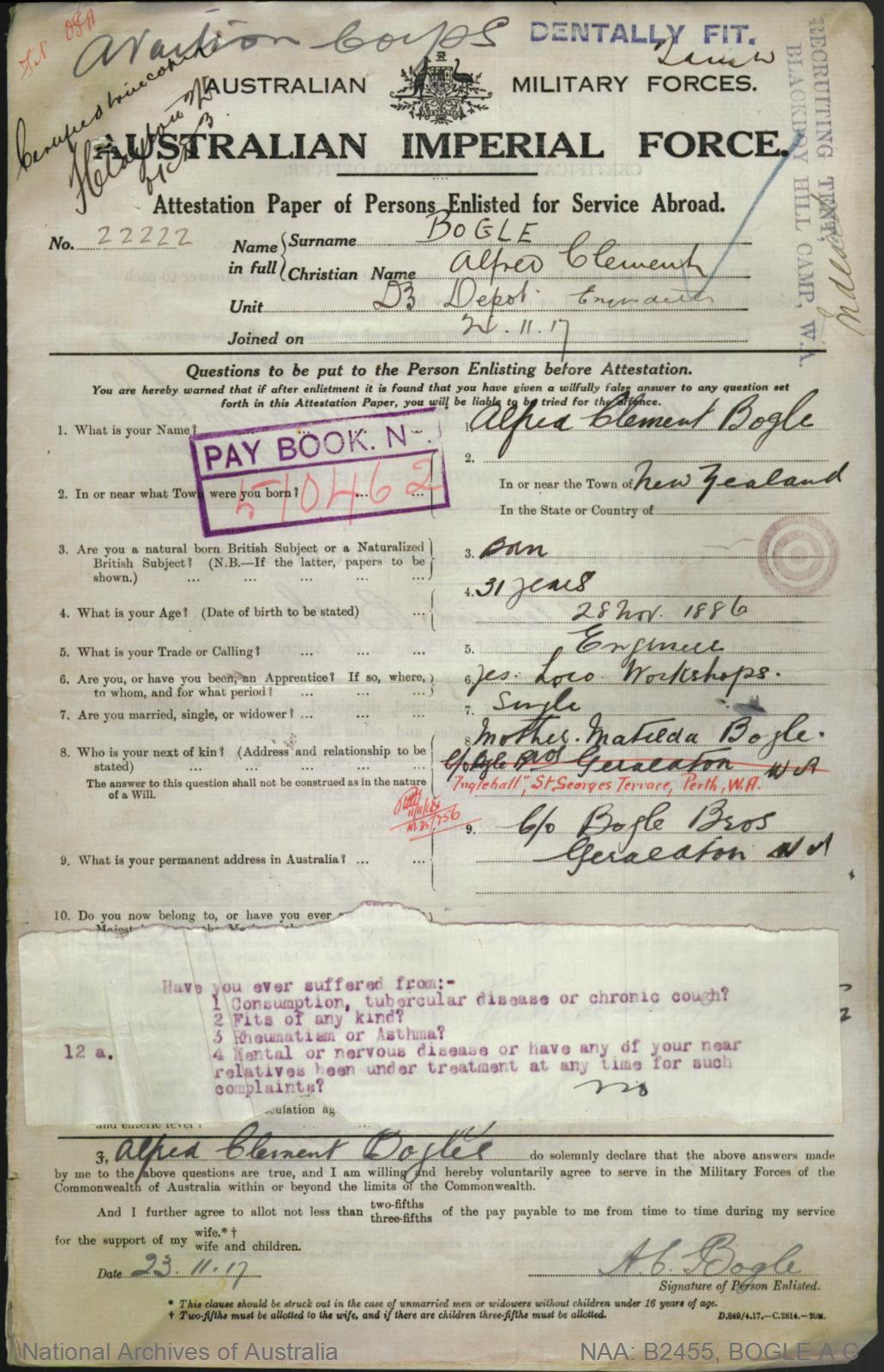
Alfred Bogle was born on 28 November 1886 in Napier, New Zealand, into a family of Scottish heritage who claim direct ancestry to Robert the Bruce. The youngest of five children to William Bogle and Matilda Wattie, he began his schooling at Pahiahia and later Hastings on New Zealand’s north island prior to the family’s relocation to Fremantle in October 1897.
Having completed his education in Fremantle and three days shy of turning 15, Clem started working as a junior machinist with the Western Australian Government Railways. When the railways moved their workshop from Fremantle to Midland Junction, Clem transferred to the new facility where he was now an apprentice fitter. In April 1907 the family was rocked by the passing of William, who was 63.
Clem’s first tentative steps onto the football field were with Fremantle Reserves in 1904. A skilful left winger with an explosive turn of pace, he stepped up to the first team with Fremantle Rovers two years later, winning the Charity Cup in his debut season and adding the Challenge Cup and Shield twelve months later. In mid-1908 he gained his first outing for the West Australian State team in a narrow 3-2 loss to the visiting England Cricket XI.
In mid-1909 Clem was among the 15 players selected for the State team’s historic interstate tour that took in New South Wales, Victoria and South Australia. Clem played nine of the ten games and scored his first goal for Western Australia in a 4-4 draw with South Australia. His final outing for the State arrived the following August, also again South Australia.
Appointed captain of Fremantle prior to the 1910 season, Clem ended his club’s six-year trophy drought by leading them to victory in the 1911 Challenge Cup and Shield. The following year he added a second Charity Cup to his haul of honours. Clem was attracted by an offer to switch to the Perth club for the 1913 season, however, when it didn’t eventuate he decided the time was right for a totally new challenge.
Toward the end of the year Clem and his brother Charles established Bogle Bros, a merchant business specialising in livestock and farm machinery, in the Mid West coastal city of Geraldton. When the 1914 football season opened in May, he pulled on the light blue and white of Thistle, whose dominance was rewarded with the league title and Hansen Cup double.
Clem was 31 when he enlisted with the Engineering Field Companies in November 1917. He attended 70 days at the Engineer Officers Training School in Roseville, New South Wales, where the curriculum included engineering, explosives, tactical exercises and signalling. Further specialist training followed when he arrived in England in May 1918.
The war was over by the time Clem proceeded to France in November. In April 1919 he took up the Australian Imperial Forces’ offer of vocational training by accepting a three months agreement with the respected engineering firm Crossley Bros of Manchester, where he was involved in testing internal combustion engines. Unfortunately, Clem’s stay was cut short and he returned to Australia in July.
Clem re-joined Charles, whose war service was terminated in late 1917 by ongoing illness, at the helm of Bogle Bros in Geraldton. In the decades that followed he acquired sole ownership of the family business, served as president of the local Chamber of Commerce, was an active member of the Liberal Party and captain of the Geraldton Golf Club, where he was Club Champion in 1928.
In January 1921 Clem married Beatrice Brown, with whom he celebrated the arrival of four children. Clem would no doubt have been proud of the fact two of his sons, Bruce and Stewart, as well as his daughter Nancy served in the Second World War. Also answering the call to arms was Clem, who was stationed at the 19th Garrison Battalion in Geraldton and Broome at a time when Australia was under threat from Japan.
Alfred Bogle was 83 years of age when he passed away in Geraldton on 19 March 1970.