

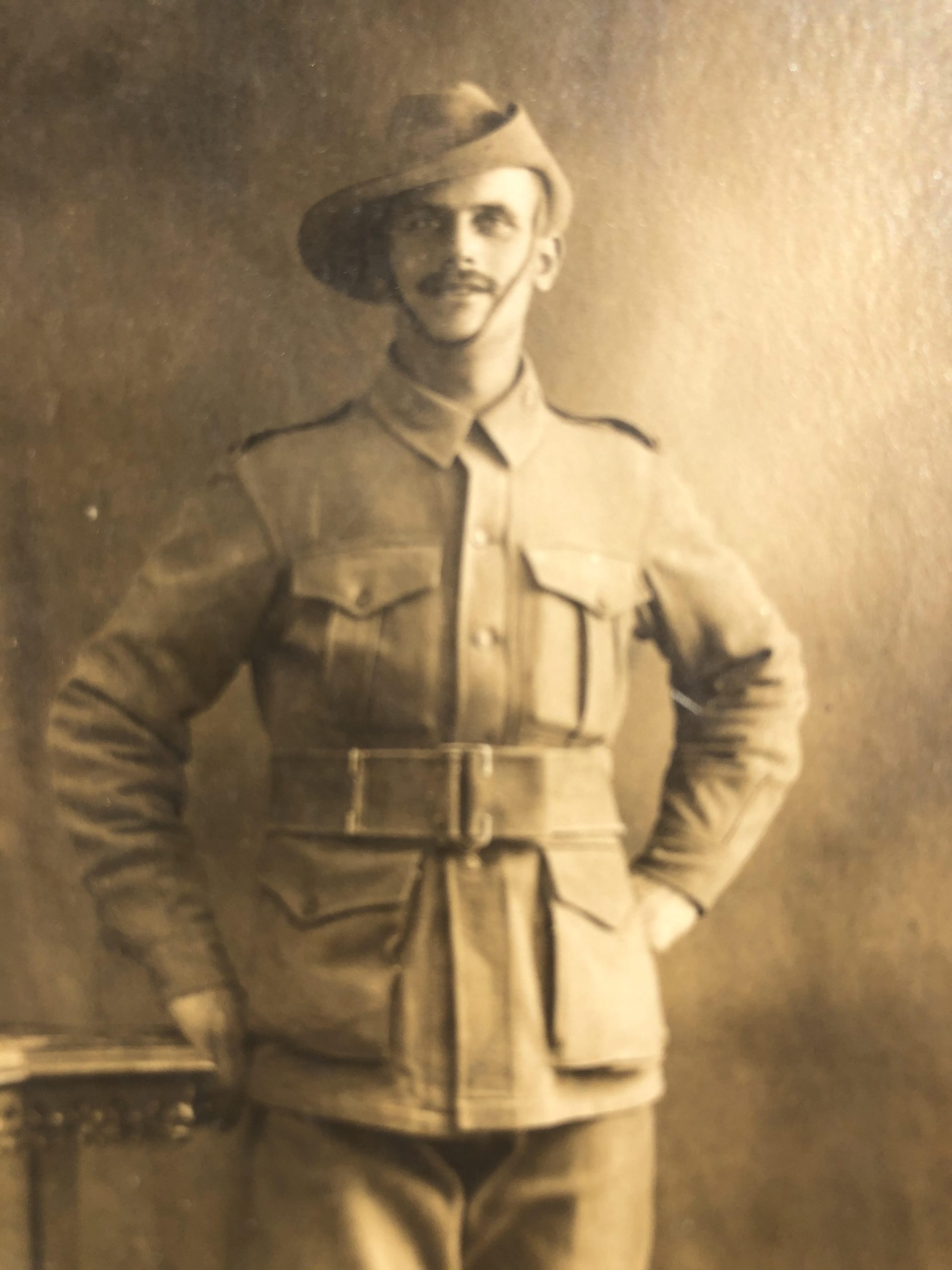
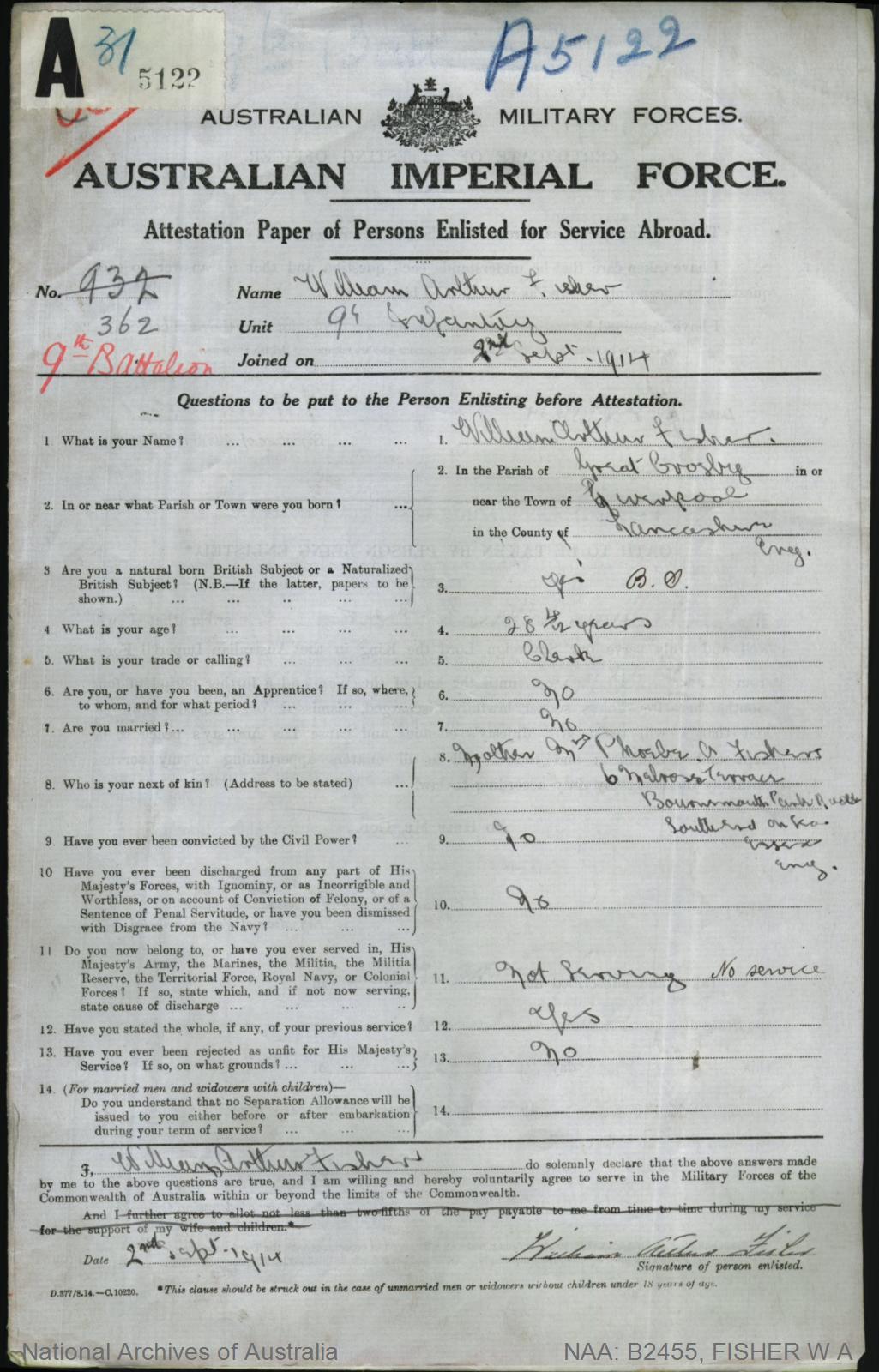
William Arthur Fisher was born in Great Crosby, Lancashire in 1886, the second child of travelling salesman William Henry Fisher and wife Phoebe. William’s childhood was disrupted by tragedy. His infant sister Frances died of whooping cough in 1891, and within a year his father was sentenced to hard labour for defrauding an aunt who employed him. The family moved to Wood Green in Middlesex, and then onto Southend-on-Sea, where soon afterwards, young William’s father deliberately walked in front of a train, an act attributed to financial distress. The shock upon the family resulted in the premature birth of William’s youngest brother, Horace.
Fisher’s life in Southend was surrounded by sport. He played cricket and was a member of the Harriers Athletics club. Fisher’s interest in football was not reported by the Southend newspapers, which unreported the local competition, but in his later years Brisbane’s The Telegraph stated he had been “a soccer enthusiast all of his life and was at one time a goalkeeper of some note.” Fisher grew up around football. He was a school-friend of English dual international footballer and cricketer Andy Ducat, while his brother Alfred Cecil Fisher became a leading figure in Western Australia football from 1906.
By 1911 Fisher was working as a waterman in Southend, helping transport passengers along the Thames estuary, before emigrating to Australia by the end of the year. In Brisbane he found work as a clerk and played football for the Kangaroo Point-based club Wellington. He enlisted for the AIF soon after the war broke out. His older brother Alfred also enlisted, as did their younger British-based siblings Frederick and Horace. Only Frederick did not survive the war, having been killed in action in 1918.
A noted rower, Fisher’s war was a short but historic one. As a member of the Brisbane-based 9th he was in the first boat to reach the shore of Gallipoli on April 25, 1915, which landed before the first Turkish shots were fired. Fisher was injured by shrapnel three times as the battalion advanced uphill, leading him to finally crawl back to the beach and be taken away to a hospital ship.
While recuperating in Malta, Fisher wrote a letter to his future wife Anna Kruse, which detailed the landing. The letter was published in the Telegraph in early June, and with other letters form survivors form an important account of the Gallipoli campaign. He returned to Gallipoli in late May before contracting typhoid in August. This led to ongoing intestinal issues which saw him return to Australia in December. Fisher was medically discharged in March 1916.
Fisher joined the Returned Sailors’ and Soldiers’ Imperial League of Australia, starting as treasurer before promotion to secretary in 1917. The League was part charitable service delivery and part political pressure group for returned soldiers. Among the initiatives in which Fisher became involved included organising funerals, the purchase of a large house for the boarding of returned soldiers, and a public campaign aimed at improving solders’ training and employment opportunities. His role brought him into contact with Prime Minister William Hughes and successive Queensland Premiers.
His political convictions also led him to tack close to the legal winds, agitating against unionist and anti-conscriptionist campaigns, and being something of a leader in the infamous Red Flag Riots. Once charged with wilful and unlawful damage to property, he avoided conviction, despite clear eyewitness evidence, because his jury sympathised with his motives.
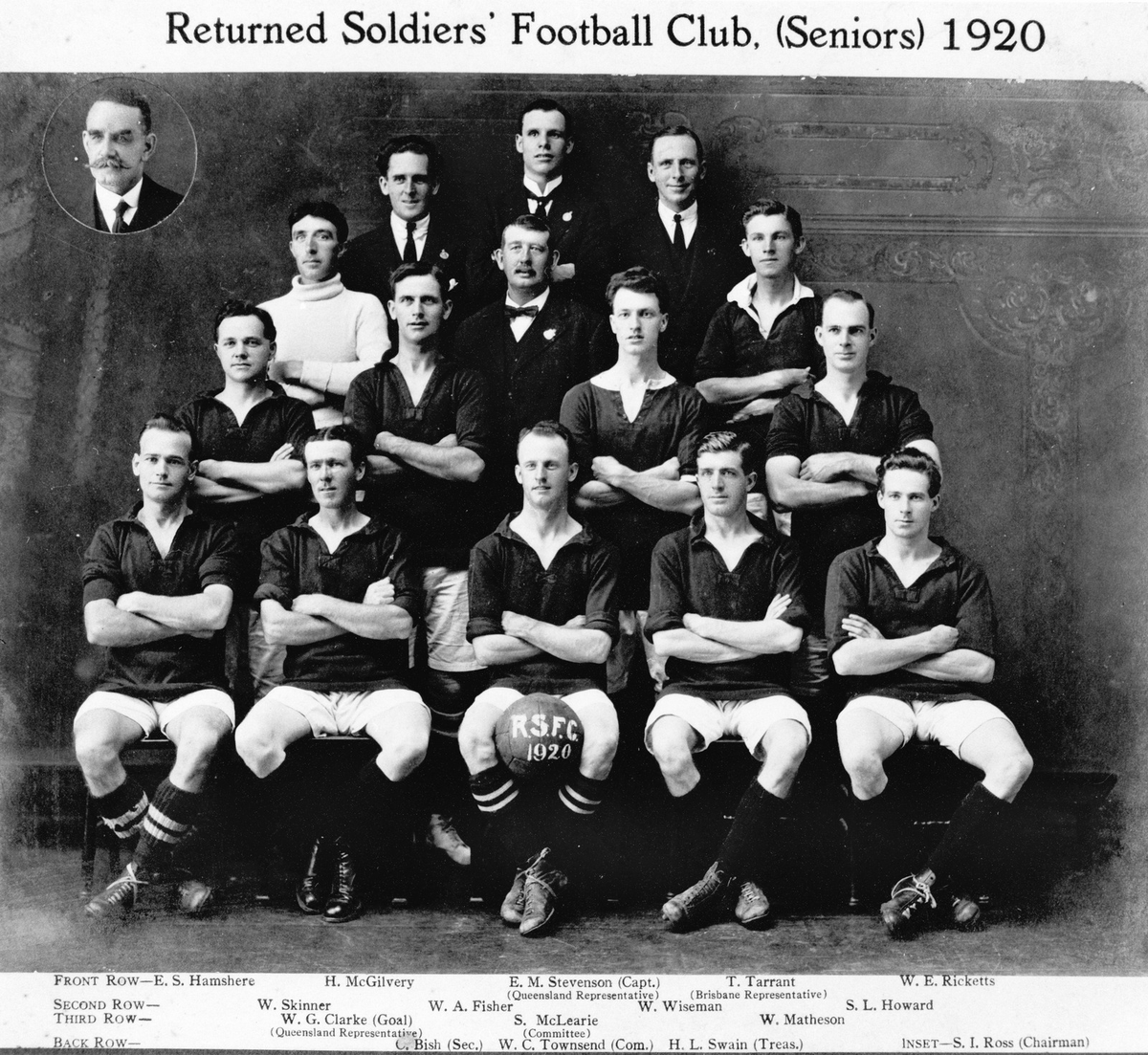
The short-lived Returned Soldiers’ multi-sports club was another of his initiatives. The club included outdoor and indoor sports such as billiards. Fisher played for the soccer and cricket teams. Fisher resigned from his position as secretary in 1920 and in 1921 was elected an alderman for the South Brisbane Council. By 1922 he was assisting the West Moreton branch of the Returned Sailors’ and Soldiers’ League, as well as the West Moreton British Football Association.
In April 1923 he became the Secretary of the Queensland Football Association. That year Brisbane hosted the first soccer international on Australian soil, as Australian played New Zealand. After the match, it was decided to mark the series with a Soccer Ashes trophy. The term “Ashes” had become a common term for bilateral sporting contests at the time. The ashes of cigars smoked by opposing captains Alec Gibb and George Campbell were placed in a razor case provided by William Fisher. The razor case had been presented to him shortly before his departure for war and was with him as he rowed ashore at the landing of Gallipoli. The case and ashes were later placed into a wooden casket made from Australian and New Zealand wood, further strengthening the ANZAC symbolism.
Fisher led the Queensland Football Association for the remainder of the year, incorporating the series against the touring Chinese. In later years he became a noted bowls player and worked as the records officer of Queensland Cricket. During World War 2 he served as a locally-based officer. He died in 1958 at the marshalling area for the ANZAC Day parade in Alfred Street, Brisbane, exactly forty-three years after landing at Gallipoli. His razor case, encased in the Soccer Ashes trophy, was played for between Australia and New Zealand sporadically until 1954, before disappearing before the 1958 series. Rediscovered in 2023, it once more became an active trophy when Australia Men’s team beat New Zealand later that year.
Fisher’s letter to Anna Kruse written on 3 May 1915 was published in the Brisbane Courier on 11 June 1915.
We left an island on Saturday, 24, on a British warship for the Dardanelles, and about 2 o’clock on Sunday morning departed from the warship in boats, towed by a pinnace. We were then about 5 miles from shore. The Queenslanders had the honour to be the first to land, and my company was the first company to get there. I happened to be one of the rowers in the first boat. We reached the beach about 4.30, and half of our chaps got out of the boat without anything happening. We were just beginning to think that the Turks were not there, when one shot was fired. Then shots came from all directions. I was lucky to start with one shot only hitting my cap and throwing me back in the water. I was not very long scrambling out again. We lay at the foot of the hill for about ten minutes, and the bullets did fly around. We could see several men hit while coming in other boats. We fixed bayonets, and the word was given to ‘charge,’ and my word we did. There was one great cry of ‘come on, Queenslanders, come on, the 9th,’ and we went up that hill in great style.
Queensland ought to be proud of her boys. The 10th, 11th, and 12th soon followed. We very soon got the Turks on the run, and chased them for about three miles, killing and wounding a good many. We lost very few men going up the hill. It was terrible country to travel over—all hills and bushes. I was feeling very well at this time, but, of course, was wet through. We started entrenching, thinking that we were going to have a spell, but the order came that the Turks were advancing on the left in large numbers. So we moved over to the left, and then the fun started. It simply rained bullets and shrapnel all day. Our chaps were dropping all over the place. By this time all the Australian division had landed, and there was no stopping them. Great Scot; they did fight! Our orders were that we were to take that hill at all costs, and that the success of landing depended on us. We did all that we were asked to do, but at a great cost, although, I believe, not so great as was expected. I was lucky, and I am all right again now. I hope to be back in time to march into Constantinople. The men in the good old British Navy are great. You should have heard them cheering our boys while the bullets were flying around, telling them to keep cool and steady, and take it easy; but our boys were steady enough. They simply went up that hill as if it were was an everyday occurrence. I am proud to know that I was one of the Queenslanders, and that we were the first to land. We had a letter from Lord Kitchener telling us that the position we were to take was almost impregnable, and could only be taken at great sacrifice. I heard one of the Navy men say, ‘The Australians will do me after this.’ There are two things they can do—they can swear and, gee, they can fight ! I suppose Queensland is very proud of her boys. It ought to make some of those who stopped behind pack up at once and get going, so as to hasten the finish.