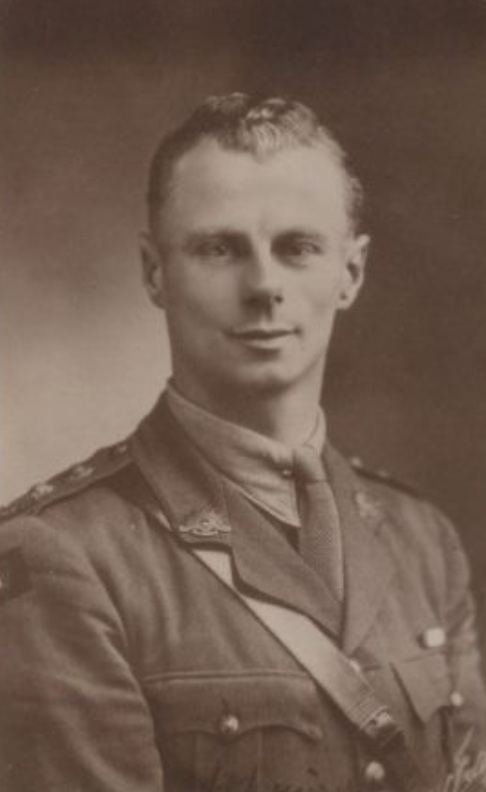
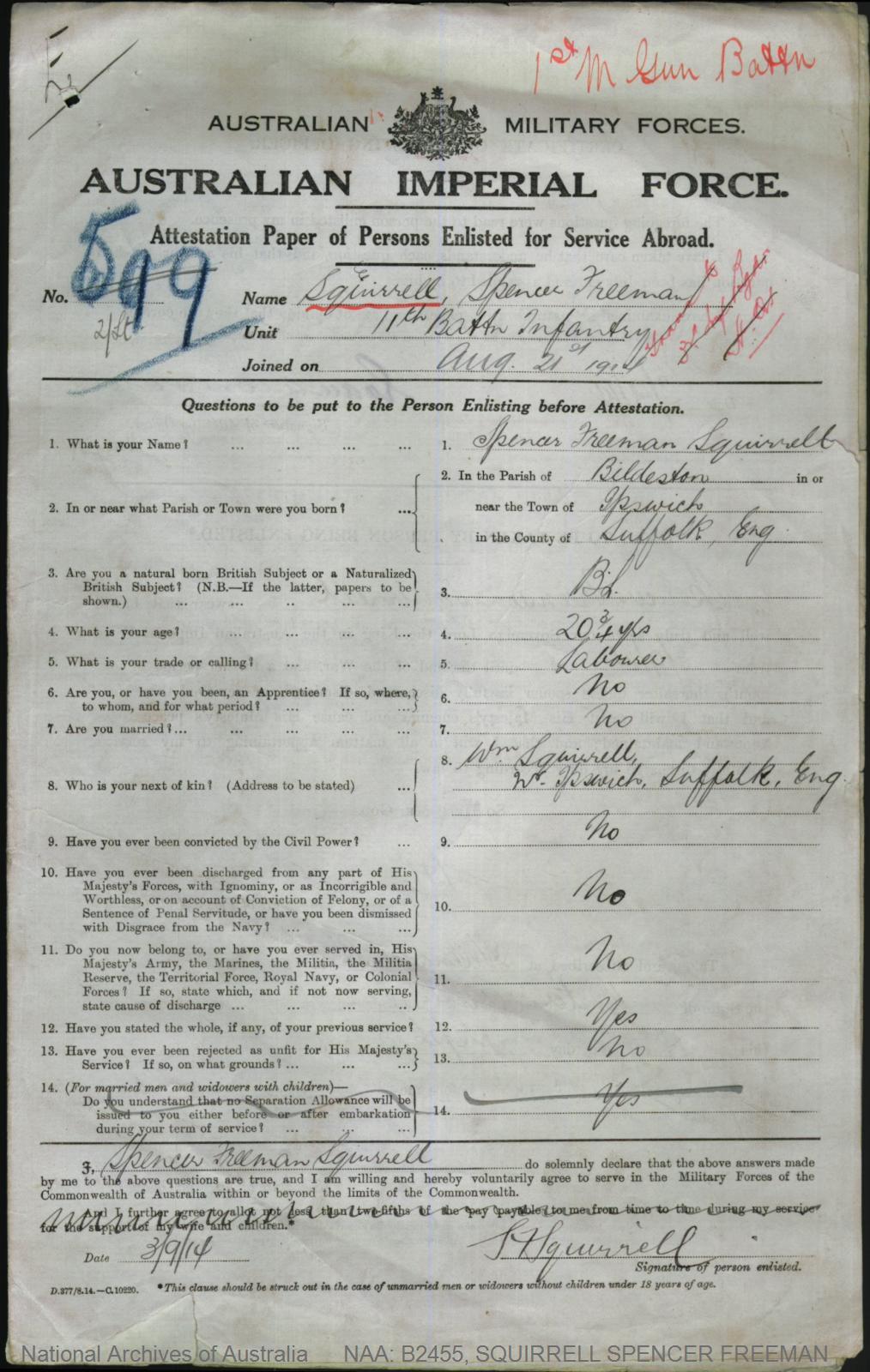
Spencer Squirrell was born on 2 November 1893 in Bildeston, a small English village near Ipswich. The sixth of eight children to James Squirrell and Nellie Clover, he studied music and in his teenage years worked as a farm labourer.
A few weeks shy of his 16th birthday, Spencer he emigrated to Western Australia on a 3rd Class ticket, possibly attracted by the State governments offer of passage, land and support to farm workers. Spencer settled in the Wheatbelt region where he found employment at 14-Mile Brook, probably on the expansive farm owned by Thomas Whitford and his sons.
A keen sportsman, he played cricket for the 14-Mile Brook team and in April 1912 gained selection for the nearby town of Narrogin against Wickepin. Spencer would play cricket for Narrogin through to the summer of 1913/14.
Association football arrived in the Wheatbelt with the formation of the Narrogin club in July 1912. He played on the left wing in the town’s first organised game – an intra-club practice game – and featured in a two-game friendly series against Katanning. The following year he was a regular fixture of the Narrogin line-up that met Cuballing and Toolibin in a newly formed regional league. Spencer turned out against visiting metropolitan league teams Training College and Rangers Glebe – scoring twice against the latter – in mid-year. And he was named one of Narrogin’s best on ground when they travelled to Perth for an exhibition game against the Coastal XI, a metropolitan representative team, in September. His final season of football was with Katanning in 1914, when he scored in a 6-1 win over his former club.
Australia entered World War 1 on 5 August 1914; four weeks later Spencer enlisted as a Private with the 11th Battalion. In the early morning of 25 April 1915, 21-year old Spencer stormed the Turkish cliffs north of Ari Burnu as part of the AIF’s landing on the Gallipoli Peninsula. The 11th Battalion attacked Turkish positions at Gaba Tepe nine days later before settling in to hold the frontline. Soon after 11th Battalion captured a Turkish trench, later named Leane’s Trench,
Spencer was struck down by diarrhoea and sent to hospital in Alexandria, Egypt, where he remained for over six weeks. On returning to ANZAC Cove in mid-October, he was assigned to the 3rd Battalion Headquarters through to the successful evacuation of the peninsula on 20 December. Spencer rejoined his battalion in Egypt ahead of moving to the Western Front in March 1916.
The 11th Battalion suffered heavy losses at Pozieres in mid-year before being engaged in bloody trench warfare in the Ypres sector of Belgium. They saw out the year rotating between rear and front-line duties on the Somme Valley, which had been transformed into a “ghastly nightmare of mud, snow and misery”. In February 1917 Spencer transferred to the 3rd Machine Gun Company which played a crucial role in major offensives in Belgium including the mid-year Battle of Messines.
Promoted to Lance Corporal in September and then Corporal in February 1918, Spencer spent the remainder of the war alternating between training courses in England and serving with his battalion in France.
On being discharged from the military Spencer headed back to Katanning where he was employed as an accountant by businessman and politician Harold Piesse. After working in Narrogin for a period as a clerk, he returned to England in 1938.
For the next three decades Spencer lived in the West London suburb of Southall, where he boarded with the Mustoe and Wells families. Spencer Squirrell was 75-years old when he passed away in July 1969 in Cambridge, England.