

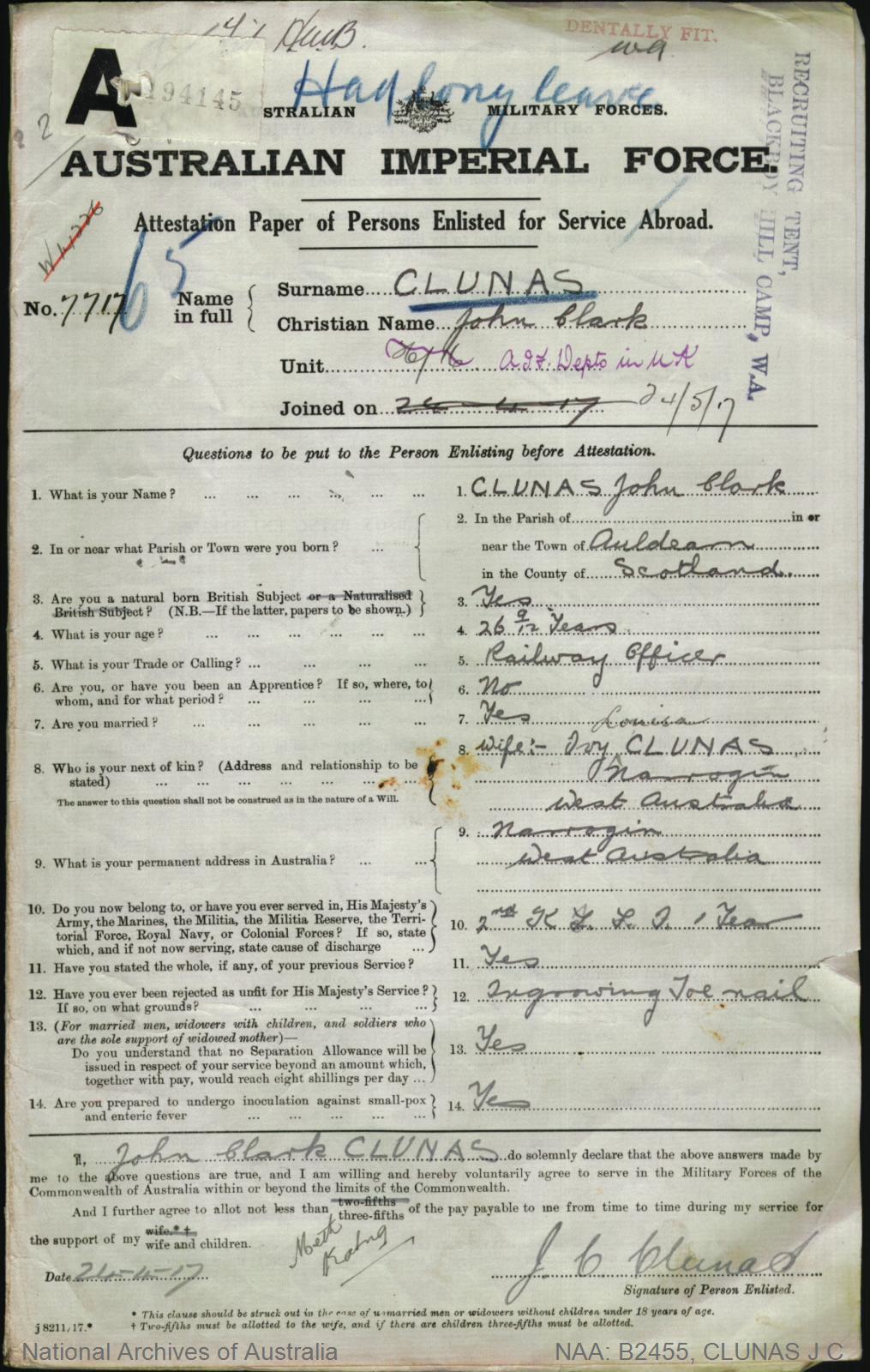
Jack Clunas was born on 8 July 1890 in the Scottish Highland village of Auldearn. The second of six children to Robert Clunas and Margaret Clark, he grew up and was schooled in Hodnet, England, where his father worked as a veterinary surgeon. In his teenage years Jack moved to central Shrewsbury and boarded with the Morris family while employed as a railway clerk.
In late 1911 Jack made the decision to emigrate to Western Australia, possibly lured by the promise of employment with Western Australian Government Railways who were actively recruiting from the United Kingdom at the time. In February of the following year, only a few weeks after disembarking at Fremantle Harbour, he commenced working for the railways as a clerk in the Wheatbelt town of Narrogin.
It’s likely Jack was turned on to football in England, so when a Narrogin club was formed in July 1912 he was quick to jump on board as player, secretary and treasurer. He featured in the town’s first organised game – an intra-club practice game – and represented Narrogin in both legs of a two-game friendly series against Katanning. The following year Jack captained Narrogin in a three-team regional league that featured neighbouring towns Cuballing and Toolibin. He wore the club’s black and white stripes when the league expanded to six teams in 1914, alternating between midfield and defence.
Unfortunately, the outbreak of war in Europe halted the progress of the fledgling competition. In December 1914 Jack married Ivy Ewings and eighteen months later the happy couple welcomed the arrival of their first child, Robert. Three additional children would be born after the war.
Jack travelled to Perth in September 1916 to enlist in the Australian Imperial Force only to be turned away due to an ingrown toenail. Jack successfully enlisted as a Private with the 16th Battalion in April 1917. After training at Blackboy Hill in Perth’s foothills and England’s Salisbury Plain, he joined his battalion early in 1918 on the Western Front where they were engaged in halting the German Spring offensive.
At the start of August Jack suffered a shell wound to the head while fighting near Amiens, resulting in his evacuation to England. Admitted to Fort Pitt Hospital in Chatham, it wasn’t until December that Jack was discharged and transferred to the Headquarters AIF Depots in Tidworth. His time here was mixed and a period in hospital with influenza, forfeiture of two days pay after failing to appear at parade and promotion to Extra Regimental Corporal prior to his return to Australia in July 1919.
Jack resumed working for the railways in Albany before being transferred back to Narrogin in early 1921. The following year he was elected to the Narrogin Municipal Council, where he remained through to 1935 by which time he’d risen to Deputy Mayor. He also served the local Caledonian Society, Citizens Welfare Association and Returned and Services League. On the football front, Jack was instrumental in reviving the game in Narrogin. He organised for metropolitan league giants Claremont to visit the town in for an exhibition game in May 1920 and two months later captained the WA Country XI against the HMAS Sydney at Claremont Oval. Jack would play for Narrogin through to 1925, serving periods as club captain and secretary.
World War 2 took a heavy toll on the Clunas household. Eldest son Robert was killed in February 1941 after his ship was torpedoed by a German U-boat while serving south-east of Iceland. And in January 1944 second-born Eric was one of seven crew killed when their plane was shot down by a night fighter on the outskirts of Dannigkow, Germany.
Jack remained an employee of Western Australian Government Railways through to 1955. Along the way he worked in Perth and Geraldton before retiring as Chief Clerk with the Chief Traffic Manager’s Office. The Clunases were only a few months shy of 60 years of marriage when Ivy passed away in March 1974 while living in Maylands.
John Clunas was 84 when he passed away on 10 July 1974, only four months after his wife’s passing.