
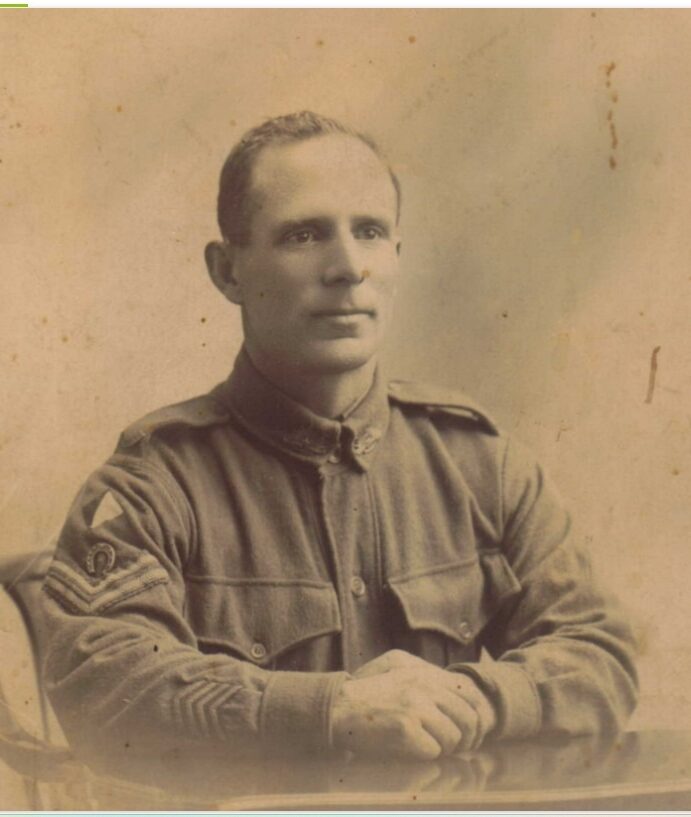
Robert Anderson was a prolific letter writer from the front. The Guardian published no fewer than six of his writings, the majority of which were received by Mr J. G. Scott, hon. secretary of the Geraldton British Football Association.
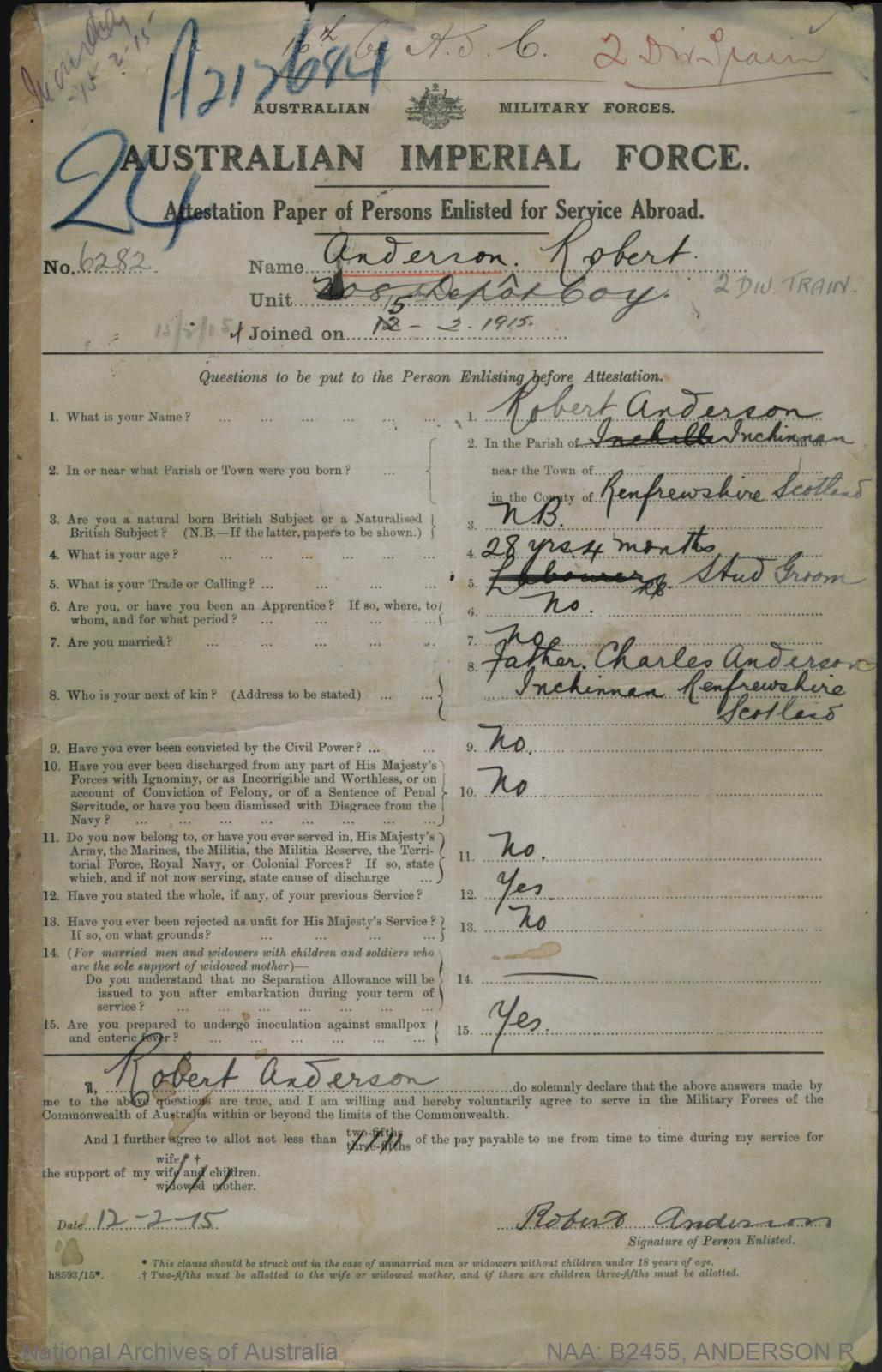
Bob was born in the Scottish village of Inchinnan, not far outside Glasgow, on 8 August 1886. One of seven children to Charles Anderson and Catherine Smith, his working life began as a cattleman and progressed to a groom (stable hand) before emigrating to Western Australia in his mid-20s. Bob chose Moonyoonooka on the eastern fringe of Geraldton, in the Mid-West region, to be his new home.
Here he played cricket and captained the Moonyconooka football team in a trio of friendlies against teams from the Geraldton association in 1914. That culminated in Moonyconooka qualifying for the final of September’s Hansen Cup, which was won 2-0 by Thistle.
In February 1915 Bob enlisted with the logistics-focused Australian Army Service Corps as a shoeing smith, or farrier. By mid-year he’d arrived in Egypt and on 21 August the Geraldton Guardian featured his first letter, written from the AIF training base Heliopolis:
I have been extra busy (not with work) looking at all the sights, frights and other things along the track. I have had a great time since I left the West. In fact you would not think we were soldiers. We were more like tourists the way we travelled round. I had a lovely time during my month at Broadmeadows. I am now amongst the sands and deserts of historic Egypt, I haven’t had time to travel over much of the historical place, but we are planning a day with a guide. We landed at Suez a fortnight ago, and travelled by train to the camp. I was greatly impressed by what I saw on my way up here, I had no idea Egypt was such a pretty place, and the way the Government has provided the people with a way of getting a livelihood is beyond all praises. They have a fresh water canal which runs for something about two hundred miles, and irrigates an area of about a mile or more on either side. I don’t know what the crops consist of but I saw a lot of tobacco growing along the line. I can tell you it was good for the eyesight, after being on the briny for nearly five weeks, I haven’t all the salt water washed off my hide yet. The natives have all the old-fashioned style of working, ploughing with oxen, and so on. I’m out of training now, and too soft for running about, but I’ll come again like the roses in June. I hope you have a good season, and that the boys will rally round the soccer banner. I feel quite confident of getting back to W.A. We will be some time in getting to the scene of action. However, I’m enjoying this life immense, not much work and plenty of time to do it, and the way we are getting treated is excellent. We have natives to do most of our fatigue work. For my part, I have not done any manual labour since I came here, and if this is soldiering it will always do me. I was looking after the sick horses coming over on the boat. We had four died on the way. One company had 150 died, so we were rather lucky. Give all the soccerites my kindest regards, and best wishes for their success.
A second letter, this one addressed to Dave Mitchell and dated 13 August, was published on 18 September.
I have been in Egypt about seven weeks now and am very much taken of—people here are making small fortunes out of the boys from Australia. You know how they do in every penny they get; they do the same thing here, so the people benefit by it. The houses are all built in the Oriental style, and some of them are very artistic. The car service between here and Cairo is the most up-to-date that I’ve seen anywhere and is run on the electric railway system. They can either run trains or cars, and the way things are conducted is very good. I’ve explored most of the funny corners of Cairo, some very nice, and some the dirtiest that it has been my lot to see. The natives are filthier than the aboriginals, so you have an idea what they are like. A party of us went out sightseeing. We left at six in the morning and got back at about nine at night. We visited the Pyramids, the Sphinx, and two or three of the most noted tombs. I enjoyed the day’s outing immensely. Nobody has any idea what marvels are to be seen in Egypt until they have been among them. They must have been a very energetic race of people in ancient days. How they got these places fixed up is beyond conception. One tomb we visited had twenty-four vaults. The slabs of marble used for coffins will weigh anything up to ten tons. How they got them into position nobody knows. I cannot explain them as I would like, but believe me Dave, they are worth looking at. I think nearly all the soldiers who come here have visited these places. The donkey and raffle men do well out of them. They charge anybody who does not know the fares about double. I have been through a lot of the irrigation areas and I think they can grow anything. If some of the Australian cockies saw the land they would go balmy. They grow a lot of maize. Some of it grows nine or ten feet high. We get a lot of it as green feed for the horses, and they are first-rate job in this lot, and I’m never too hard pushed. I’m supposed to do my bit at the shoeing, but the farriers have all the sick horses to look after, so it takes me nearly all the forenoon to get them fixed up. I rather like being amongst the horses, as this marching in the infantry is a bit too solid. I only wish they would send us away to the front, but I hear we are to go soon.” And in a postscript dated 15 August – “Jack Campbell came down yesterday along with a chap who used to be in Crooks and Brooker at Geraldton. We went down and had a look at the Obelisk, the Virgin’s Wheel and Mary’s Church. This is at the spot where Mary rested when fleeing from Egypt. The old tree under which she is said to have sat is still growing, but getting the worse for wear. They had tea with me, and then we strolled round the camp. I can tell you it’s nice to meet old acquaintances, and there are men here I never expected to see.
Bob’s next letter appeared on 7 March 1916, written again from Heliopolis under the date 12 January:
I am still in the land of ‘Moses’ and the other names that it has been christened since the arrival of the Australian Army. Of course these names are not fit to be published, so you will have an idea what they are like. I am still in the same old camp. In fact, when we shift we don’t go above three or four miles. However, we might be in a worse place. Duncan McColl and Bill Murray have both left for some place unknown, but I will know once they are settled down in their new quarters. I had a letter from Harry Willsden, Moonyoonooka, letting me know he had joined. I hope to see him some of these days. The camp here isn’t a bad old place once you get into the run of things. We have plenty of football (soccer). We have formed a team out of this company, but it’s the same old story — only about half of us know the game. We have had three matches and haven’t been beaten — two wins and a draw. Duncan got a team out of the 11th. He also got the old Queens Park centre (Swan) to play for them. He didn’t play himself, but he had a better football team than ours. However, it is not always the best team that wins, and they were very lucky to get a draw. They only scored in the last five minutes. Our goalkeeper thought the ball was going past, but it struck the post and went through. I was playing back and had plenty to do. I stopped Swan a few times. No doubt he is a good player and a dandy shot, but I think he is a bit rough. We will be playing next Saturday, so we may get knocked. I’m captain of this lot, and it’s not too easy a job, as sometimes the best men either go to town (Cairo) or are out on duty. News is scarce, and a man can’t say too much, as all letters are censored now. I met McPhie. He came over a week or ten days ago. I hope this finds all of you Geraldton boys in the pink. Give one and all my kindest regards. I’m afraid I won’t be back in time for the football this season, so ‘au revoir.'” In March, Bob was promoted to Farrier Corporal, something he snuck into the closing words of his letter dated 25 April from “somewhere in France” and published on 27 June – “No doubt you will have heard prior to this that a lot of the Australian Army have landed in sunny France. Well, up to a couple of days ago we did not see much sun, as it has rained every day more or less, and we were swimming in mud up to our knees. However, the weather has taken a turn for the better. We were about six days on the railway trip and it was not too comfortable, sleeping under the wagons. In fact I don’t think any of us got right warm until we arrived at this camp. Things were not too pleasant our first night or two, but we have everything fixed up now, and it is all right. There is plenty of company in these barns between rats and other bodily companions, so we have not much chance to be lonesome. It is not too nice to be wakened up in the night with half a dozen rats trying their paces over your head. We don’t mind the rats so much as the others. They stick to you closer than a brother, and it’s not your ear they bite either. However, we are all quite satisfied to be near the scene of action, and can put up with all these little matters. We do see a bit of life and the guns keep booming day and night. We see some fine aeroplane duels, but it is very seldom they get hit. Of course some of them are unlucky and come down pretty solid, especially when they fall from a height of five or six thousand feet (I’m sure it must hurt). You have heard about larks getting up in the morning, but the aeroplanes are up before them. I have not seen any of the other lads since I got here, and I can’t get away during the day to look for them. I saw B. Murray before I left Ismaila. I think we will all get a trip home to the Old Country, because they are giving leave to one or two men every week. We draw for our turns, but I have been unlucky so far. My younger brother got a bit of a knock and is home wounded, but I don’t think it is anything serious. I have been promoted to Farrier Corporal since I wrote you last. I am not playing any football now, so will be out of form soon.
William Anderson, Bob’s younger brother by four years, was killed on a Belgium battlefield while serving as a Gunner in the British Army’s Royal Field Artillery in March 1917. Three months later Bob was admitted to the 6th General Hospital in Rouen, France, where he spent three weeks being treated for piles. Bob enjoyed a brief respite from the war by taking leave in England. On returning to France, he sat down on 18 September 1917 to pen a letter home which was published in the newspaper on 29 November:
Here we are, still alive, kicking, and as per usual going strong. I got your latest letter, but was just on the point of leaving for that dear old place called ‘Blighty,’ and hadn’t time to reply, excitement being too great. This is my second leave since I lobbed in this so-called sunny France, and believe me, it is very acceptable, and I’d willingly go every month if the powers that reign supreme would ordain it too. I was glad to get home this time, as the poor old father and mother are on their own now, all of us who were single joined the army, three in all. Two of us are still doing well, but one has gone under. He is buried down the line at a spot near Anas. I had the satisfaction of visiting his grave. Father and mother are bearing up extremely well, but it must be a great strain on them. In fact, I think the people at home worry too much about the war. If the boys were to do the same thing, well, life wouldn’t be worth living. As it is, you couldn’t find a more happy-go-lucky lot anywhere. It’s a case of being happy while you can—there’s no time like the present. I can’t understand how any young fellow, single and fit, can keep away from this life. It is an experience that anyone who is lucky to get through will never forget. Of course there’s always an off-chance of one being unlucky. However, we have only once to go under, and a death-time always comes sooner or later, and believe me, it’s a game worth playing. If by chance we were to lose the game, where would all our old traditions go—under the heel of uncivilisation But we have no intention of losing, and only too well old Kaiser Bill knows it. I haven’t seen any of the old mob lately, as we are a bit scattered. There’s always one or two dropping out, but that’s all in the game. I heard the other day that Jimmy Wilson was back with the Battalion again, so I may have the pleasure of meeting him soon. We have had a lovely spell lately, sports and everything imaginable, but we are back to the scene of action again. I was playing football regularly for two months, for one of the battalion teams. We played ten games, won six, and had four draws. Nothing could stop us, and we met some good English teams. However, we were picked out of the Second Division, so you’ve an idea what sort of talent we had. We are now up again, and will be lucky if we get a kick at a ball for some time. Sorry to hear the game had died down in Geraldton, but just wait until this is finished and we will get it going again. I can’t tell you anything about the war, you see quite enough in the papers, but perhaps someday I’ll be able to whisper in your ear some of the things that happen out here.
Bob’s final letter appeared on 4 February 1919, written from France on December 9, a month after the war had ended.
I saw W. Murray and Jack Douglas about six weeks back, they were both doing well. Bill was just going on Blighty leave. He has been awarded the D.C.M., so that makes him D.C.M. and M.M. We who know him personally can fully realise that he has well earned these honours. In fact, by what I’ve heard, he didn’t get enough, as he did some good work during the last operations on the Somme. Bill won’t tell you much of what he was up against, but I got all the information from one of the men who was with him. They reckon that he knows no fear, and has a heart like a lion. Nobody is more pleased than I to see him come through the whole affair scatheless. Poor old Duncan has had a very rough spin. The last time I saw him was up near Ypres last year. He was going on leave then. The next news I had of him was from Murray telling me that Duncan had been wounded, but he did not think it was serious. However, it has turned out to be worse than any of us expected. I saw Jack Dick a few times during this last stunt. He was looking and feeling in the best of health. I am still feeling in the pink, and as proud as a dog with two tails about the war being finished. The finish came very quick. We could hardly realise the truth of it. However, as soon as we were certain we had a night out, not too bad, just enough cargo to sail easy. We soon settled down, however, and all we look forward to now is for the boat to take us home. The sooner it sails, the better I’ll be pleased. The A.I.F. have started an educational scheme in which any man who wishes to specialise in any particular branch of trade or profession can have training, either in France or in England. This is no doubt a good scheme, especially for any young fellow who hadn’t quite finished his apprenticeship, as it will help to brush up his memory, and will be interesting as well as instructional. Needless to say, I am not putting in for anything. All I want is to get out of these clothes. I’ve had nearly four years of being a soldier, and am quite satisfied if I remain another twenty years I wouldn’t make a soldier then. As you know, I don’t specialise in any particular trade, and can adapt myself to anything, bar pen pushing. As it is, we who left in 1915 have a good chance of getting back on this furlough stunt. Most of the men who left in January and February have gone, so we ought to be going soon. We left the West in April, 1915. It seems much longer than four years since we sailed out of Fremantle. I might be home in time for Easter, if not, shortly after. I have not had a game of football since last July. The last game I played was for the 2nd Division team against the Frenchmen. When the push started in August we had no opportunity of carrying on the game. We have not enough players in this company to start a team so I don’t bother too much about it. I’ve played for a good many teams since I left Australia. I could always get a game, but by playing for another team in the competitions I was going against the rules, so I decided to leave the business alone, but I’ve nearly cried on several occasions while watching some of these teams. A lot of them couldn’t kick doors. As you say, we will have to do our best to get the good old game going again when the boys come home. We are now camped at a village called Boulonge (not the seaport). It is out on the never-never, and has been a fairly prosperous place in pre-war days, but all this country has been in the hands of the Huns for the last four years so one can’t expect to find things a bed of roses where those men have been for that length of time. This district puts one in mind of Blighty. All the farms are divided into small paddocks from about one to twelve acres each. I think dairying has been the main industry prior to the war. However, old Fritz took away all the cattle long ago, and all he left in each place was a donkey, so as far as work goes there’s nothing doing. This part of France is far superior to anywhere I’ve been in the country, more up to date, and the people seem to be better off financially. Most of the farms in the Somme district, and also on the Armentieres and Ypres fronts were built anyhow, but around this district they are good substantial buildings. In fact, in my opinion, the war came as a blessing, as a lot of the places that were destroyed on the Somme were ready to fall at any minute, but I am quite sure the owners of the place didn’t think so. It really was a pity to see towns like Albert getting levelled to the ground. That town wasn’t too badly knocked about when we left here in 1917, but now there’s not a brick left in position. Amiens got pretty well knocked in some places, and it will take some time to build it up again. But of all the towns that were destroyed, Ypres was easily the worst. The way that town was wrecked is beyond explanation.
When the AIF put forward an offer for servicemen to gain experience on Britain’s stud farms, there was no holding Bob back. In April he accepted a position at Craigie Mains near Kilmarnock, Scotland, where he spent four months learning to care for and handle Clydesdales under the tutelage of renowned horse breeder James Kilpatrick.
In September, Bob returned to Australia. He married Catherine O’Reilly in Perth in mid-1921. By the time the first of their five children were born in 1923 they had moved to Bridgetown, in the south west of the state. A short time after and the family were again on the move, this time to Manjimup where Bob established himself as a veterinary farrier and owned several trotters. Bob’s eldest two son’s, William and Robert, served in World War 2 with the Australian Military Forces.
Robert Anderson was 78 years of age when he passed away in Manjimup on 16 June, 1965.