
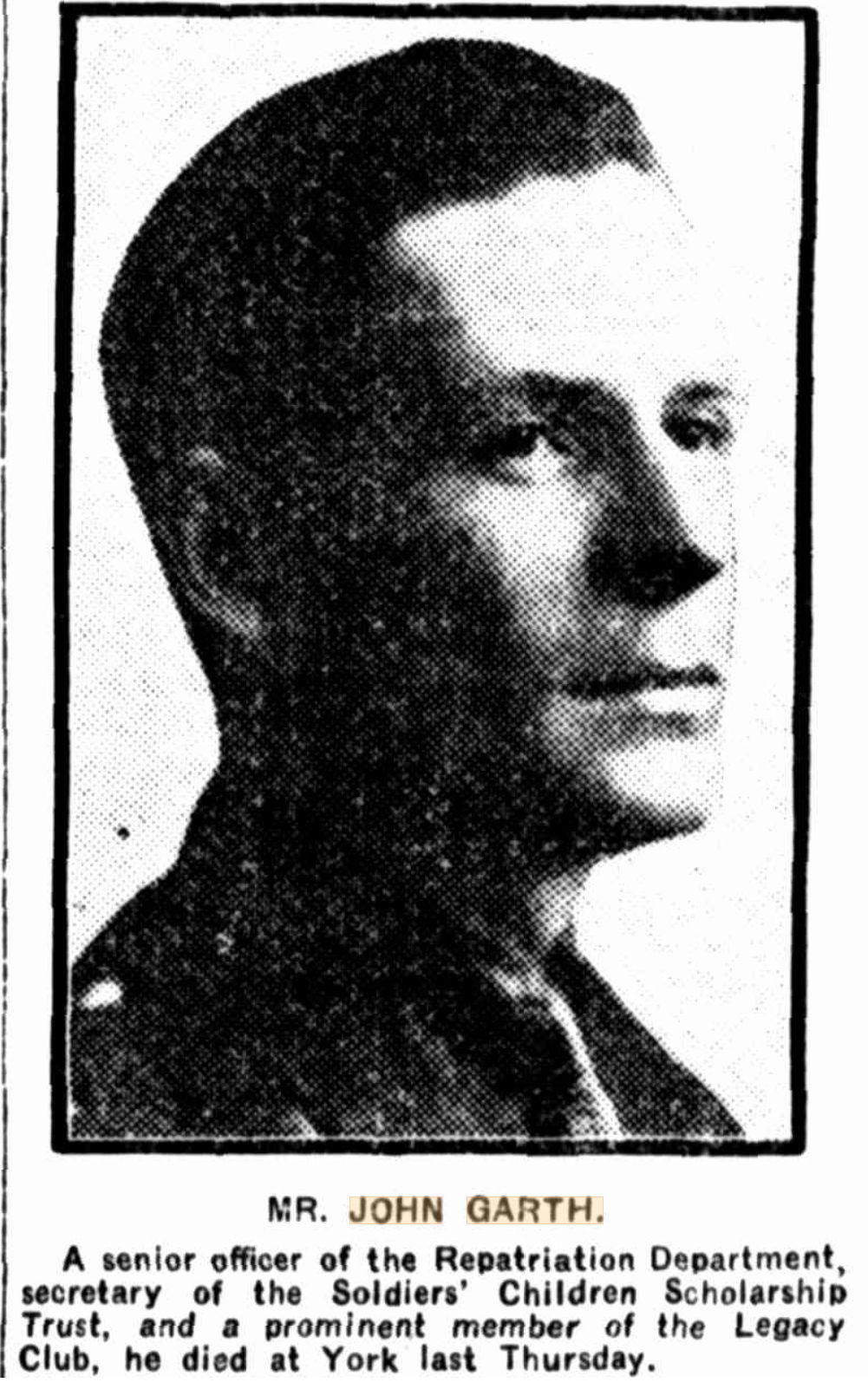
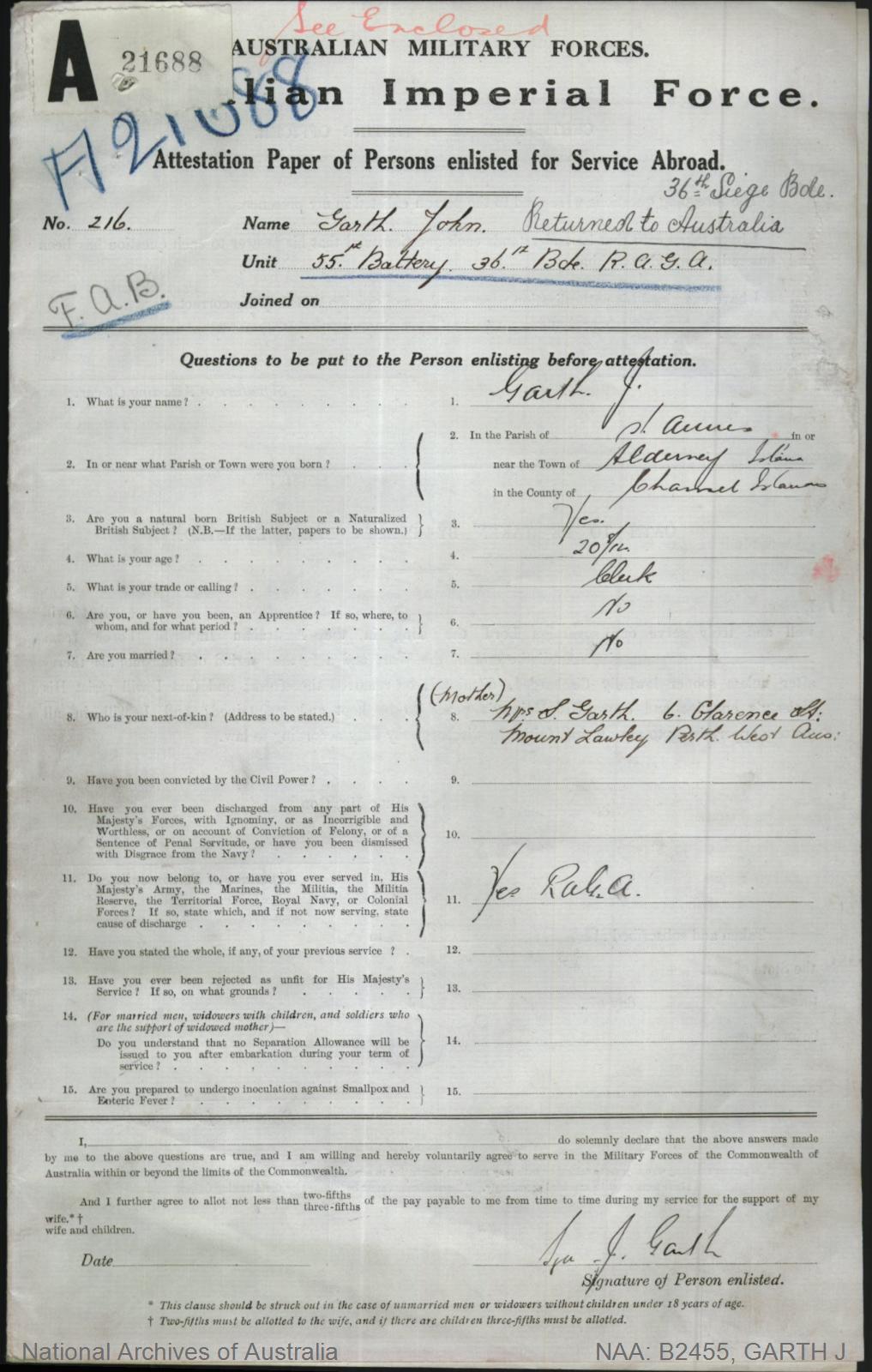
John Garth was born on 20 October 1894 on the Channel Island of Alderney. The eldest of five children to Thomas Garth and Sarah Martin, his father served twenty-one years with the Royal Fusiliers and, consequently, the family moved around a lot with stints in India, Gibraltar, Malta, Egypt, Sudan and England. When Thomas left the army the family migrated to Western Australia, arriving in Fremantle in November 1911. Jack initially worked as a clerk before joining the 36th Royal Australian Garrison Artillery in 1913.
The following year he played football for RAGA, who competed in the First Junior league but disbanded in August following Australia’s entry into the war. The artillerymen were not given permission to serve abroad until 1 June, 1915, when Jack and ten of his RAGA teammates enlisted in the Siege Artillery Brigade.
Following training in England, they arrived in France in March 1916 and soon after three of the gunners were killed and fourteen others, including Jack, were wounded at Mont St Eloy near Arras. He was evacuated to hospital in England where he remained through to mid-May before rejoining his unit. After four weeks back on the battlefront, Jack was hit by shrapnel in the head, back and left wrist. After initial assessment in France, he was sent back to England and admitted to the 3rd London General Hospital where he remained until the end of August, when he was invalided home to Australia.
On arriving in Fremantle he was admitted to No.8 Australian General Hospital and, being medically unfit for further service, was discharged in February 1917. While Jack was waiting for his release to come through, his father Thomas (28th Battalion) and brother Frank (16th Battalion) were both killed in action while serving in the Somme Valley, France. The family successfully petitioned the authorities for 19-year old Thomas to return to Australia on the grounds that he would need to support his mother and siblings at the family home on First Avenue in Mt Lawley.
Since returning to Australia Jack had become a frequent visitor to hospital, undergoing several operations as a result of his war wounds. In April 1919 he married Josephine Smith at St Alban’s Church in Highgate and soon after celebrated the arrival of their only child, a son who was also named John. They didn’t stray too far from family matriarch Sarah, living in Mt Lawley and Perth. After a period of home service with the Defence Department, Jack worked for the Repatriation Department as one of its original staff and devoted the majority of his time to the welfare of soldiers’ children.
For some time he was secretary of the Soldiers’ Children Scholarship Trust and at the time of his death was secretary of the Soldiers’ Children Education Scheme. Jack’s health never improved and he passed away while in the regional town of York on 22 August, 1929, after being taken ill with pneumonia. His loss was much lamented and the West Australian branch of the Returned and Services League published a fitting tribute in Listening Post:
John Garth’s work since the war, particularly in the interests of deceased soldiers’ children, is known to all returned men and to the public at large. His humanity, which was displayed officially in connection with his work in the Repatriation Department, and his outside activities, especially that with the Legacy Club, will make his loss a heartfelt one. His general kindness to sons of deceased soldiers and to the widows of the war, together with his lovable disposition, had made him a host of personal friends. Jack’s great sufferings as the result of his war service did not deter him in his humane work. Soldiers’ boys, soldiers’ widows, and soldiers, too, mourn his loss, and on their behalf we extend sincere sympathy to Mrs. Garth and her infant son. Jack Garth was a guardian and a friend to the orphaned children of the war.