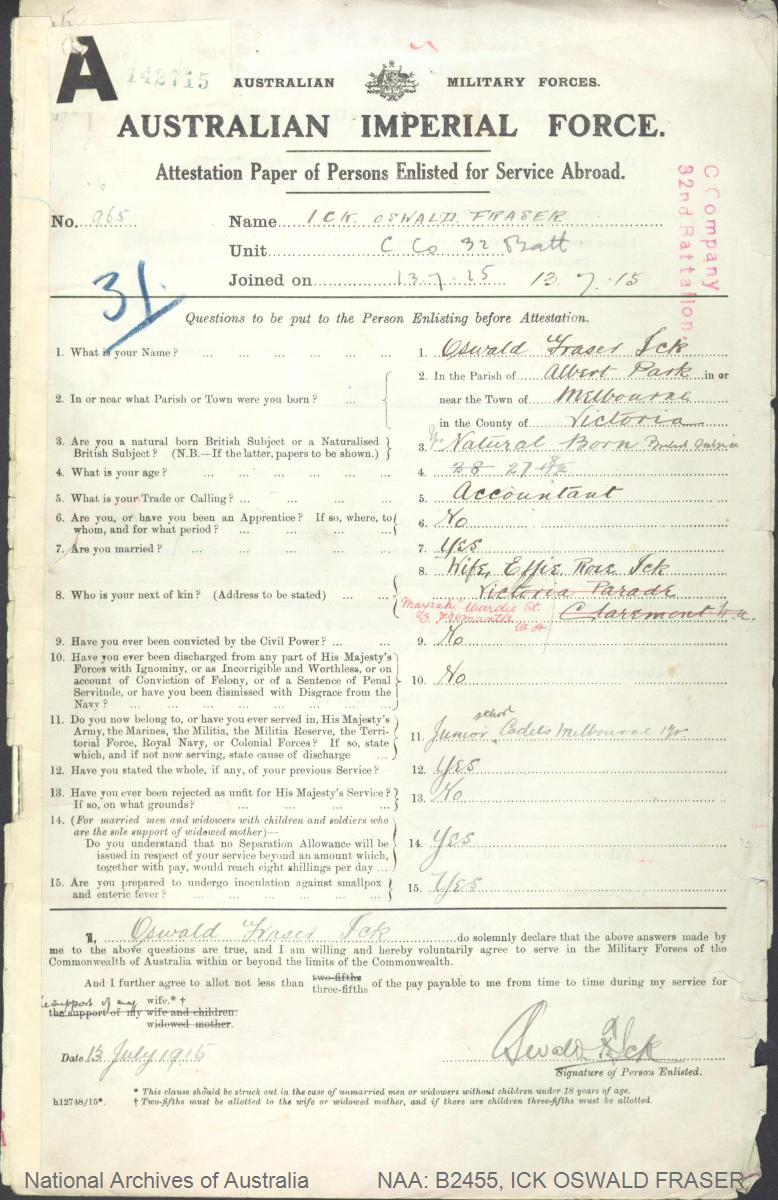
Oswald Ick was born into the large family of Thomas Ick and Gertrude Dawson in Albert Park, Melbourne, on 25 November 1887. His father had only a month earlier completed his medical studies at Melbourne University and, having chosen to give up life as a clergyman with the Presbyterian Church, worked as doctor in the Victorian goldfields city of Ballarat and Scottsdale in Tasmania.
In 1902 Thomas, Gertrude and their seven children journeyed across the country to Western Australia where, five years later, the patriarch of the family passed away. Oswald had by this time found work as a clerk in the Claremont area and in mid-June 1912 he married Fremantle-born Effie Allpike in her hometown. Shortly before tying the knot Oswald accepted an Assistant Town Clerk position in the Mid West coastal city of Geraldton.
The formation of the Geraldton British Football Association in July 1913 prompted Oswald to join the Civil Service club, who were declared joint league winners with Geraldton Town. He wore the clubs colours again the following season, when they played as Queens Park Rangers.
Oswald, a Junior Cadet as a Melbourne schoolboy, enlisted as a Lance Corporal with the 32nd Battalion in July 1915. Following the completion of training at Blackboy Hill, he arrived in Egypt early in 1916 and soon after transferred to the 16th Battalion and was promoted to Lance Sergeant following a reorganisation of the Australian Imperial Force. The 16th Battalion’s first deployment was to the Somme Valley in France where Oswald sustained shrapnel wounds to his right shoulder and back in July.
Following an initial assessment in the field, he was evacuated to England and admitted to the General Hospital in Tunbridge Wells where he remained for 37 days. On being released from hospital Oswald spent a period at the Musketry School of Instruction in Tidworth. It wasn’t until June 1917 that he rejoined his unit to fight in the successful battles at Menin Road Ridge and Polygon Wood in Belgium.
During this period he was promoted again, this time to Sergeant. Oswald was attending the Infantry School of Instruction at Boscheppe, Flanders, in January 1918 when his younger brother, Thomas, died of pneumonia while serving in France. In April Oswald was gassed and suffered gun shot wounds to his temple and left thigh, most likely while fighting at Villers-Bretonneux. He was again sent to England to recover and, although he returned to his unit, didn’t see further action.
Given the injuries he suffered in France and Belgium, it’s no surprise Oswald didn’t returned to football after arriving back in Fremantle in the middle of 1919. Instead he found work as an accountant and lived with his wife, Effie, in the Fremantle area before they moved to West Perth in the late 1930s.
Oswald Ick was 58 passed away on 27 March 1946 in Subiaco.