
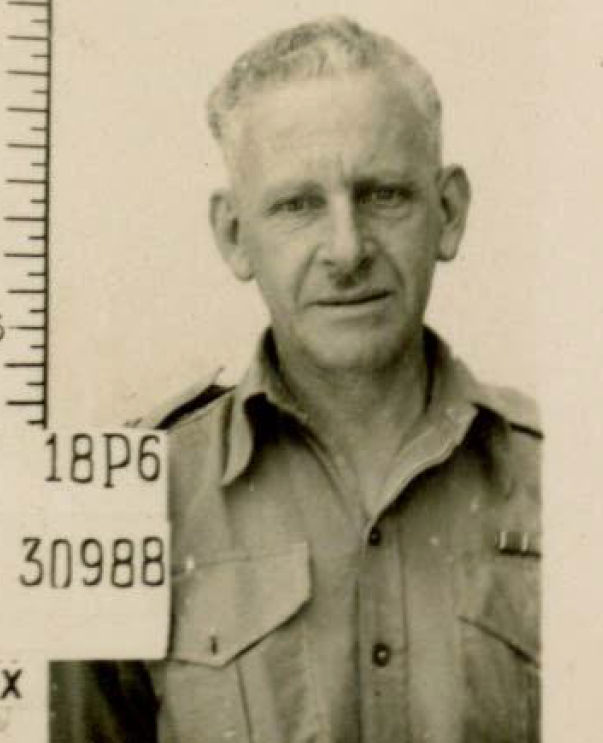
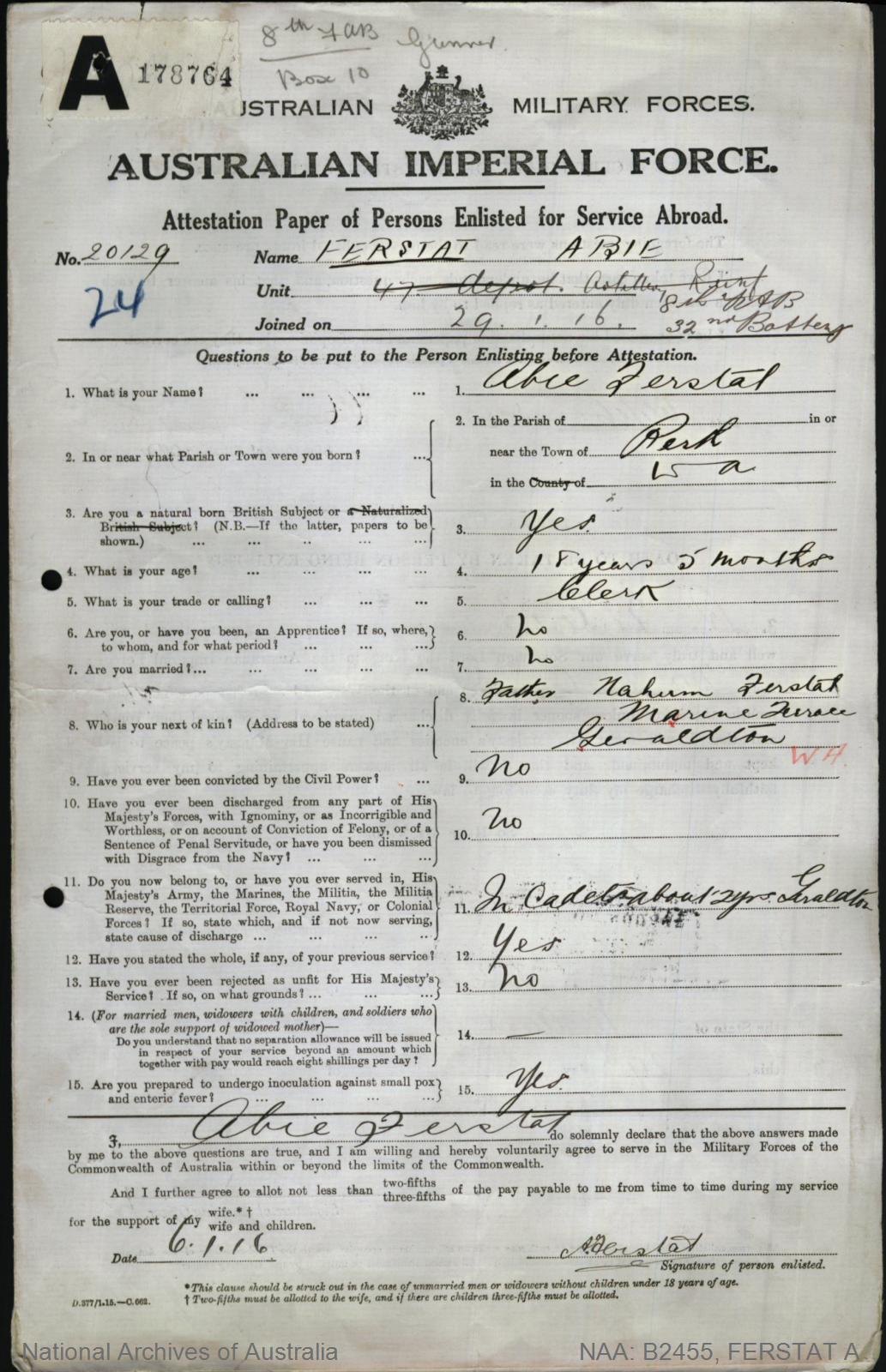
Abram Ferstat was born in Perth on 23 June 1898, the second of five children to Jewish migrants Nahum Ferstat and Gertrude Merport. Within a few years the family had moved north to the Mid-West coastal city of to Geraldton where Nahum became established as a well-known retailer of fruit, confectionary and soft drinks.
Not long after war broke out in Europe, Abbie’s older brother Aaron (or Archie, as he was better known) enlisted with the Australian Imperial Force. That prompted Nahum to pen a letter to the local newspapers –
It has been reported to me that some malignant persons are making statements in Geraldton to the effect that my son left Fremantle a couple of weeks ago for the purpose of going to Germany to join the German army. The facts are to the contrary. My son, who is only 18 years of age, is enlisting to go with the Geraldton contingent, and being under 19 years of age, has received my written consent to do so. Regarding myself, I have never been in Germany. I am a Russian by birth and have been a naturalised British subject for many years, whilst my four children are natives of Western Australia.
Abbie was just 16-years old when he made his debut in Geraldton Town’s 2-2 draw with Thistle in mid-May. Playing in midfield, he was joined at the club later in the season by his 14-year old brother Jacob, with the pair playing their part Town’s Hansen Cup final replay win over Thistle. The brothers were both selected in the Junior team that met the Association team in an end-of-season friendly.
In January 1916 Abie enlisted in the AIF, joining the 8th Field Artillery Brigade as a Gunner but transferring to Driver prior to his mid-year departure for Europe. He spent four months training at Lark Hill on Salisbury Plain, England, before proceeding to France. He was struck by a serious bout of influenza in February 1917 and swiftly returned to England, where he was hospitalised for the majority of the year. It was during that period that he learnt of the death of his father in October.
Abie rejoined his unit in the Somme Valley in November and, after a short stay in hospital with minor illness, reverted to the rank of Gunner. He would have been part of the Allies’ Hundred Days Offensive, the series of decisive attackers on the German defensive lines that ended the war.
In May 1919 he was treated for scabies in a French hospital before returning to Australia in July. It was not long after that Abie changed his preferred name to William and his religion to Church of England. In March 1922 he married Ellen Haigh in West Perth and nine months later the newly weds welcomed the arrival of a son, Norman, in Geraldton. The family expanded further in 1924 with the birth of a second son, Albert, following their move to North Perth.
William was now employed as a motor salesman. He enlisted with the Australian Army Service Corps in September 1940, serving in several Australian General Transport Company units and rising from the rank of Lieutenant to the rank of Captain. In October 1944 he changed his next of kin to Myrtle Stone of Potts Point, Sydney, to where he moved after leaving the military three months later.
Abram Ferstat was 50 years of age when he passed away on 22 September, 1948, in Sydney.