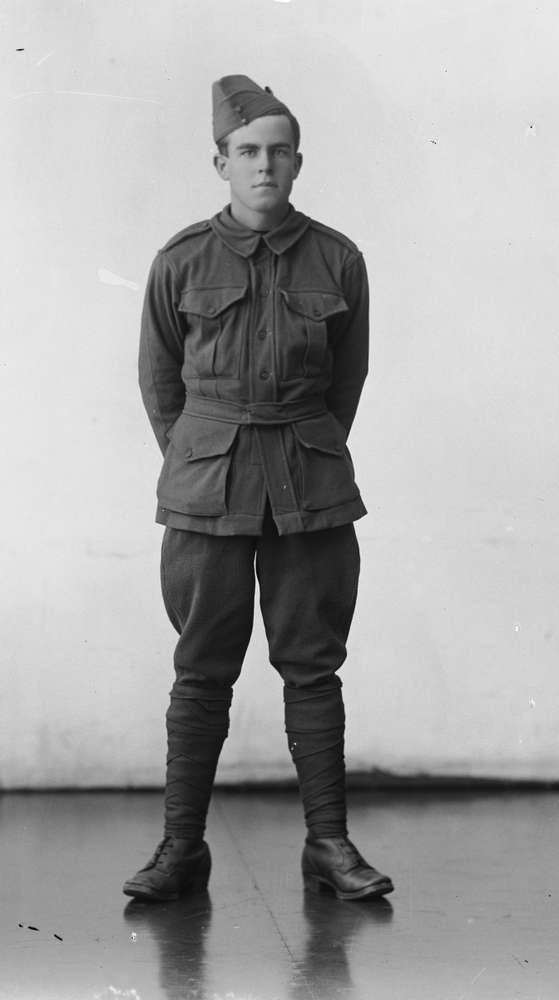
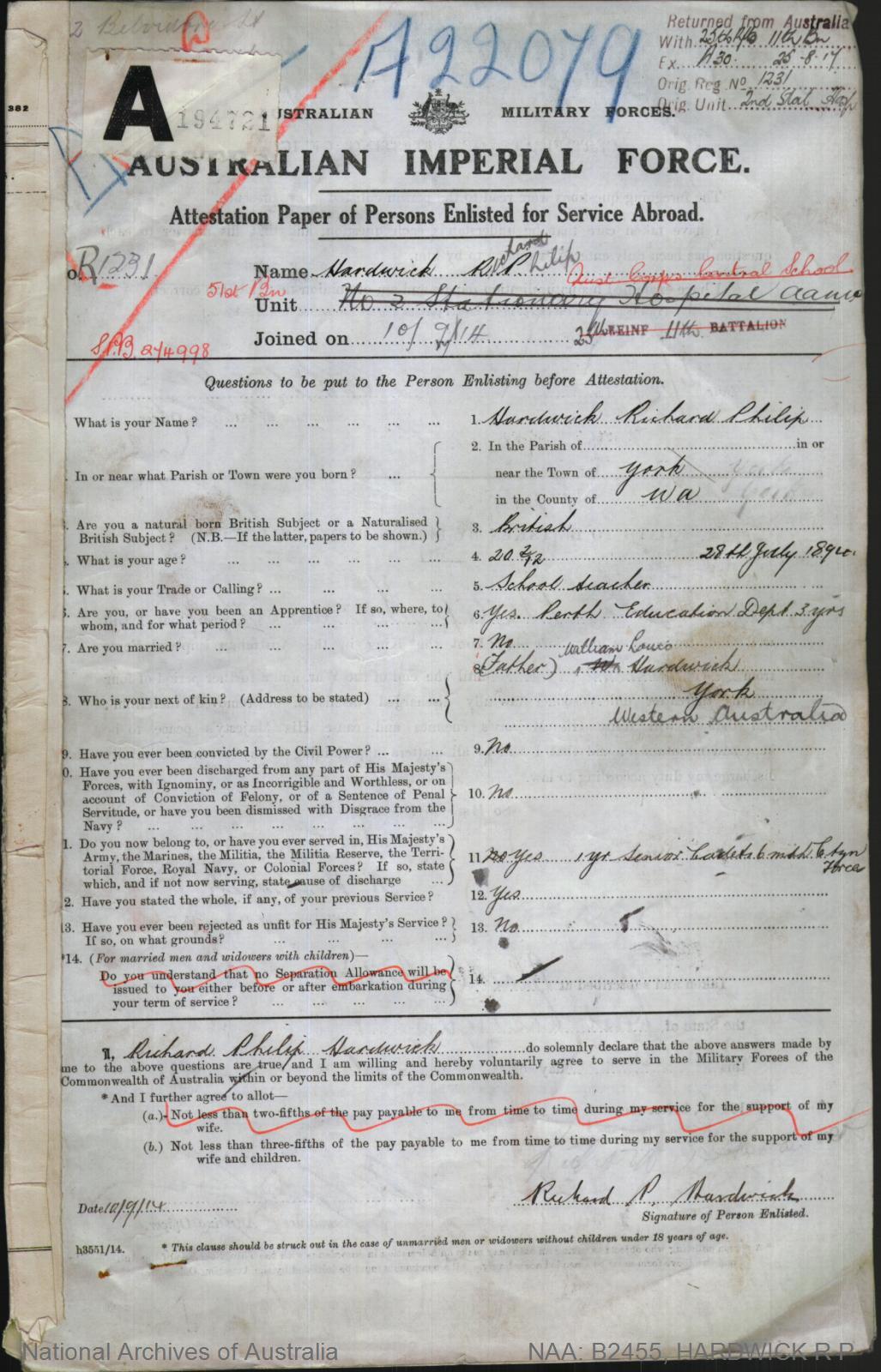
Richard Hardwick was born in the wheatbelt town of York on 28 July 1894, the fifth of nine children to William Hardwick and Minnie Cross. He attended York State School where he won a prize for Arithmetic. In late 1909 William moved the family to East Perth to establish a saddlery business with his brother, John, a future State parliamentarian.
Dick continued his studies with three-years at Claremont Teachers College, where trainees weekend activities included athletics, cricket and football. Dick threw his lot in with the latter, playing in the First Junior League for the Training College club across the 1912 and 1913 seasons. There is some suggestion he may have also played cricket.
Australia entered World War 1 in early August 1914 and the following month Dick enlisted with the 2nd Australian Stationary Hospital. He was assigned the rank of Private despite serving the previous six month in the Citizen Forces and having a years experience under his belt with the Senior Cadets.
By April 1915 Dick was serving on a hospital ship in the Aegean Sea, tending to wounded soldiers being ferried from Gallipoli to Alexandria, Egypt. He was struck down by dysentery four months later and admitted to Bethnal Green Military Hospital in London. On release, he spent further time recovering at the 5th Convalescent Depot in nearby Abbey Wood.
Dick rejoined his unit in Egypt in late February 1916 but mid-year had been “struck off strength” – deemed medically unfit for duty – and transported back to Perth, where he lived in West Subiaco. On returning to England in June 1917 he was made Lance Corporal before attending Non Commissioned Officer training at Candahar Barracks in Tidworth.
Dick joined the 51st Battalion who, on 24/25 April 1918, participated in the night assault at Villers-Bretonneux which resulted in the town being taken from the Germans. In June he was hospitalised for a time with a gun shot wound to the elbow sustained during the successful offensive around the French village of Sailly-le-Sec.
The 51st Battalion were resting out of line and training when the Armistice was declared in November 1918. Six months later Dick was attached to the Australian Corps Central School prior to his embarking for the journey back to Fremantle in July 1919. His discharge from the Australian Imperial Force came through late in the year.
In January 1926 Dick married Florence Gadd, with who he would have two children. by this time he had returned to teaching with spells at various metropolitan schools as well as those at the regional areas settlements of Tutunup and Arrino. Dick was Headmaster at three State primary schools prior to retirement in 1958, when he was Florence were living in Cloverdale.
Richard Hardwick was 85 years of age when he passed away in Perth on 3 May, 1980.