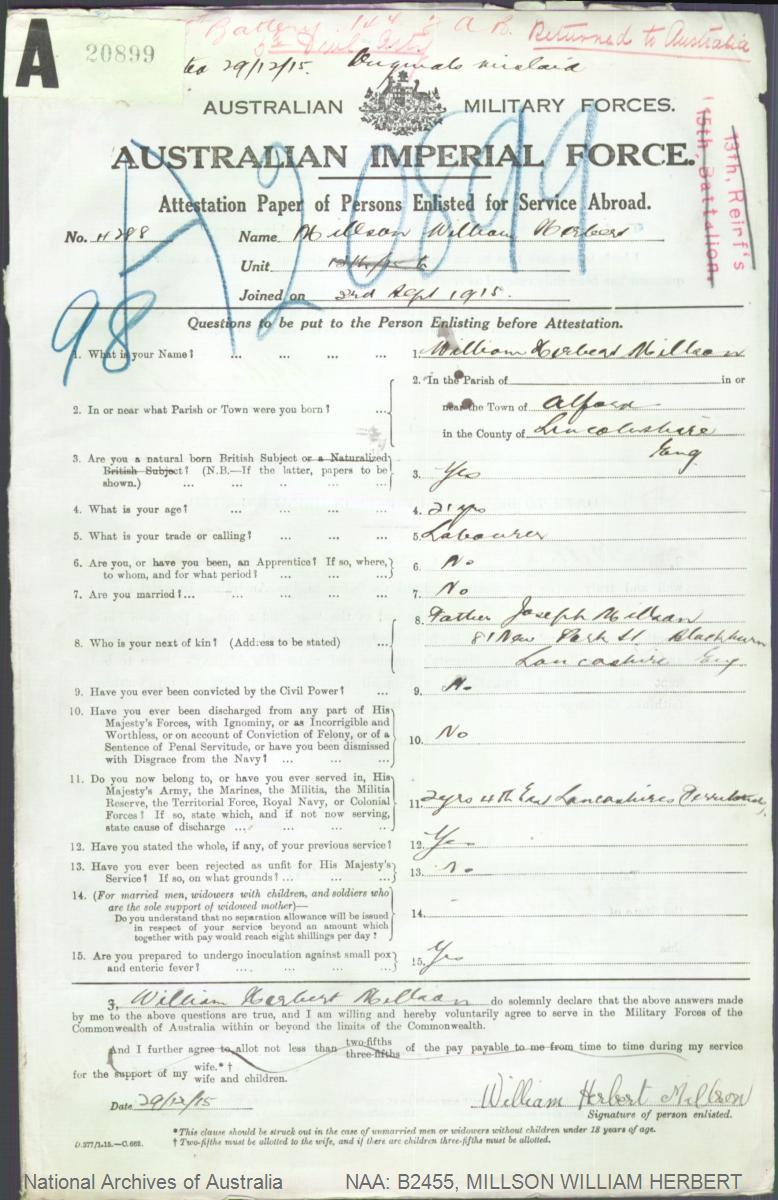
The story of any soldier, not least of all a Soccer Anzac, is the story of many people, and to tell the story, as much is known, can sometimes require telling the story of others. Thus is the story of William Millson, his wife Margaret, and her ex-husband John Rundle.
Millson played for Toowoomba’s Returned Soldier’s Club when it was formed in 1919. He appears not to have lived in Toowoomba before the war, explaining his absence on the Toowoomba British Football Association Honour Board. That he was living in Toowoomba in 1919 was due to a local war widow Margaret Rundle, nee Tetzlaff.
Millson was born in Alford, Lincolnshire and was still living in England as late as 1911 but his movements until his enlistment are unclear. He enlisted in early September 1915 at Thompson’s Paddock, which was part of the barracks at Enoggera, Brisbane. Margaret Tetzlaff – born Margaretha – was a Toowoomba local. Her surname was of East Slavic German origins, but it appears likely she was second generation Australian – her father’s birth details are unknown, but his slightly younger sister was born in Queensland.
James Rundle had been born in Victoria, and by the time of the war was a theatre agent. He also enlisted at Enoggera in September 1915, a fortnight after Millson. Rundle married Margaret on 1 October, and his attestation papers were quickly amended to change his next-of-kin from his mother to his new wife, whose address was given as Samford St, Enoggera. Margaret had given birth to a son in 1914, though no father is listed on the birth certificate. Some family history sites currently list Rundle as the father. The son retained the surname Tetzlaff into adulthood.
Millson was 20 in September 1915, Margaret was 18, and Rundle 31. It is unknown whether Millson knew the Rundles, but proximity at Enoggera allowed the possibility of this occurring and may explain how he married Margaret despite not living near her after his return. If they had not known each other before September 1915, any interaction would have been brief. illson arrived in Egypt in March 1916. Rundle did not leave Australia until April. Milllson, though, returned to Australia by the end of the year. Rundle would never return.
Millson was taken on strength in Egypt in early April 1916 and allocated to the 14th Field Artillery Brigade. By the end of the month was in hospital in Abbassia, Cairo with venereal disease. Here he stayed until late June but was back in hospital within a week. Here he was diagnosed with double hallus valgus – a deformity which causes the big toe to lean inwards against the next toe causing inflammation – as well as flat feet. This diagnosis saw Millson discharged to Australia in July. His military record stated, rather starkly, “In the opinion of the Board this man should not have been enlisted.”
Millson arrived back in Australia around late August. Rundle, meanwhile, was in France with the 25th Battalion. Margaret had not heard from Rundle since his departure. She wrote to the Australian forces on 1 November 1917 asking for his whereabouts as “his mother & myself are very anxious about him.” The response was dated 9 November, stating there was “no report of a casualty has been received in the case of your husband, No. 4758, Private James Rundle”, and giving his unit’s address.
Only 5 days later Rundle was dead. Wounded in action on 14 November he died of his wounds later the same day at the 6th Australian Field Ambulance. Rundle’s death was not correctly circulated. Instead, he was incorrectly reported as being wounded, leading to Margaret writing an urgent letter on 6 January 1917: “Kindly let me know at once if my husband has been wounded. Last week I noticed a name exactly the same as his in the Queensland wounded list. I am very anxious about him.” The Telegraph of 23 December 1916 shows Rundle’s name appearing on the Queensland wounded list. It took until 8 January before Rundle’s death was added to his military record via a memo received from the 6th Field Ambulance.
Base Records officially replied to Margaret on 26 June 1917 by which time she was already married to Millson. At the time of their marriage, Millson was living in Beerburrum on land he received from the Queensland Government as part of a solder resettlement scheme. He was recorded as using the land to grow fruit, which was typical of the scheme. This scheme, though, became a source of dispute. The Toowoomba Chronicle covered the dispute on 10 February 1917 and listing Millson as one of the aggrieved soldiers. The dispute with the Queensland Government regarded whether the soldiers should receive freehold, which the soldiers preferred, or a perpetual lease, which the Government wrongly claimed stated the soldiers preferred. The letter as published stated:
Dear Sir,—We, the undersigned, returned soldiers at the soldiers’ settlement at Beerburrum, strongly protest against Mr. Hunter’s statement in the House on Friday night, when he said that the returned soldiers were quite satisfied with perpetual leasehold. We have never been consulted whether we preferred freehold or leasehold. The majority of us here would prefer freehold, and we would be much obliged if you would bring this matter forward. At present there are 21 men up here. Thanking you and also your fellow members who have fought for our interests in the House.
Millson married Margaret in April 1917. It is unsure how they reconnected or met. While Millson had been in Beerburrum, Margaret had been living in her hometown of Toowoomba since Rundle left for war. Millson was still as living in Beerburrum in July 1917, as the dispute rumbled on. By 1919 the family were living in Toowoomba. Millson gave his address as Phillip St in the suburb of Willowburn in an advertisement in the Toowoomba Chronicle on 1 October 1919. Earlier the same year, he was also seen in the newspapers playing for Returned Soldiers soccer club. Rundle’s military record showed Margaret and Millson later moved across town to Ranfurly Street in the suburb of Newtown.
By 1923 they were living in Goodna, where Millson was arrested for theft from his work. Asylum Warder at the Goodna Hospital, he was charged with stealing sheets and clothing. He pleaded guilty and was given a good behaviour bond. The Police Gazette referencing the case describes Millson as having “Australian Coat-of-Arms tattooed on right forearm; four vaccination-marks left upper arm; two kangaroos, and ‘1916 Egypt’ tattooed on left forearm”, among various scars.
By 1925 the Millsons were living in Sandgate, Brisbane, and they would continue to live in Brisbane’s northern suburbs until his death. His funeral plaque – erected at the Mt Thompson Memorial Gardens shows after he died in August 1960, aged 66 – shows the Australian Imperial Force crest and giving his rank as Gunner. According to the 1968 electoral rolls Margaret lived in Zillmere, after which she disappears from the record.
The combined stories of Tetzlaff, Millson and Rundle touch on the complexity of war years, from the realities of unwed mothers and widows in the era, the deficiencies of record keeping in conflict, to the experience of returned soldiers from housing disputes to how they self-organised under sport. These stories remain incomplete, but they hint at the difficulties of life and death in the era.