
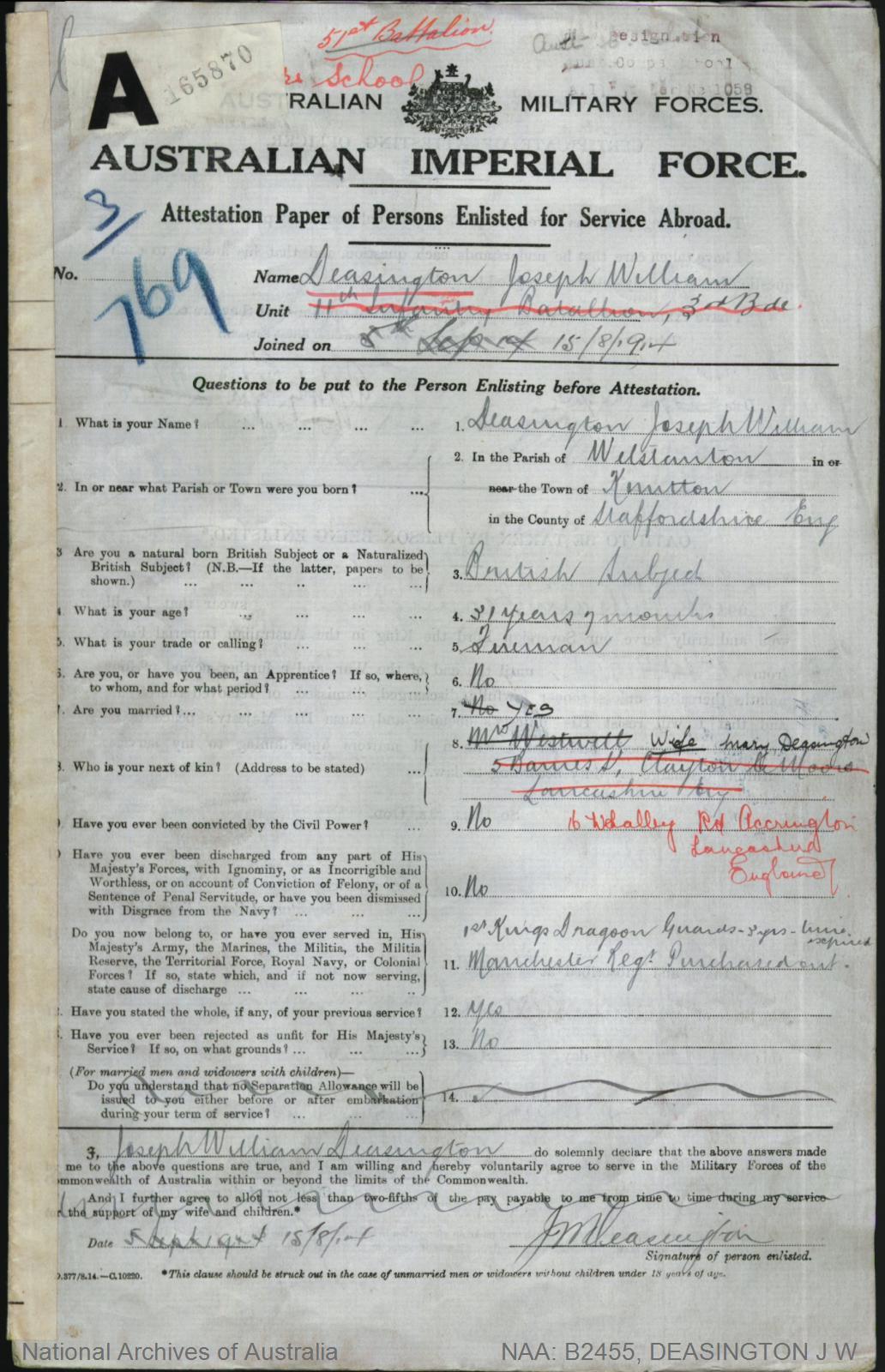
Born in Wolstanton, England, in about 1883, Joseph Deasington arrived in Australia in August 1911, disembarking at Adelaide, South Australia. Prior to emigrating he served eight years as a horse cavalryman in the 1st Kings Dragoon Guards and spent time with the Manchester Regiment as a line infantryman.
By 1913 Joe found himself in Geraldton, a coastal city in the Mid West of Western Australia, working as a fireman. That same year he wore the red shirt and white knickers of Geraldton Town, playing in midfield and occasionally captaining the team in the inaugural season of the Geraldton British Football Association.
Joe enlisted as a Private in the 16th Battalion of the Australian Imperial Forces within a few days of the nation entering the war. And two days after enlisting, he was part of the first contingent from Geraldton to travel to Perth alongside fellow footballers William Allen and John Hithersay, both of the Queens Park club.
32-year old Joe would have been amongst the first ashore when the AIF landed at Gallipoli in the early morning of 25 April, 1915, by which time he’d been promoted to Lance Corporal. Four weeks later he promoted again, to Sergeant. The unsanitary conditions at Gallipoli lead to Joe being hospitalised in August with dysentery.
In a letter home published in the Geraldton Guardian in October, Joe made clear his thoughts on those who hadn’t joined the war effort:
I often wonder whether some of the slackers will ever begin to realise the seriousness of the situation. They ought to send them here and let them see some of the sights I have seen. It might be the means of wakening a spark of manhood in some of them. I should be sorry after this war to be one of those who have not been in it. It will be decidedly uncomfortable for some people then.
In March 1916 Joe was transferred to 51st Battalion and promoted to Company Sergeant Major. After a short period in France he was again admitted to hospital, his service record noting he was “Dangerously ill” with pneumonia and pleurisy. To recuperate, Joe was transferred to Birmingham, England, where he spent four weeks.
The 51st Battalion were engaged in the final stages of the Battle of the Somme when Joe returned to France. He was hospitalised for a third time in November and soon after was demoted to Sergeant after pleaded guilty to being drunk when on active service. Joe was also charged with “disobeying in such a manner as to show wilful defiance of Authority to a lawful command given personally by his superior officer” but found not guilty.
Joe served in Belgium and participated in the battles of Messines and Polygon Wood as part of the AIF’s advance on the Hindenburg Line during 1917. In January of the following year he was appointed to the position of Instructor with the Australian Corp School, an AIF training facility in France which delivered courses on infantry, weaponry and other military skills.
In early November 1918, just over a week before the Armistice, Joe was granted 75 days leave with pay. He seemingly returned to England to be re-united with is wife Mary, who had not seen since departing for Australia seven years earlier. The couple disembarked at Fremantle in mid-1919 and before the year was out Joe returned to working as a fireman, this time in Kalgoorlie.
It is not known when Joseph Deasington passed away.