
The man missed the train for Melbourne at Brisbane & was discharged by Commandant, 1st Military District.
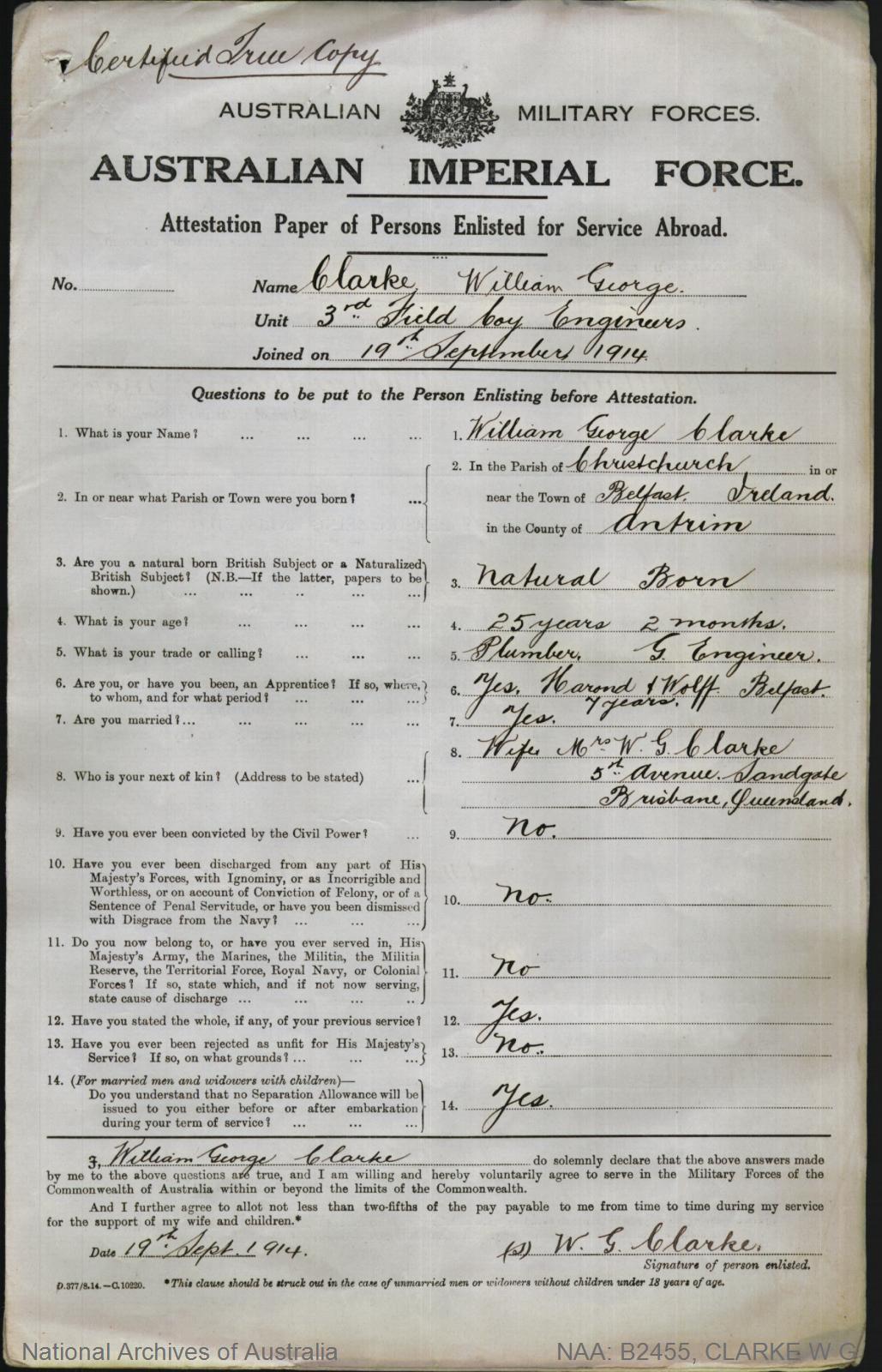
This is from a letter to Base Record in Melbourne regarding William George Clarke, of the 3rd Field Company of Engineers, who had enlisted in Brisbane on 19 September 1914 but left the city. The letter appears in his scant military record.
Yet Clarke played in goals for the Returned Soldiers soccer club in Brisbane in 1920, and with such success he was selected for Queensland against the visiting New South Wales side that season. How did a soldier who never served overseas play for Returned Soldiers? And why wasn’t he seen playing soccer in Brisbane during the war?
Born in Belfast, Clarke had been an apprentice ship builder there for 7 years, before working as a journeyman for another two. He later worked for J&A Hall Refrigeration Engineers in Dartford.
He arrived in Australia in 1913 and worked as a plumber. He married Eva Rogers in Brisbane in January 1914. Their first daughter was born in Surat in August, six weeks before his enlistment, though the family was living in Sandgate when he signed up.
After missing the train, Clarke instead moved to Sydney, where he spent 3 years working as a Ship’s Plumber for the naval authorities at Garden Island Naval base, with the suggestion he worked on transport ships, though whether this was in dock or in transit is unknown. He also worked for the Australian United Steam Navigation Company. It appears Eva moved back to her hometown at Midsomer Norton in Somerset due to family illness. Eva and Clarke’s second daughter was born in Midsomer Norton in January 1917.
Clarke signed up as an Australian Munitions Worker, part of a scheme to bolster ammunition manufacturing in the UK, while allowing Australian workers to learn new skills. He departed Australia from Fremantle in May 1917. It appears he took up the opportunity to be near his wife, though he complained about not being able to secure work near where she lived, in a communique to the department overseeing the scheme in England. He began working for Nieuport Aircraft Co in Cricklewood as a plumber and fitter in August 1917.
In November he took up a contract with Sir Robert McAlpine & Sons, a civil engineering firm which had contracts in France. Clarke worked in France until March 1918 when the contract finished, at which point he was transferred to the firm’s office at Derby. It is unknown how close to the fighting he worked.
Clarke and Eva had a third daughter, born in Midsomer Norton in January 1919. The family had arranged passage back to Australia as part of the munition workers’ scheme, but their expected passage in April 1919 was cancelled when their daughters suffered from whooping cough.
The family finally left on the SS Port Macquarie in November. He was supposed to return to Sydney with the Australian United Steam Navigation Company but the family was not allowed off the boat as their baby had smallpox and scarlet fever. Instead, Eva and the daughter had to stay in isolation in Brisbane. According to a letter Eva wrote after Clarke’s death, the Colonel in charge of the hospital refused to classify the disease as smallpox but instead chickenpox to reduce time in quarantine.
Eva, Clarke and the three daughters then moved to Sandgate. Clarke joined the Returned Soldiers soccer club and was soon playing for the Queensland representative side against the visiting New South Wales. Clarke’s performance in the draw at Woolloongabba saw The Daily Standard, of 11 June 1920 declare that he “did good work, one shot in particular from Doerner’s right boot being beautifully saved.”
Clarke moved to the Wynnum South club (often simply known as Wynnum) in 1921. He disappeared from the soccer record after the end of the season though remained in Brisbane working as a plumber for the rest of his life.
That Clarke was given the opportunity to play for Returned Soldiers was not unprecedented, as contemporary sentiment in Queensland honoured those who had joined the war effort in non-combat roles. Another munitions worker, William Tregea, for instance, was listed on the Toowoomba British Football Association Honour Board.
Clarke may have been recognised by his soccer peers, but it appears he was not eligible for much of what soldiers received. This came out in the letter Eva wrote after his death. Clarke, she stated, worked at Enoggera base as a plumber during the Second World War, but despite his combined effort to the war effort, as a naval plumber, a munitions worker and at the Enoggera base, she was told he was not eligible for war housing unless he served in uniform.
Clarke died of lung cancer in June 1964.
Eva wrote another letter asking for his discharge papers soon afterwards, claiming their copy had been lost by the Department of Works after he applied for a position. (As a munitions worker, Clarke had a termination of agreement provided by the Department of Defence, and a service number of 1581.) The Central Army Records responded, stating only two William George Clarke’s had enlisted and neither were her husband.