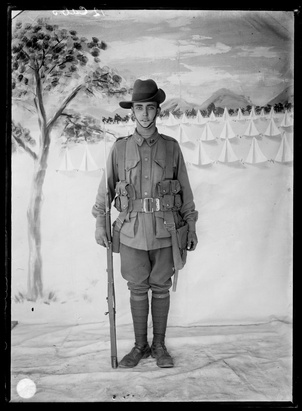
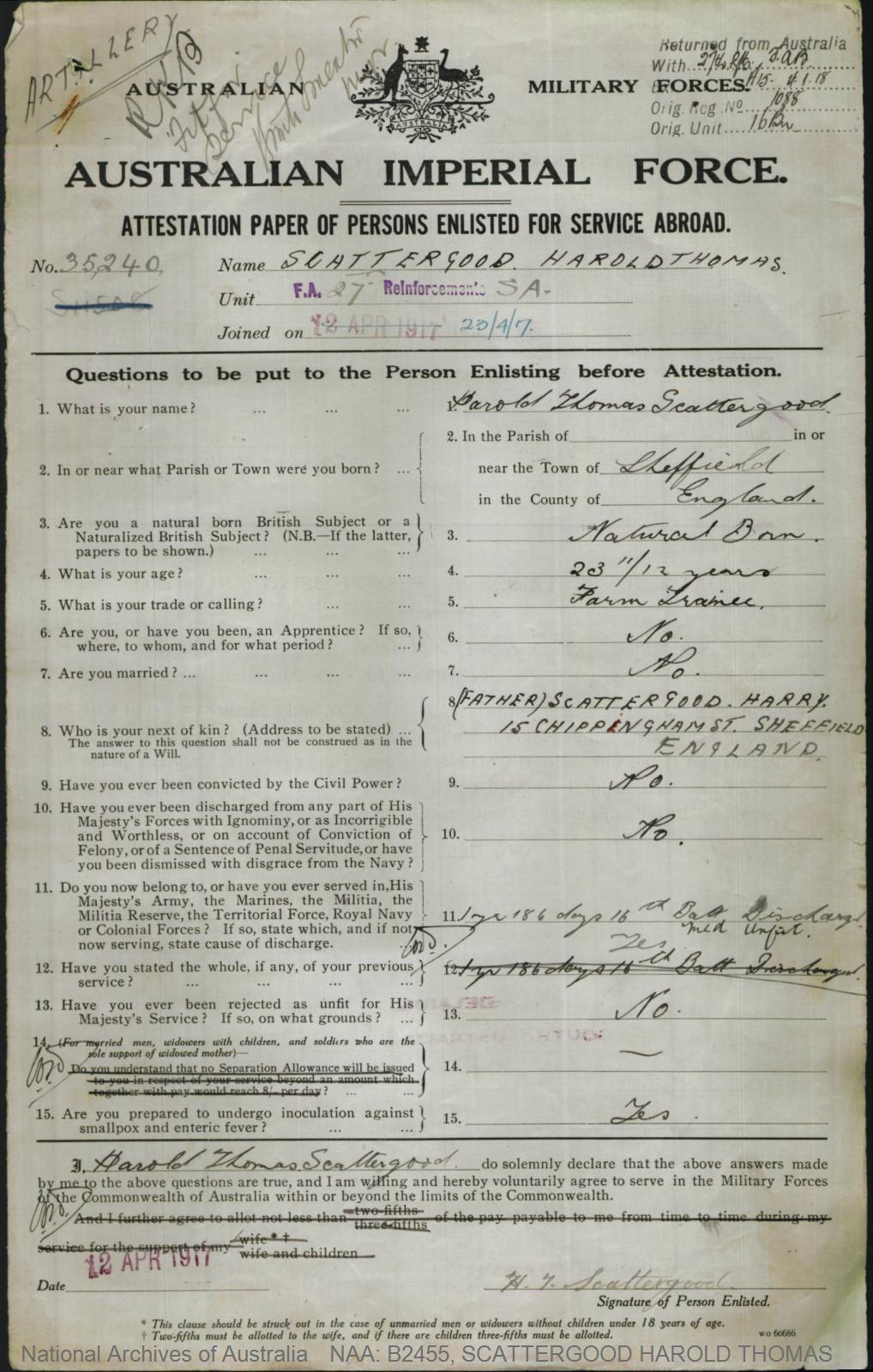
Harold Thomas Scattergood played for Petersburg before the war, re-enlisted in the AIF after losing a finger at Gallipoli, and later became a prominent trade unionist.
Born in Sheffield in 1893, Scattergood arrived in South Australia in 1913 and was working at Petersburg for SA Railways as a locomotive cleaner when he enlisted soon after the outbreak of war. On 8 June 1914 he had played on Petersburg’s half back line alongside two other future Soccer Anzacs, Peter Butt and Thomas Wood, in a match against South Adelaide. The locals won this match, but when they played a Metropolitan XI two weeks later Scattergood was relegated to twelfth man.
He travelled to Adelaide to enlist at the Morphettville camp on 11 September, and landed at Gallipoli with the 16th Battalion, only to receive his serious hand wound on 5 May. After time spent in hospitals in Egypt and England he was returned to Australia and discharged by the end of 1915. Scattergood re-enlisted in April 1917, giving his occupation as “farm trainee”. After field artillery training at Maribyrnong he arrived in England in early 1918. Here he married Beatrice Ellen Hardy in Birmingham on 3rd April 1918 before seeing action on the Western Front. After the Armistice he transferred to the Australian Provost Corps with the rank of corporal. In 1919 he also had non-military leave to study carpentry and joinery and motor car assembling, and it was not until June 1920 that the married couple returned to Australia on the “Hororata”.
In 1924 Scattergood and a friend were charged with stealing tools from their employer, Holden’s Motor Body Builders. They claimed they needed the tools to make furniture, and intended to return them afterwards. They were lucky to avoid a prison sentence, because of their previous good character. Soon afterwards Scattergood became involved with trade union activities, and by 1930 he was the head of the SA branch of the Carpenters and Joiners union. After World War II he held high office in the Australian Builders Workers Industrial Union, finally retiring in 1960.
Harold Thomas Scattergood, who was known as “Tom”, died in an Adelaide nursing home in 1971.