

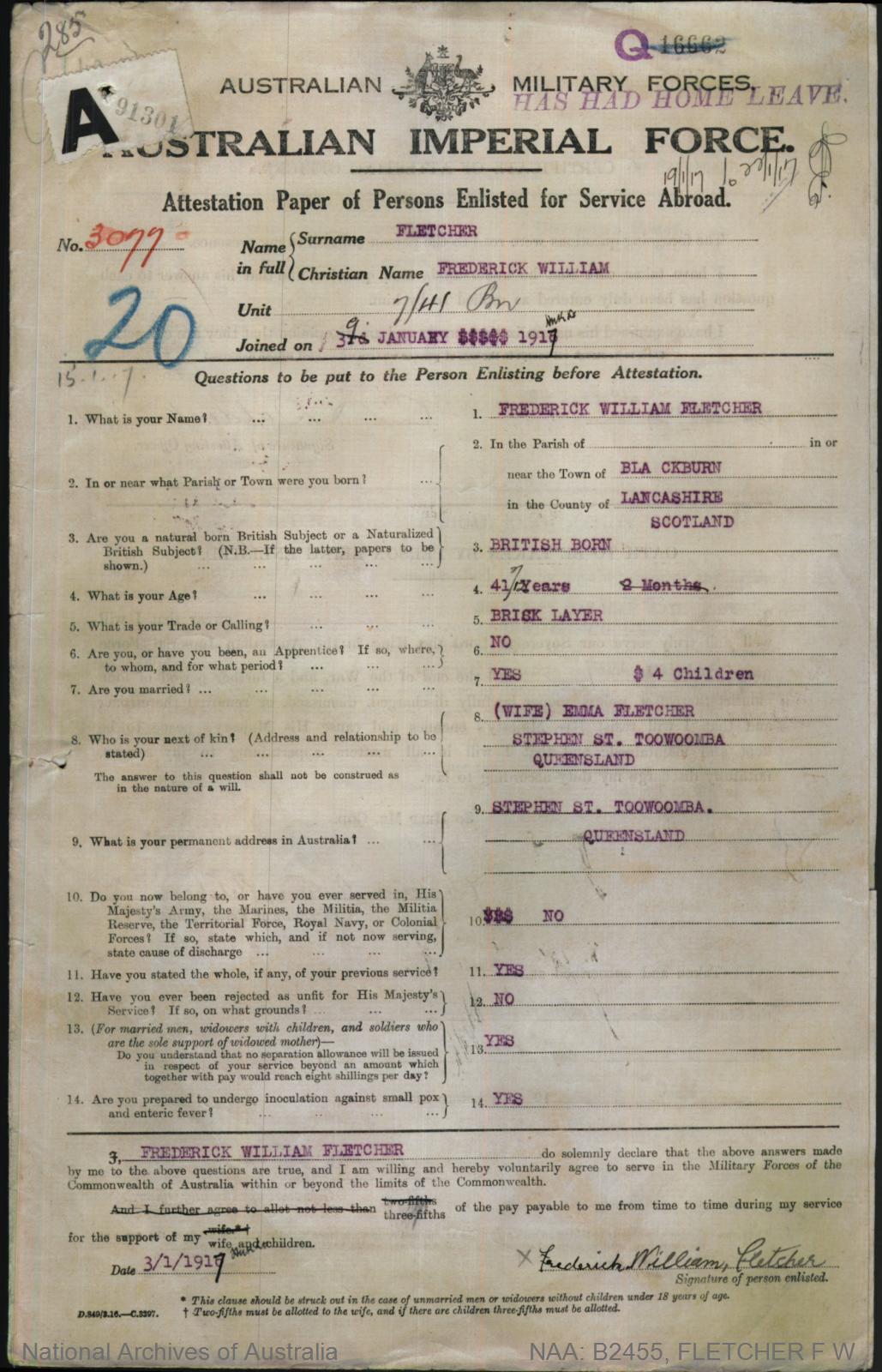
Frederick ‘Dad’ Fletcher became one of the earliest known coaches of women’s soccer in Australia. A nascent women’s football competition was formed in Toowoomba in mid-1921, contemporaneously with efforts in Brisbane and Sydney. The Darling Down’s Gazette of 10 September 1921 reported:
In connection with the Toowoomba lady Soccer players it is learned that there is still a possibility of a match being arranged locally before the termination of the season. Under ‘Dad’ Fletcher’s able coaching the girls have made appreciable progress.
The same newspaper on 18 July reported that Fletcher’s daughter Eva, aged 19 at the time, was a member of the side. The sport was not unknown to the women and girls of the area. Australia’s earliest known women’s football match was between the girls of Toowoomba schools Harlaxton and Souths Girls School in August 1917. Fletcher never saw that match, having enlisted in January 1917 and departed the next month.
At the time he was a 41-year-old bricklayer. He was born in Blackburn, Lancashire, where he married Emma Holt. It is unknown when the family emigrated, but it seems to have happened after 1911. He was initially allocated to the 41st Battalion but according to his military records his entire war was spent in England with the 11th and the 9th Training Battalion.
He returned to Australia at war’s end. Fletcher later wrote to Base Records in 1936 stating he twice went to France. The first was helping one Captain Findlay take a draft over in late August or early September 1918, staying a night in Boulogne, and another in Etaples. The second occasion, in October, was accompanying a draft to Le Havre, this time staying four nights. Base records replied that they failed to find any evidence Fletcher reached France. Base Records suggested Findlay was Captain St Clair Findlay of the 34th Battalion, but a search for him to corroborate Fletcher’s story had failed as of March 1937.
Despite his age, Fletcher played soccer for the Returned Soldier’s in 1919, and sporadically for Casuals and the Toowoomba Club in the early 1920s. The highlight came when he helped a Toowoomba representative team beat Brisbane 3-2 at home on 31 July 1920.
Fletcher died in September 1946.