
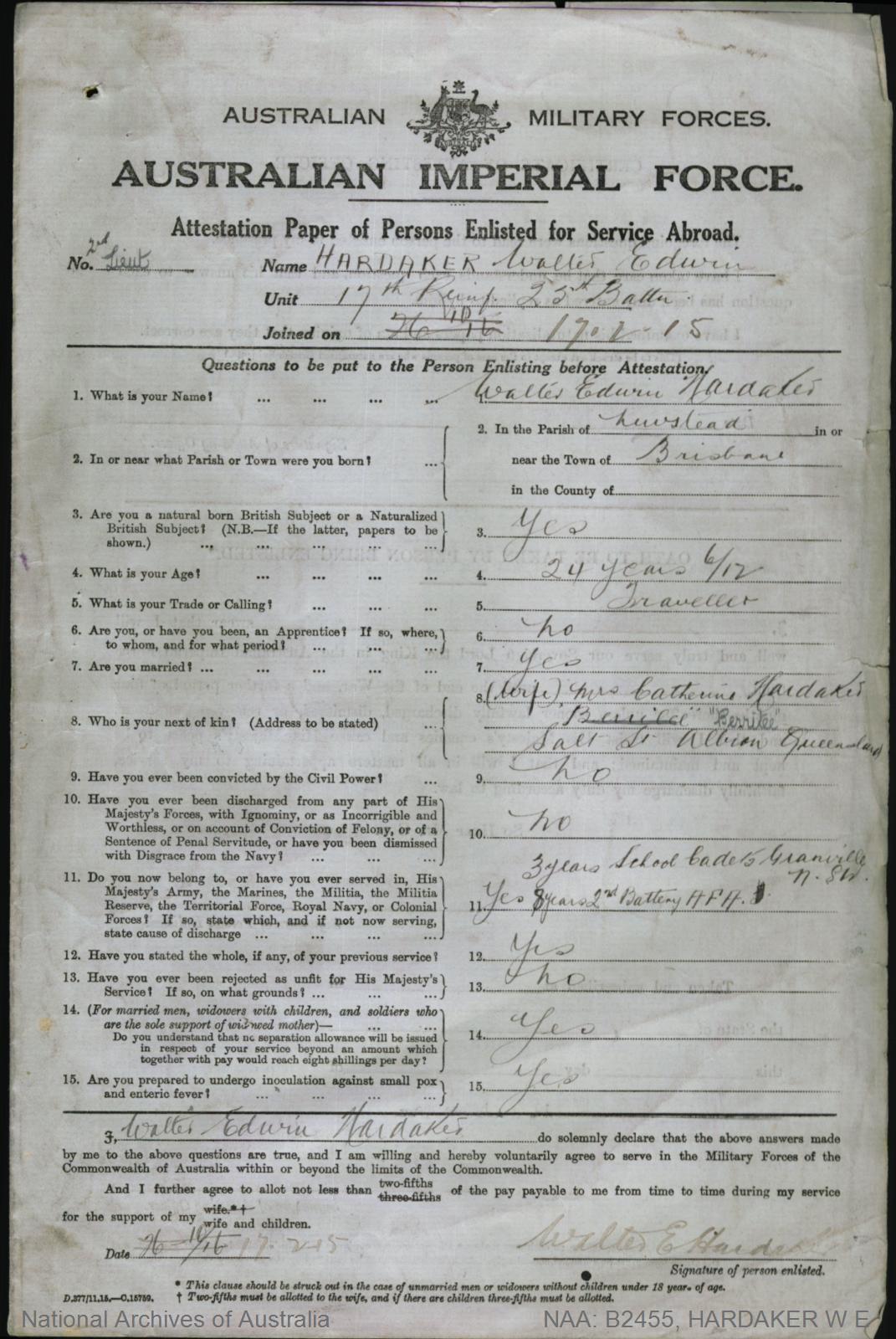
Walter Hardaker’s early life was defined by the military and, it is implied, by sport. He was 24 when he enlisted in mid-1916. His enlistment form stated his previous military experience included 3 years as a school cadet in Granville, NSW, and almost eight years with the 2nd Battery 3rd Field Artillery Brigade of the Australian Field Artillery. It appears his military career took him to Chermside and Harrisville Camp, south of Ipswich, before the war.
His sporting prowess is harder to define but it is suggested he was a useful bowler for the Chermside cricket team in 1911 – though his interest in sport is mostly revealed with his time in the military and later life. In 1914, while a Sergeant at Harrisville Camp, he helped organise a military sports day. Competition ranged from egg and spoon races to wrestling on horseback, while the sack race and tug-of-war was delayed until mid-week due to the lack of light.
The Daily Standard of 12 May 1914 stated that many locals attended wishing to see the fun. Later, during the war, and while attached to the Chermside base, Hardaker helped set up a series of soccer matches between the military and a Brisbane select team. The Daily Standard, on 17 June 1916, reporting on the monthly meeting of Queensland British Football Association stated:
Major Hardaker, from Chermside, who, on behalf of the ‘Soccerites’ at Chermside camp, thanked the executive for sending out a team to play the ‘boys’ on Saturday last. Arrangements were made for a return match against the ‘Signallers’ to be played at Bulimba on Saturday.
Five games are known to have been played between the sides, while a sixth and final match was planned though it is unknown whether it took place. The Brisbane select side included many players otherwise unable to play due to the suspension of senior competition in 1916, which occurred to encourage enlistments.
The Depot Signallers brought together players from around the state. Hardaker played in both games in which line-ups were published in the newspapers. It is likely he played in the remaining games as well. Whether he was an experienced soccer-player is unknown. That he spent time at school in Granville, a major soccer hotspot in Sydney made exposure to the game probable. Whether he played in Brisbane in the early years of the 1910s is obscured by the fact most teams never had line-ups published. Any soccer career is currently untraceable.
Hardaker’s service timeline is confusing. It appears he originally enlisted in February 1915, though this may have been for home service. He married Catherine Muller later that year 1915, and they had a son a month after he enlisted for active service in June 1916. His move to active service saw a promotion to 2nd Lieutenant.
Hardaker’s active service, though, proved to be short. He left Australia in October 1916 and arrived at the 7th Training Battalion in January 1917 and departed for France with the 25th Battalion in May. He lasted until mid-June, when he was sent to hospital with trench fever and returned to England. A derangement of his knee joint – a chronic issue caused by an issue with the meniscus – was soon discovered and he was sent back to Australia in August. He arrived back in Brisbane in January 1918 where he was officially discharged.
Two brothers also enlisted. George was killed in action around the time Hardaker was invalided back to Australia, while a younger brother David survived the war.
Walter spent a few years living in New Guinea in the early 1920s but spent much of his life living in Brisbane. In later years he became involved in bowls and rugby union, as well as the New Farm sub-branch of the Returned Soldiers’ League. It appears he was 2nd Lieutenant in the home service during the second war and was placed on the retired list in 1946.
He died in 1959, aged 67.