
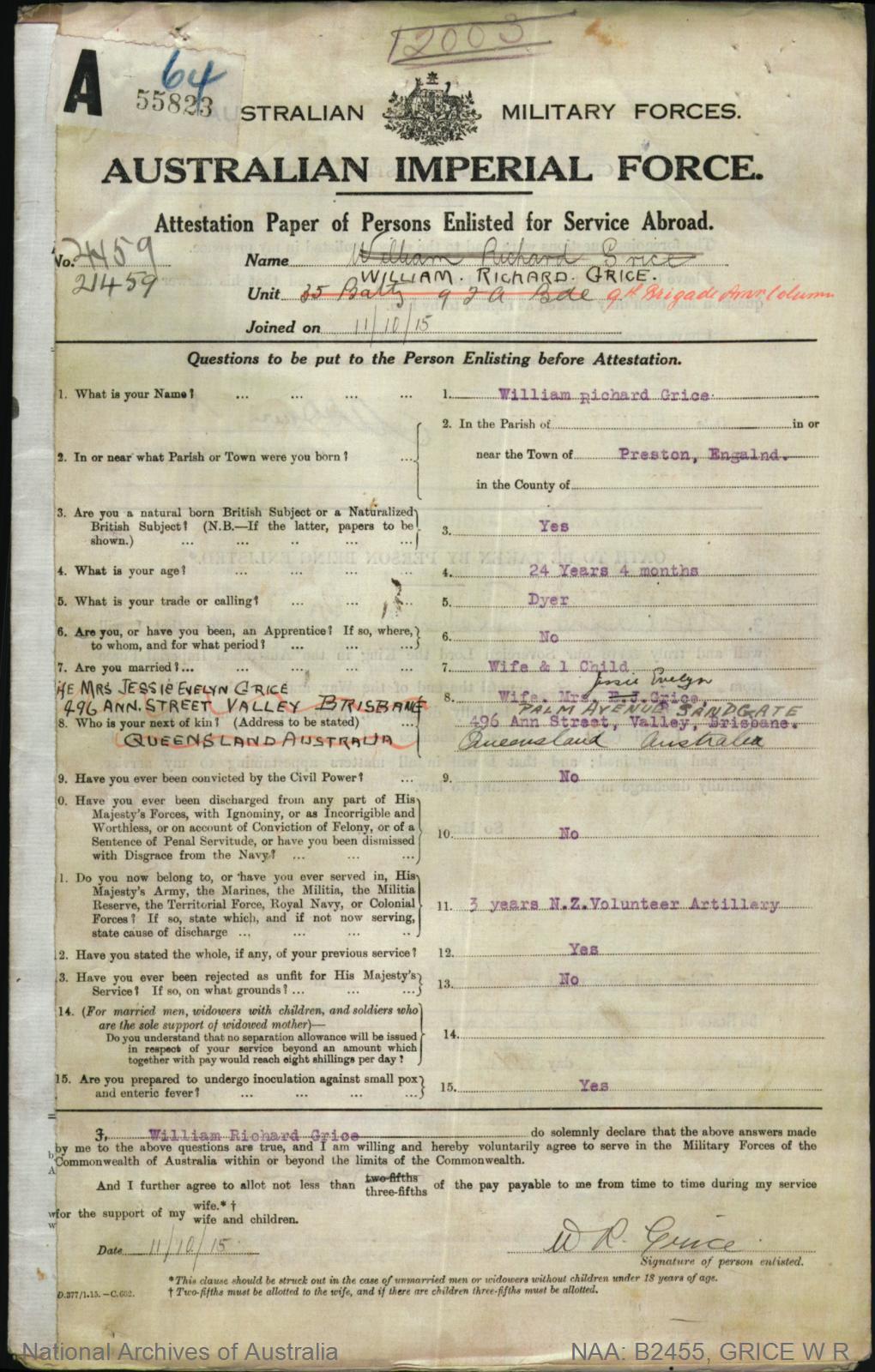
Richard Grice’s war was in constant flux. He twice completed a set of transfers in 1917 between the 3rd Divisional Ammunition Column (3rd D.A.C.), the Australian General Base in Etaples, France, and being picked in a base staff draft to return to work in England. No formal reason is given why he was caught in such a loop, but the suspicion is that his health may have been a cause.
Grice enlisted in October 1915 but didn’t reach Europe until mid-1916, almost immediately being hospitalised with bronchitis. Grice returned to the 3rd D.A.C. and arrived in France late in the year, where he suffered from haemoptysis, the medical term for coughing up blood. He was later diagnosed with phthisis, a group of bacterial infections which include tuberculosis.
Grice was discharged from hospital just after Christmas 1916 and returned to his unit. In March he was transferred to the Australian General Base Unit for the first time. In May it was noted that Grice had “chest trouble”, was anaemic and suffered from sleeplessness. He was promptly transferred to a base in England. It is unknown why he was sent back to the 3rd D.A.C. in September, but soon enough he was returned to Etaples and then back to an English base by the end of the year.
When Grice was put on a boat back to Australia in February 1918, a side note simply stated, “Change bronchitis”. Grice’s casualty form, which summarised his war history and stamped with medals earned, was not fully completed. This may explain why in 1923 Base Records in Melbourne was asked to clarify his transfer rotations and medical history. It was only then that his condition became apparent.
He had been found to be medically unfit due to “dilatated action of the heart” (now known as dilated cardiomyopathy) and bronchitis. In other words, his heart muscles had become enlarged and weakened, leading to the heart not being able to pump enough blood. He had been found to be unfit for both active and home service and discharged on his arrival back to Australia.
Grice’s health must have recovered as he was seen playing soccer for the AIF team against the Renown in Brisbane in 1920. The AIF team was made up of those who had played soccer before their enlistments. Grice had played for Queen’s Park before the war and Thistle from 1919 until a move to South Brisbane in 1921.
Being a son named after his father, Grice was known by his middle name, meaning “R. Grice” and “W. R. Grice” were used interchangeably in match reports on either side of the war. Grice was born in Preston, England. Prior to the war he had spent three years in the New Zealand Volunteer Artillery but was living in Brisbane by the time he married Jessie Gilbert in 1912. During these years he had worked as a dyer and the couple had their first child.
Sometime after the war, Grice became the secretary of Enoggera branch of the Returned Sailors’ and Soldiers’ Imperial League of Australia. He stepped down in 1933 citing ill health, though aimed to remain active in the branch.
Grice died in July 1939.