
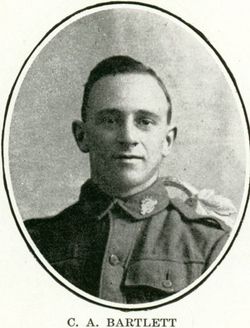
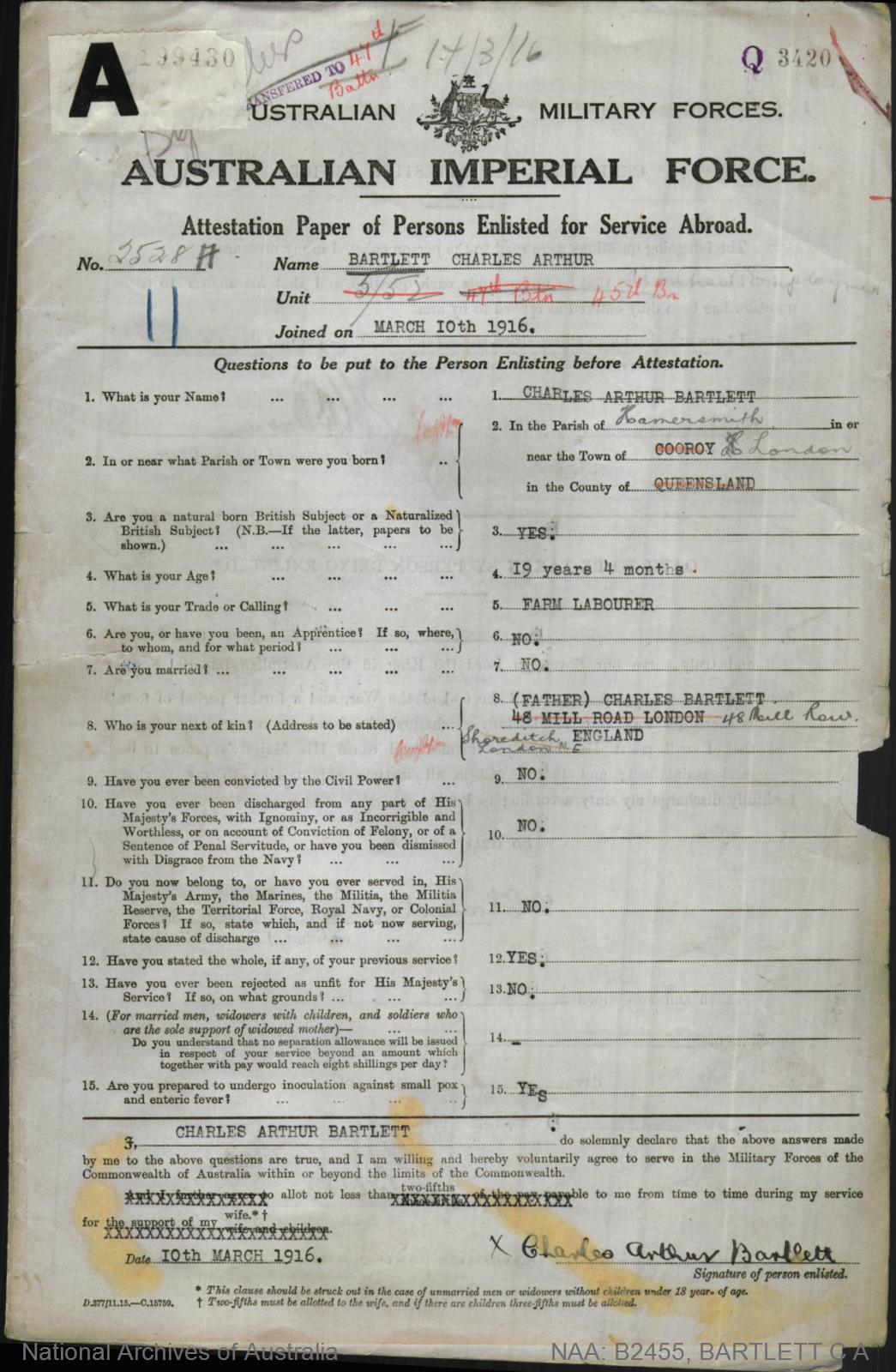
Charles Arthur Bartlett was a London-born farm labourer living in Cooroy, in the Sunshine Coast hinterland when he enlisted aged 19 in March 1916.
It is unknown whether he played soccer in Australia before his enlistment, the game being said to have started in the region by war veterans in the early 1920s. This does not preclude scratch matches having been played in the 1910s, but if so, they went unreported. Despite the lack of known opportunity to play, Bartlett was familiar with the game, which he may have learned in England.
After enlisting, he played for the Chermside Signallers Depot, who faced a Brisbane select team in a series of games across the middle of 1916. Bartlett was named in the team which played on 8 July and may have played in the remaining games considering the line-ups of these matches are unknown. (At one point in his military record he was mistaken for 36-year-old Charles Arthur Barlett, who enlisted in Warwick and was at Enoggera and Exhibition Camps at the same time.
This Charles’s wife had written to the base to ask for him to be discharged but kept on as a bootmaker so he wouldn’t go to the front. She pointed out they had 5 children, and she was of ill-health. The AIF replied saying any discharge would not see him taken on for home service. They promptly discharged him in May 1916 after several disciplinary offences.
Only the younger Bartlett was still in service when the Depot Signallers played their games.) Bartlett departed Australia in September and arrived in Etaples, France the next March, where he was allocated to the 52nd Battalion. During his time with the 52nd, he was trained in the use of power buzzers, a ground-based signalling system used when telephones proved ineffective. Bartlett was transferred to the 47th Battalion in May 1918, and onto the 45th in 1919.
Being a signaller, it is unknown how much time he spent at the front or further behind the lines. He was not reported as suffering any physical injuries or illness during the war. After the war, he spent time in France with his unit, before heading to England in March 1919. Here he undertook a period of leave for non-military employment as a farmer. His records state that he had previously worked at the farm, presumably before he came to Australia. He was allowed to undertake the work to refresh his skills before his return to Australia.
Bartlett eventually left England in September and was discharged back in Australia in November. His final medical report identified no disability. Bartlett was not seen playing soccer in the early Sunshine Coast league, but this may have been due to his health.
He died at the Mater Public Hospital in August 1922. His friend, W. Luke of Maleny, thanks the sisters and nurses of the hospital in the Brisbane Courier on 23 September 1922. According to Luke, Bartlett has died of an unspecified illness. He was 24 years old.