
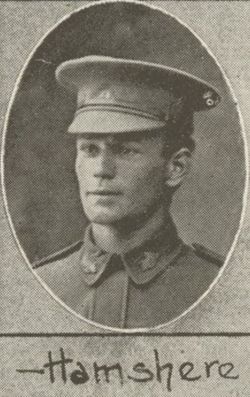
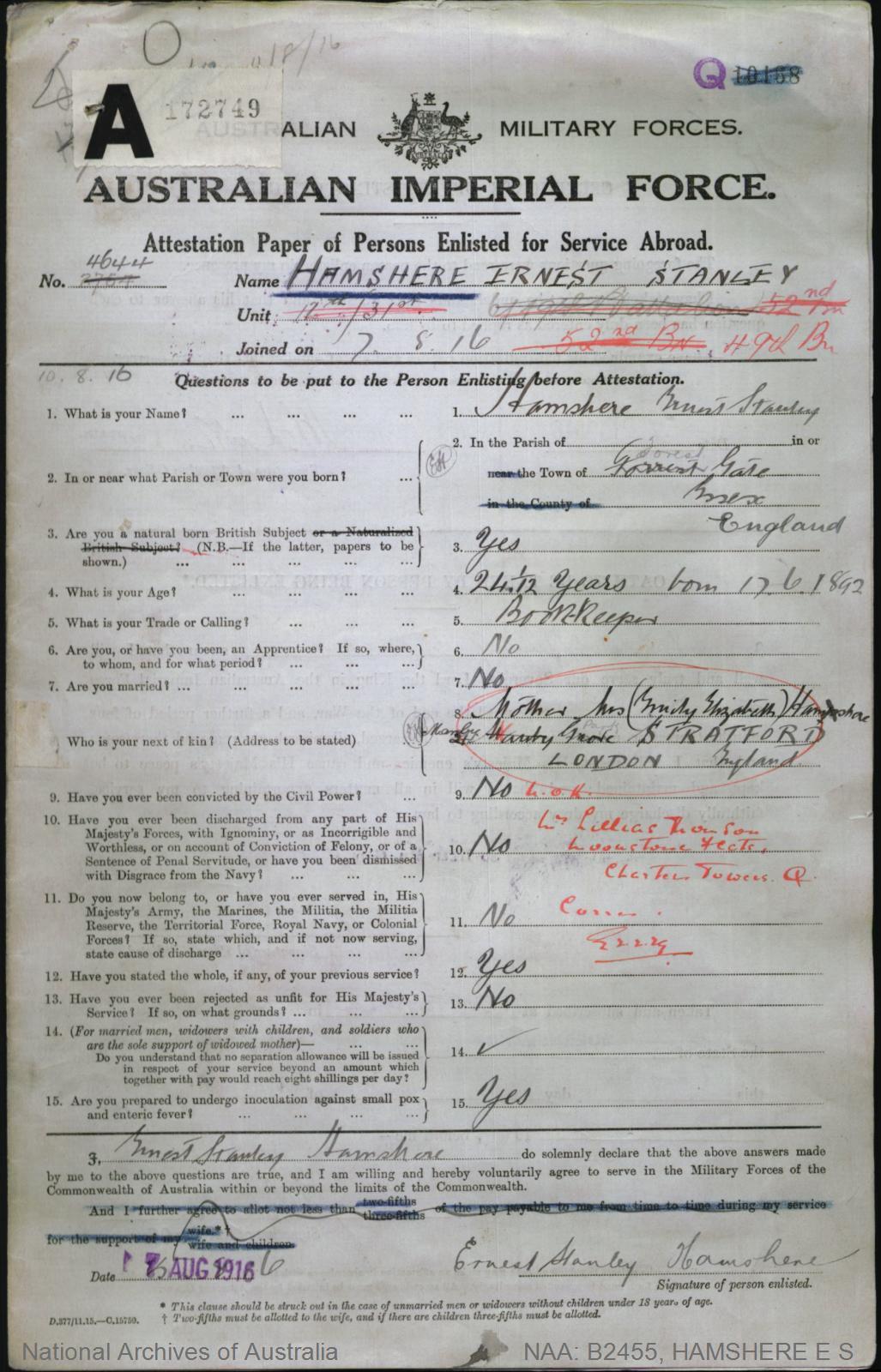
Ernest Hamshere came from a family of many spellings. His forebears and siblings bore the names Hamshire, and Hamsher, while his own gravestone in Toowong Cemetery named him Hampshere. He was also the “E. A. Hamshae” listed as a reserve for the Returned Soldiers’ soccer club in the Telegraph on 22 July 1920. The distinctive face is seen in the club’s team photo matches his wartime mugshot. Even his military record has at least one hand-written correction to his name. These alternate spellings make tracking his life difficult.
Hamshere was born in Essex, before emigrating to Townsville in Queensland at some point before the war. Soccer was strong in Townsville from 1912, and even during the war. Townsville was a major port, and despite losing players to enlistment, games were regularly played between locals and the crews of visiting ships. Hamshere, under any spelling, was not reported as playing in Townsville during this time.
He enlisted in August 1916 but did not arrive in England until March 1917. Hamshere spent the next year training in Devonport and Aldershot before arriving in France until February 1918. He served in the 52nd until diagnosed with piles and prolapsed haemorrhoids mid-year. After recovering, he was transferred to the 49th Battalion, but not much else is known of his service before he left France in April 1919.
Back in Brisbane, he played for Returned Soldiers in their only season in 1920, before the club merged with Brisbane City. Two years later, Hamshere played for Mitchelton. At the time he was living in nearby Enoggera.
Hamshere married Linda Thomson in 1921, who hailed from Charters Towners. Two years later they welcomed a son, Stanley. But family tragedy soon followed. Hamshere’s sister died in Townsville in 1924, followed by Linda a year later.
Hamshere then passed away in 1929. According to the Repatriations Commission, he died of tuberculosis contracted on active service. His next of kin was listed as Lillian Thomson of Charters Towers, his mother-in-law, and Stanley’s grandmother. It appears Stanley, orphaned at 6, went to live with Thomson after his father’s death, but he died in his mid-teens in 1938. His funeral notice, which appeared in the Northern Miner on 24 October 1938, stated he was known as both Hamshere and Hampshere.
Such tragedy presumably explains why Hamshere’s medals ended up with the Public Curator. In 1959, they sent the medals to the Central Army Records Office for “disposal”.