
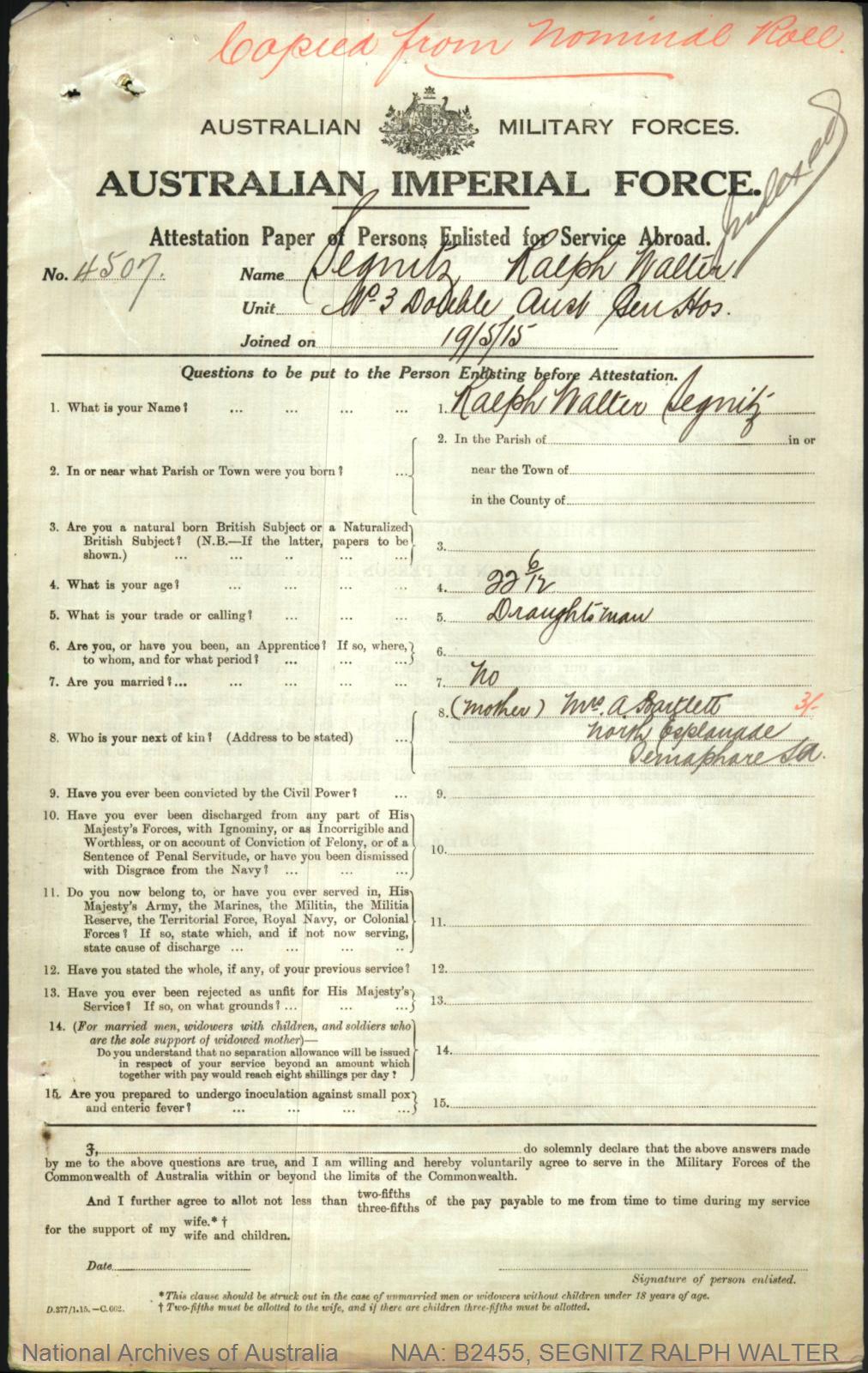
Ralph Walter Segnitz became a prominent Australian scientist after the war. His military service aided his academic career after he obtained an army scholarship to attend Oxford University. He played junior and reserves soccer in Adelaide before the war.
Born in Adelaide to a Broken Hill family in 1893, he lived at Parkside, only a short walk from the soccer grounds in the South Parklands, playing for Cambridge juniors in 1910 and Sturt reserves in 1911, often with his brother Curt. He was studying art at the School of Art, and engineering at the School of Mines when he enlisted on 19th May 1915 giving his occupation as draughtsman.
He began as a medical orderly in the 3rd Australian General Hospital, based at Mudros and Alexandria. Arriving in England in late 1916 Segnitz became a supernumerary and was attached to a postal section at Brighton. Here a strange incident occurred: he was put on charge for possessing a camera for forgery and fraudulently possessing a censor’s stamp. This sounded serious but his punishment was surprisingly light – he was reduced in rank from Lance Sergeant to corporal and removed from work in the mail room.
Before the war Segnitz had been an active member of the Church of Christ and was keenly pro-conscription. While overseas he wrote letters to his mother (included below) which were published in The Barrier Times, in which he expressed disappointment at the referendum result. The IWW were to blame, he thought.
The mail room incident did not impede his military career. He was soon promoted to sergeant and was at the Front with the 10th Battalion. Officer training followed in England in 1918 and after the Armistice the army enabled him to study geology at Balliol College, Oxford. Whilst studying he was promoted to 2nd Lieutenant in January 1919.
Segnitz returned to Australia in July 1920. At this time he changed his surname – simply dropping the “z” to call himself Segnit. He married Ruby Howard in Adelaide in 1922. Segnit was soon on the move again, accompanying the Oxford University Arctic expedition to Spitzbergen, and another which attempted an ascent of Everest. He became a Fellow of the Royal Geographical Society and earned many research fellowships. By the 1930s he was assistant government geologist of SA.
Professor Ralph Segnit died in Adelaide in 1965. His nephew Edgar also became a prominent geologist.
The following are three letters from Segnitz to his mother published in the Barrier Miner 24 February 1918
SERGEANT R. SEGNITZ.
Mrs. A. Bartlett, of Oxide-street, has received three letters from her son, Sergeant Ralph Segnitz, who writes from France, under the dates of December 9, 16, and 26. The first letter reads as follows: –
Another week has gone, though it only seems a couple of days since I wrote to you last. I have very little news to tell you, but I am glad to be in the position to say that I am well and in the best of spirits. All the week we have had a very cold snap. Everything has been frozen, but the weather is on the improve. The ice has all thawed, and in its place there is plenty of mud and slush. We have also had rain. During the week the brigade competitions continued. We were beaten this time in the battalion drill. We were placed third. We were, however, successful in signalling, bomb throwing, rifle grenade throwing, runners, transport turn out, and, I believe, in the company drill. We also had the opportunity of voting during the week on the conscription issue. I voted the same as at the previous poll. It was rather amusing, but I think jolly hot to read in the London ‘Daily Mail’ that Mr Hughes had made a statement to the effect that all the 1914 men from Australia were on ‘base jobs.’ I wonder who the brainy individual was that told him. If Mr. Hughes just comes here for a while he will see that about 80 per cent of the 1914 men are very far from the base and doing their bit. Still, how are those home in Australia to know what we are doing here in France? I am no politician, however, so I think I had betta dry up. It is drawing very near to Christmas, and I suppose when the day comes we will be well back in the lines and into the forward area.
The second letter reads: –
I know you detest those French postcards, so I always like to write a few lines in a letter. I am in the reserve at present, but I expect to be moved up into the lines to-night. I am writing this letter on the back of my plate, and in a crouched-up position in an old dug-out. I can tell you that I feel horribly cramped. The weather is very wet and cold here, and my feet at present are just like ice. I heard from a chap here yesterday that Captain Fred Sims had been killed at Ypres on or about October 4. He was killed in the hop over after we took Polygon Wood. He was killed within two hours of the commencement of the fight, together with his man and a sergeant. Our present sector is very much quieter than up at Ypres. Still I don’t trust ‘old Fritz.’ We may be here for a month, so you can see that I will be in the lines, both during Christmas and New Year.”
The third letter reads: –
I am sorry that I did not write last week, but I was unable to owing to being in the lines. I was on a ‘look-out’ job with ‘old Fritz’ sniping at me the whole of the time. I am thankful to say that he did not get a shot ‘in.’ We came out of the trenches last night in snow and sleet and feeling very tired. I had not had any sleep for 36 hours previously. It is no use mentioning how I spent Christmas; it would only be a farce writing about it.