
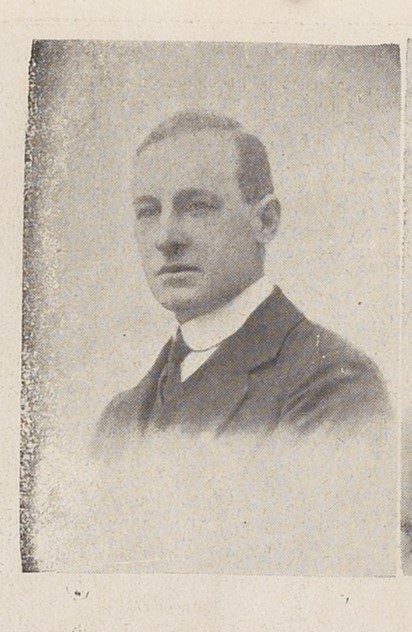
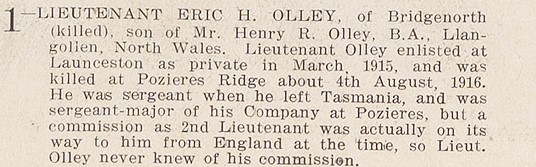
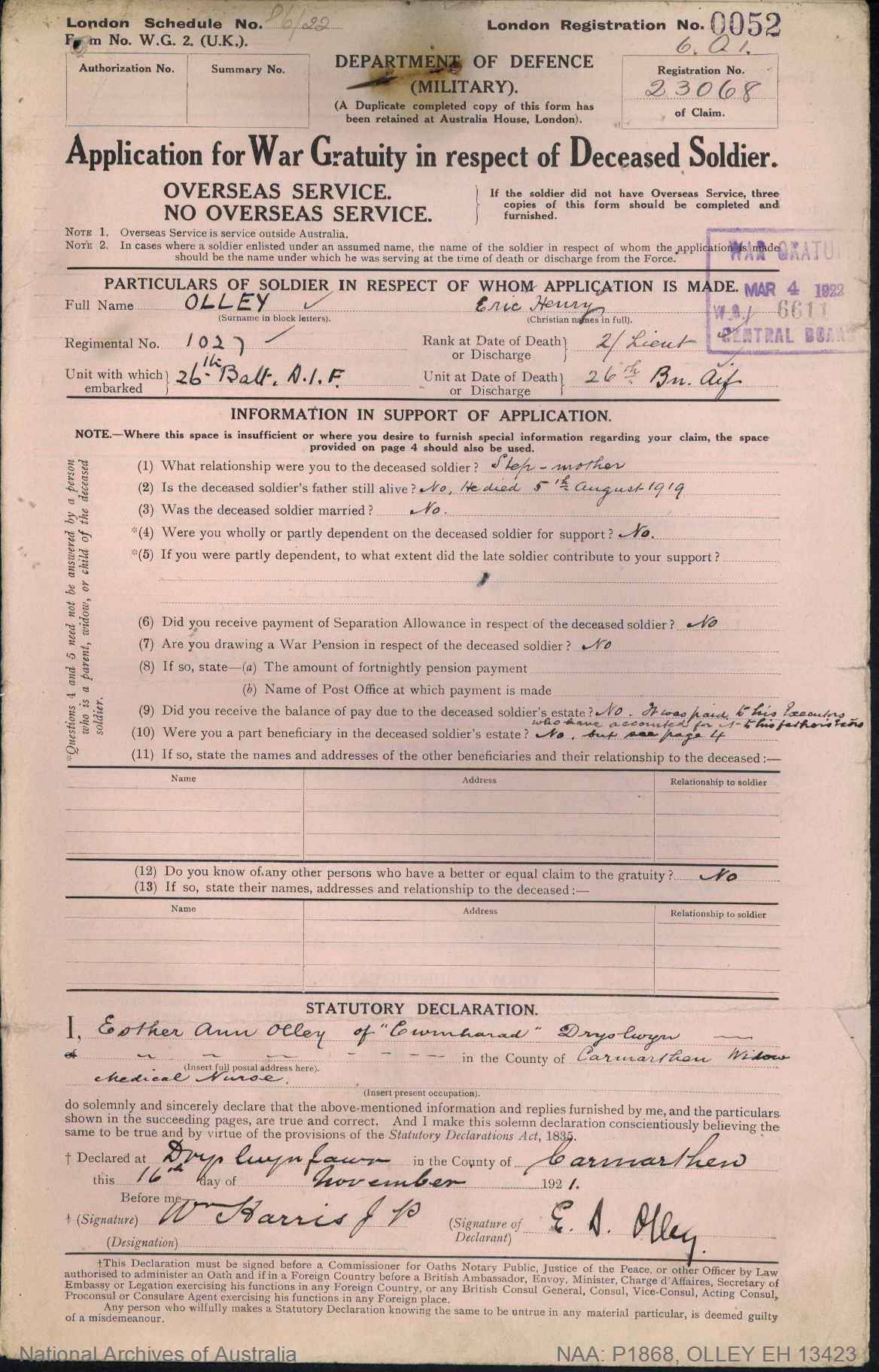
Eric Henry Olley was born in the English seaside town of Scarborough in 1888. His father was a school teacher, working at Oliver’s Mount School in Scarborough at the time of Eric’s birth. At age 7, Eric moved to north Wales, where Eric’s father became headmaster of the Llangollen County School. He migrated to Tasmania in 1910, initially working at a property owned by T J Hopkins at Melrose in Tasmania’s north-west. In 1913, he acquired land near Bridgenorth, 20km from Launceston, where he resided until enlisting in the forces.
In 1913, a new soccer team was established called West Tamar. This team was primarily comprised of recently arrived English migrants working on farms and apple orchids along the fertile Tamar Valley region, many of whom travelled up to 40 miles to play in matches. Eric was a regular feature for West Tamar across the 1913 season, primarily playing as a half-back. He was selected for the Northern Tasmanian team to play against Southern Tasmania in an intrastate match in August 1913 but had to withdraw a week prior to the match as he was unavailable to travel. In 1914, his work on the farm and within the Bridgenorth community prevented him from playing.
Eric was among the first to enlist from his area on the 1st April 1915, joining the 26th Battalion, D Company. Eric and his Battalion saw action at Gallipoli in the later half of 1915, prior to the withdrawal from the peninsula later that year. The 26th battalion were subsequently transferred to France to fight in the Battle of the Somme. Sergeant Olley was reported missing by Tasmanian newspapers on 8th September 1916. Later in the year, this was changed to killed in action on the 4th August 1916. Subsequent reports from his Red Cross file describes how he was killed.
Q.M.S. White reported:
2nd Lieut Olley was killed at Pozieres Ridge about 5 weeks ago, I think. He had been badly wounded in the elbow and was being bandaged by Private W. Manning when a shrapnel shell burst alongside, killing him and wounded Manning. Finding his officer dead, Manning crawled back and is now in England. It was impossible to bring Mr. Olley in. He was CSM [Company Sergeant Major] of my company. His commission was dated from the day he went over so he never knew of it.
Private W. Manning said:
Lieut. Olley was hit by machine gun fire through the arm. I was tying him up when a shrapnel shell burst near and must have hit him again for his head dropped and he fell back into a shell-hole. I felt his heart had just a flutter. This was at Pozieres. He was a most popular man in the company, could not have got better.
Records confirm that on 4th August 1916, Olley was given a promotion to 2nd Lieutenant of his company, however this did not arrive to the front line for 2 days, so Eric never knew of this commission. Eric’s fellow northern Tasmanian Soccer Anzac and member of the 26th battalion, Richard Gordon Powell, died at the same battle one day later. Eric Henry Olley is commemorated on numerous honour board and memorials across the world. These include a headstone at Serre Road Cemetery, France, the Roll of Honour at Bridgenorth, Tasmania, and the war memorial at Llangollen, Wales.