


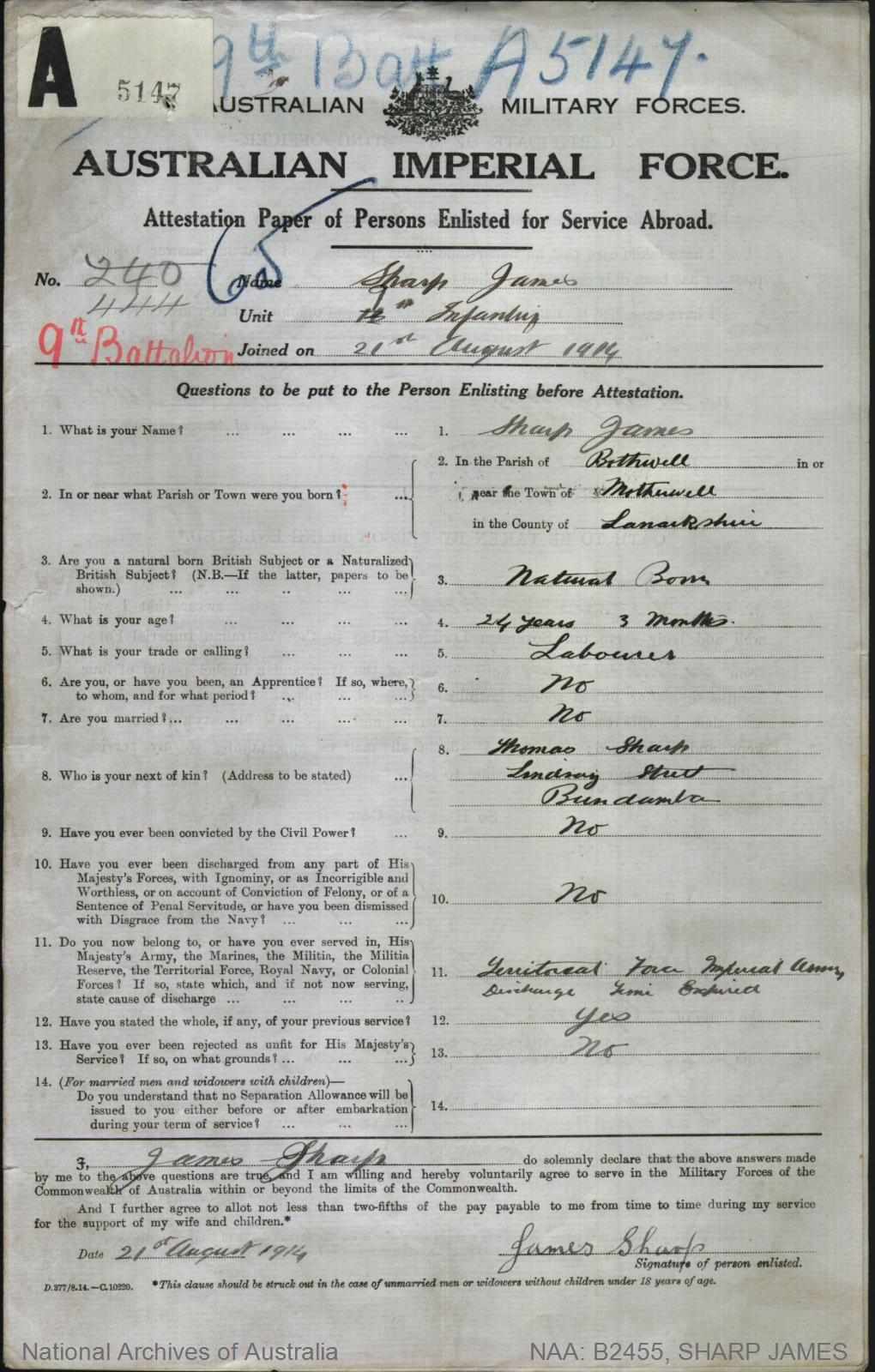
James Sharp was a labourer who had been a regular referee in the Ipswich and West Moreton competitions in the years leading up to the war. He was also the recently elected secretary of Bundanba Rangers when he enlisted in August 1914.
Sharp’s short war was detailed in a letter he sent home which was published in the Queensland Times on 19 October 1915. The letter did not shy away from detailing the bloodshed he witnessed after landing on the 30th of April. Sharp described being twice wounded, with the second occasion, shrapnel wounds to both legs, seeing him evacuated to Egypt and later back to Australia.
This was not before the Queensland Times had erroneously pronounced him dead, something editor and sportswriter Tom “Old Horse” Barker apologised for in person when Sharp arrived home in 1916. “I’ll forgive you”, Sharp replied to Barker, “Now I am here to report myself alive and kicking!” Sharp added that he was keen to return to the fighting once fit again.
Despite the optimism, his war was over. Sharp’s association with football continued when he again took up the whistle when Ipswich competition recommenced in 1919.
James Sharp’s letter, Queensland Times 19 October 1915:
LETTERS FROM WOUNDED SOLDIERS.
Pte. James Sharp, formerly of Bundanba, writes to his parents from Cairo
:— I will tell you a little bit about what I have gone through in the firing line. As you know, I did not land with the boys, but I went ashore a few days after them. I landed on the 30th of April, about 10.30 p.m. and the rifle fire was something awful. The Turks were making a bit of a charge, but nothing came out of it. As you know, the troops landed on the 28th, and had to jump out of the boats up to their necks in water, as the Turks were firing at point blank range at them. We lost a lot of men in getting ashore. I could see the shells landing amongst our men, and I could see the “Big Lizzie” sending her big shells over the Turks. I can tell you I was just about mad, because I could not get off to give our boys a hand. Well, on the 18th of May, the Turks shelled our trenches and about 3.30 a.m. on the 29th of May, made a charge.
Our losses were very small — killed 20, wounded 23, total, 43. The loss of the Turks was something awful about 5000 killed. The wounded men were all over the place. We gave them six hours to get their dead and wounded in. The smell was something awful. I don’t wish to see the same again.
I was wounded on the 23rd of May, but only slightly. I was asleep at the time. I came out of the trenches at 7.30 a.m., and was subsequently wounded in a leg. Everything was very silent for a time until the 28th June, when we went out to Snipers’ Ridge to stay a column of Turks going down to Cape Helles to engage the French and English troops, and the Turks got round both sides of us with machine guns, shrapnel, and high explosives. It was a hell upon earth. Our list was four killed and wounded.
I got wounded that day by two bullets from a bomb, in the right and left legs. The Turks made another charge at our trenches on the 29th. and our naval and big guns, and maxims just cut them down like ninepins. About 6000 were killed and wounded amongst the Turks. I landed back here in July. I was out for a walk in Cairo on the 12th, was sent out to Mena on the 13th and to Houlahoum Hospital on the 27th. This is all at present—- only a little bit. Will give you the rest when I come back.