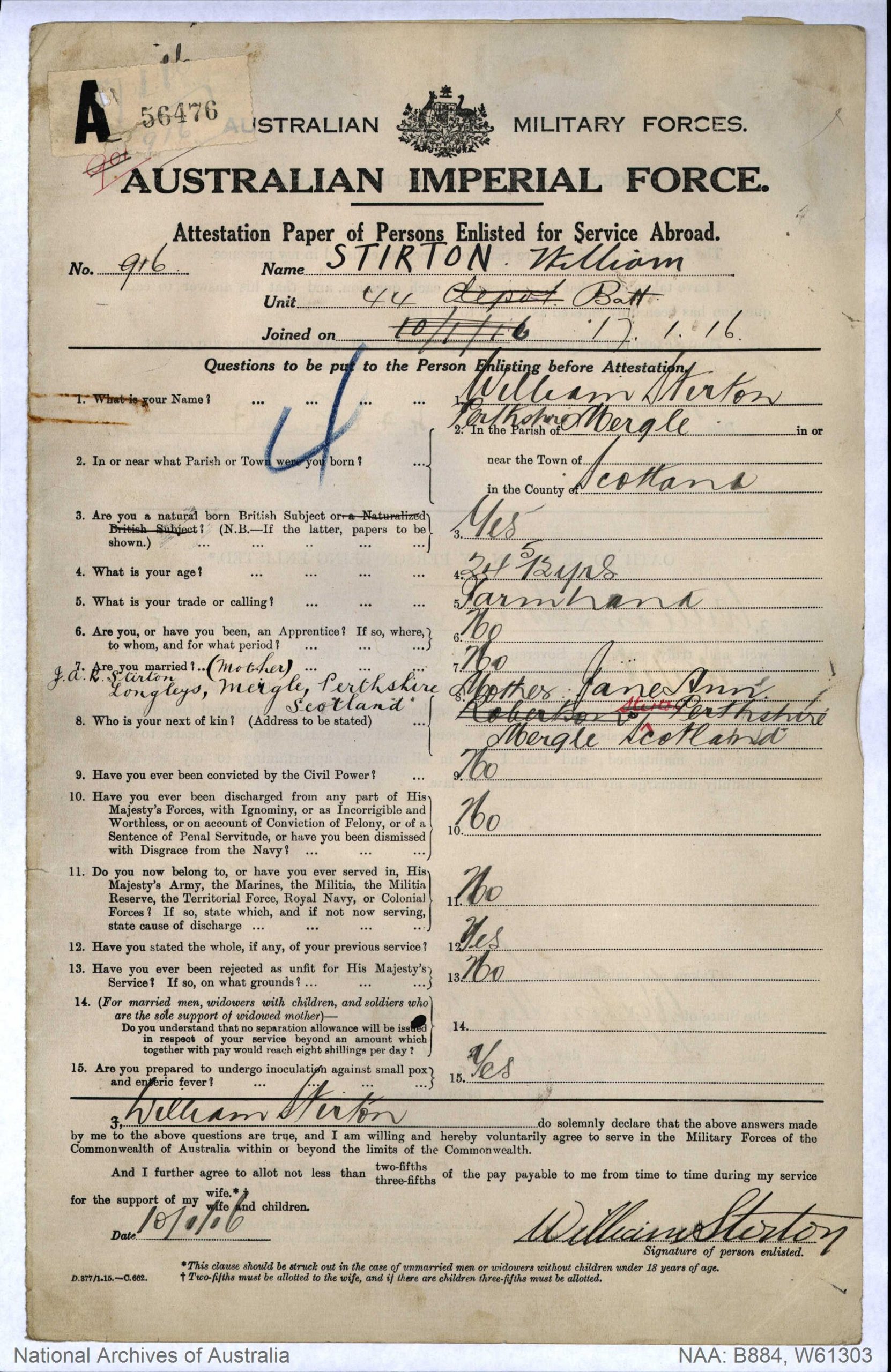
William Stirton was born in the Scottish village of Meigle on 14 August 1893, one of thirteen children to farm labourer James Stirton and Jane Robertson. The family was struck by tragedy in 1912 with February’s passing of first-born James compounded just a month later when head of the house James died at the age of 59.
In mid-1913 William travelled alone by ship to Western Australia where he settled in Geraldton and worked as a farm hand. The Geraldton British Football Association had just been formed and William represented Whites against Red and Blacks in the regions first organised game. He wore the light blue shirt of Thistle during the season that followed and in 1914 turned out for the Moonyoonooka club, who lost September’s Hansen Cup final 2-0 to his former club.
In January 1916, 24-year old William enlisted as a Private with the Machine Gun Section of the 44th Battalion. On completion of training Salisbury Plain in England, he proceeded to France late in the year but before he could see action was hospitalised twice with “tender feet”. Soon after William was appointed Lance Corporal and by May 1917 he’d been promoted again, this time to Corporal.
In the first week of June, William was seriously wounded when he was struck in the right thigh and right arm by an exploding shell while fighting near Messines, Belgium. He was treated at the Horton (County of London) War Hospital in Epsom for three months only to have his right arm amputated in October. William’s war was over in February 1918 he returned to Australia on board the Llanstephen Castle.
William chose the small town of Yandanooka, in the Mid West region of Western Australia, as his new home. Working as a farmer, he married Daisy Warrener in 1922 and in the years that followed they welcomed the arrival of two sons. By 1931 the family had moved some 680km east to the Goldfields town of Wiluna, where William struggled to find work and was drawing a pension.
Another move brought the family to the Perth beachside suburb of Cottesloe. The outbreak of another war in Europe led William, now 48, to re-enlist as a support officer at Karrakatta Camp in March 1942. Discharged 19 months later after “being considered unfit for the duties of his corps”, William and the family moved to South Perth and later Claremont, where he worked as a watchman.
William Stirton passed away in Perth on 30 August, 1956, at the age of 65.