

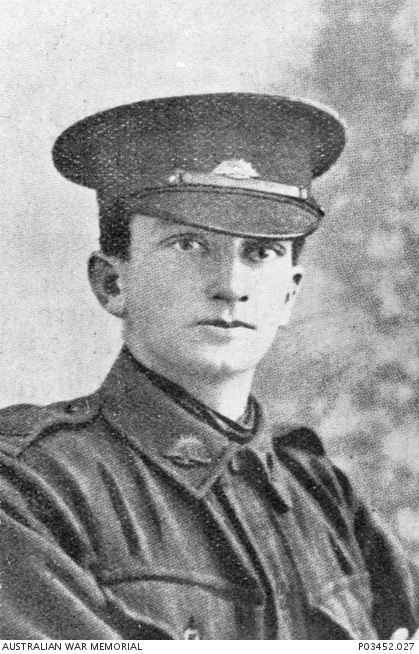
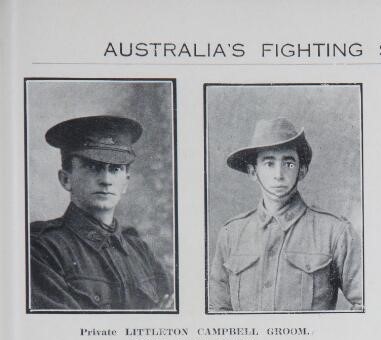
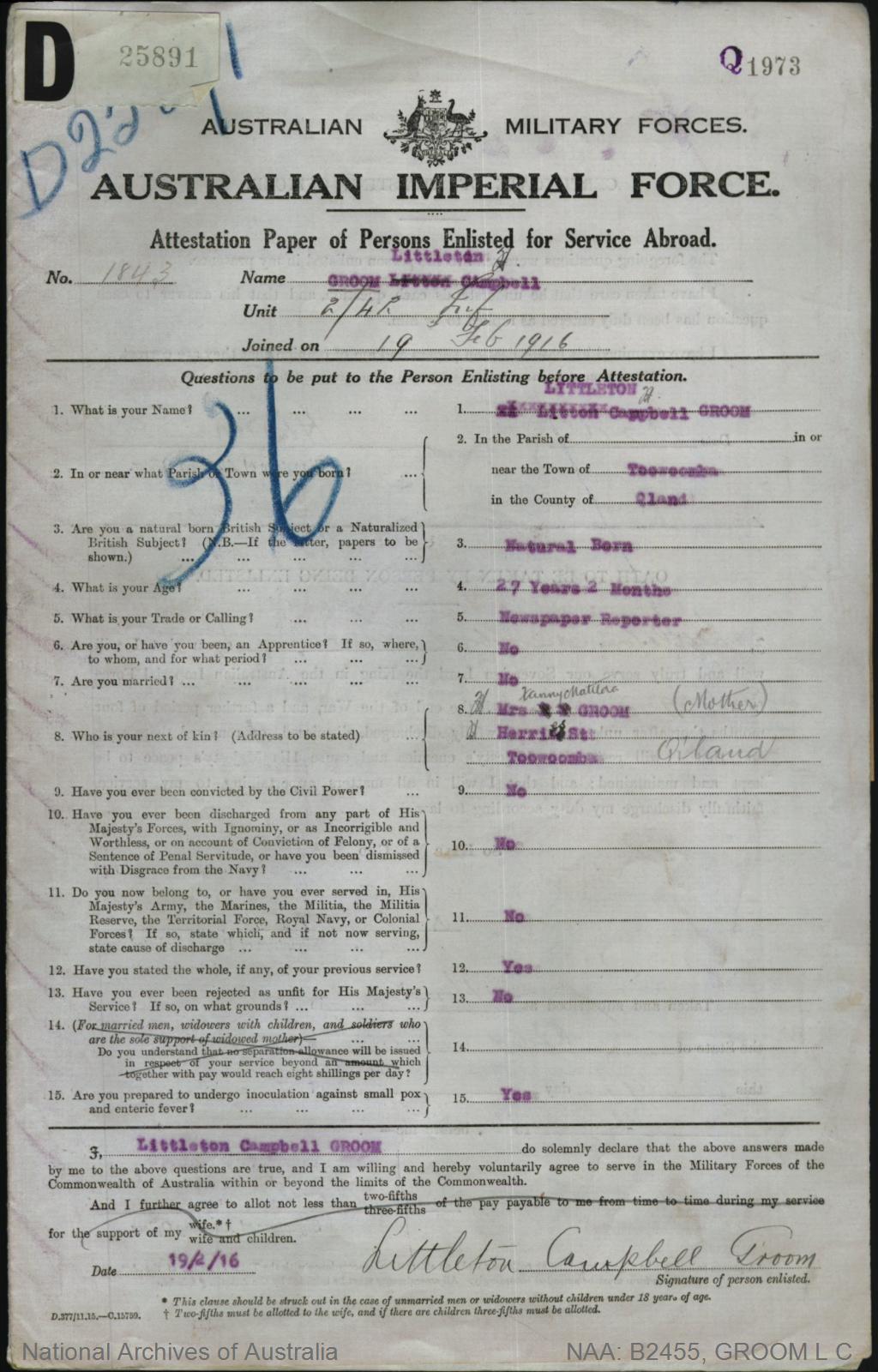
Lit Groom looms large in the stories of Toowoomba soccer and the war for the simple reason that he did much to record them. Groom was a journalist at the Toowoomba Chronicle. He regularly wrote about soccer and cricket, the two sports he played and loved, and latterly Rugby once it saw a local resurgence. Groom played for Western Suburbs in the Toowoomba league alongside his brother Colin, who also wrote about soccer in the Chronicle, though whose day job was as a railwayman.
Colin would enlist in 1915 and Groom early next year, but neither would return. The brothers were both killed in France in 1917. Before Groom died, he captured his war experience in a series of letters detailing his training at Enoggera in Brisbane, the voyage to Europe and his time in France. These letters were published in the Toowoomba Chronicle, giving locals a snapshot of the war and updates on local soldiers.
The Groom family was heavily involved in politics. Groom’s grandfather, William, was a state MP and owned the Toowoomba Chronicle before being elected to the first Australian parliament in 1901. He died the same year at the first Commonwealth Parliament meeting. Two of William’s sons also entered politics, with Henry becoming a state MP, while Littleton E. Groom replaced William in federal parliament. L. E. Groom would go on to become a minister in several federal governments and was Speaker of the house in the 1920s. Letters by L. E. Groom regularly appear in the military records of Toowoomba soldiers, as he assisted their families in obtaining information from the AIF bureaucracy regarding their sons. Finally, Groom’s father Frederick took over the Chronicle from William with the family retaining control until 1922.
Lit Groom was known as “Little Lit” in the newsroom to distinguish him from his namesake uncle. He joined the newspaper straight from school, and possibly had duties in the newsroom as young as eight. He rose to sub-editor by the time he enlisted in February 1916 and embarked for Europe in August.
He arrived in France in late November with the 42nd Battalion but two months later was taken to hospital with scabies. This would sideline him in France until April, though he used his time to write more letters. Groom’s letters were a snapshot of the war, but it must be remembered they were largely written as letters to his parents. They contain an optimistic tone and often lacked the same descriptive sombreness of something like the diaries of Frank Dunstan, his Toowoomba contemporary.
While Dunstan wrote of devastated villages, Groom only occasionally did, or instead wrote of beautiful countryside. Groom had parents to soothe, regularly talking up the superiority of the Allies and the demoralisation of the Germans. This upbeat approach may also be explained in a letter to a colleague in the Chronicle, which was published on 13 April 1917. Here he dwelled on the usage of the word “indescribable” regarding artillery bombardments, which reads as a metaphor for the difficulties in writing about the horrors of the war. “There is one simple opinion expressed, and it is expressed without superfluous adjectives (Australian adjectives are always necessary, though) that best meets the case, and it is that it is hell – the simple truth”.
The darkness of the war may simply have been too hard to write about. While Groom’s letters were not usually gritty documentaries, his letter detailing Christmas 1916 was different. It was part humorous, describing how dinner was “bully beef and the granite plated biscuits”, and of the puddings he wrote, “they almost pleaded guilty to have been sent over per the medium of a German trench mortar.” But he did write about having seen villages being “knocked about”; of the untouched church in one region; of an aerial dogfight he witnessed. Overall, he emphasised merriment overcoming the grim situations, and his description of trench warfare was understated. A large part of the letter was a longing of an Australian Christmas having had his Battalion moved to the front line on December 24. Groom’s letters were also important in relating information regarding Toowoomba soldiers including those who had died, who were wounded and who were well. While his letters would not beat official missives back to Toowoomba, he mentioned soldiers of whom there was nothing to report, a balm for families in troubling times.
But as 1917 continued, Groom’s letters instead became a memory of loss for his own family. On 7 May 1917, a letter was received from Groom to his father, dated early March. The letter was written while Groom was convalescing in hospital. In the letter, he wrote about not having heard from his brother Colin in some time, and not having met him yet in Europe. Sadly, he would not get the chance. Colin Groom died in the Somme in late March, after the letter was written and well before it was delivered to Toowoomba.
Further lengthy letters arrived in July, one of which describing a soccer game between two battalions which was interrupted by shelling. In another Groom reflected on Colin’s death and described the Lewis machine gun crew he had joined, all manned by Toowoomba soldiers.
Groom’s final letter was written on the 1st of June, nine days before his death. Groom wrote on holding the front line, and of the superiority of the Allies artillery, with typical optimistic patriotic fervour — though he was impressed by the strength of the German lights which swept across the field at night. He also described British gas attacks on the Germans, and the use of aeroplanes in the field. Among his final thoughts were “In plain words, something is doing. When will the crucial moment arrive? We do not know. This awful bombardment tells us something will soon happen. It is a big business. We will do it; you will read of it. You will know before this reaches you.”
By the time the letter arrived at the start of August, the family already knew Groom was dead. Austin Carrigg, another member of Groom’s machine gun crew, cabled home from hospital in England detailing his own wounds, as well as the words “Lit killed sympathise.” The next day uncle L. E. Groom cabled confirmation of the news. Official confirmation arrived within a week. Further details came later in a letter written by Private Algie Graham, another Toowoomba soldier who was in Groom’s Battalion. According to Graham, Groom was taking part in the attack in Messines with his Lewis machine gun crew. The unit had captured the first line and were making cover for the gun when they were shelled. Groom was the only member of the crew to be killed.
Many words were written about Groom after his death, the privilege of a newspaper man being remembered by newspaper men. Among those who wrote were those who had long left the Chronicle. To them, Groom was the curly-haired child who hung around his father’s newspaper, the sub-editor and the soldier. “The Critic”, writing in both the Toowoomba Chronicle and the Darling Downs Gazette remembered Groom’s love of soccer and cricket, and suggested that Groom had enlisted due to the fact many of his teammates had done so.
It is easy to forget, given the number, and importance of these letters, how short Groom’s war was. He barely saw four months active service in France. His legacy are his words, and the fact they were published contemporaneously. Groom was also remembered by the Toowoomba soccer community, those he had written much on before he enlisted. Groom, as well as his brother Colin, had their names added to the Toowoomba British Football Association honour board in 1918. They were survived by another brother Syd, who also played soccer in Toowoomba but had not enlisted.
Syd Groom would later name his son Colin Littleton.