
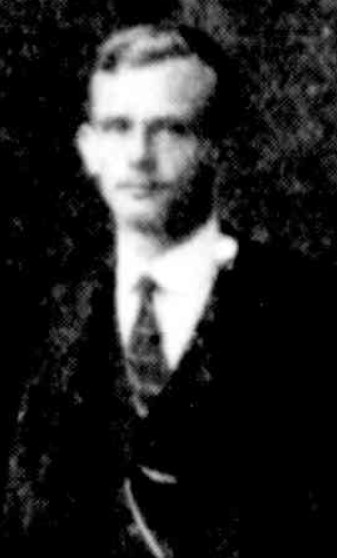
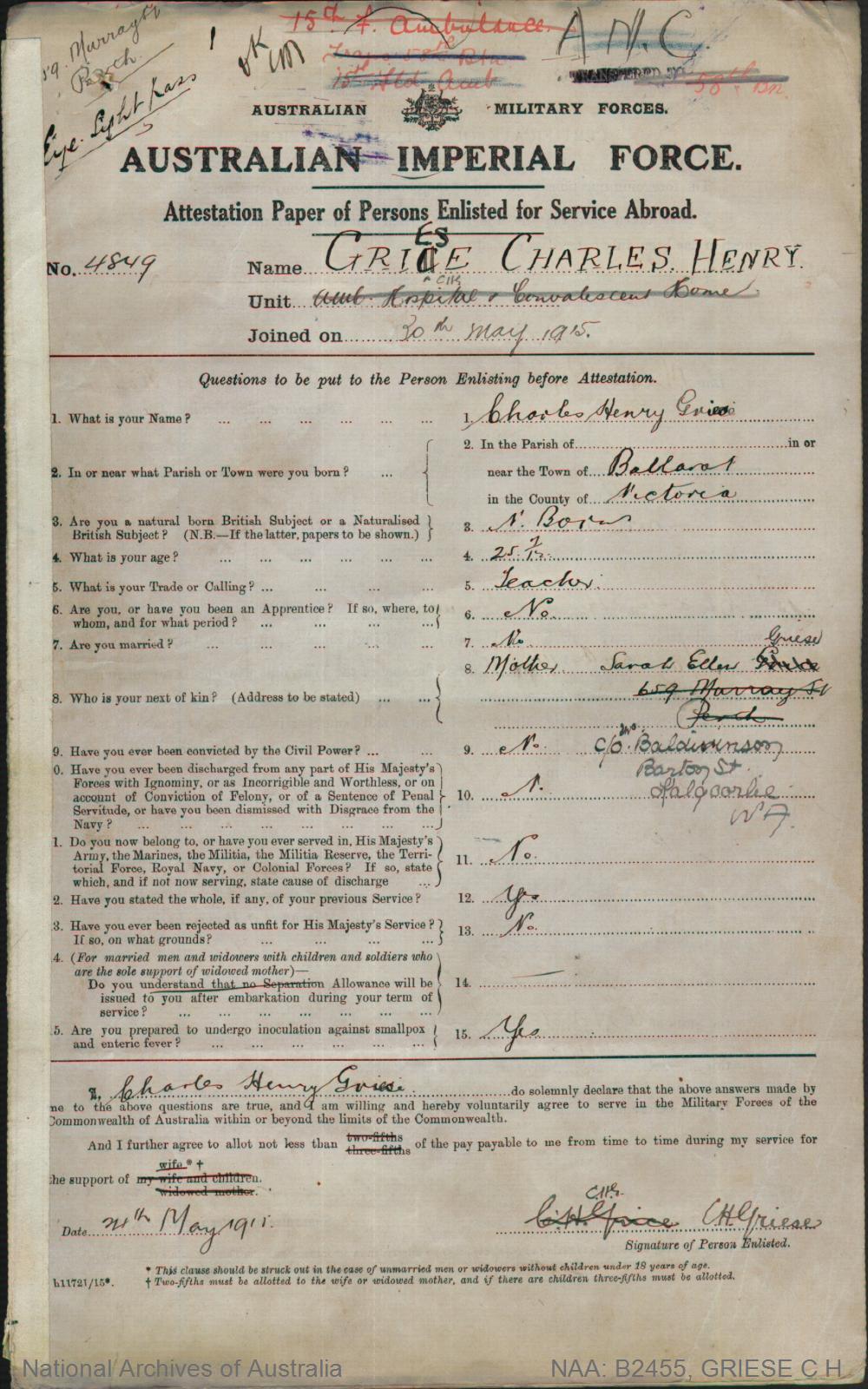
Charles Henry Griese was born on 12 October 1889 in Ballarat, Victoria. His teaching career began in 1907 in Kalgoorlie before moving to Perth via Hopetoun. He matriculated in 1914, qualified to study Arts. In 1913 Griese had been promoted to the College 1st team from the juniors and played well, becoming a regular by 1915.
On 5 June 1915 the West Australian reported the “latest Student to take the shilling is Charlie Griese, which brings the total number of pedagogues with the flag to 21.” Lieutenant Griese served in England and France before being granted 3 months leave on 6 May 1919 with full pay and subsistence of 6/- per day to study French at the Sorbonne, Paris. His military appointment terminated on 20 February 1920 shortly after his return the Perth.
He died on 28 March 1964 in Fremantle, Western Australia, at the age of 74, and was buried in Melville, Western Australia.
WITH THE FORCES IN EGYPT. THE CAIRO UNIVERSITY.
In a letter to his parents from Cairo, Private C. H. Griese, A.M.C., gives an interesting account of his experiences, as a member of the Western Australian expeditionary forces in Egypt. Before his enlistment Private Griese filled a position on the Subiaco school staff, and soon after his arrival in Cairo he attached himself to the university of that city in order to fill in spare time. He was surprised to find the Egypt climate intensely cold in January, “even men from Scotland complaining of the chilly, piercing morning air—especially when the wind blew strongly from the desert. Hospital work was slackening down, owing to the marked decrease in the number of typhoid cases, and he had an opportunity of visiting Alexandria. In Cairo there were few visible signs of grim war, and the Australians stationed there played tennis and football matches. The ‘Gypos were first-class players—light and extremely agile, and, being in constant practice, they proved tough opponents. The French and British section of the Cairo University had begun recently. The university is well endowed in many respects. The lectures take place during the day and the early evening, but, as the graduating regulations were printed in Arabic, he was unable to appreciate them. To take a Cairo University degree it is necessary to excel in Arabic. However, he went to the opening lectures, and found that Mr. Percy White, of London, was to open with “The History of English Literature, and the Drama from 1550 to the Present Day.” The class consisted of seven British people, of whom three were young ladies; twelve French, half of whom were ladies; a couple of Italians, and 12 Egyptians. In the second lecture the professor dealt mainly with Shakespeare. At the close a mild-mannered ‘Gypo stood up, and asserted that he thought Shakespeare wrote in a very distressed manner in all his works, and that despair was his chief theme. The professor referred him to the last group of the Shakespearean plays, particularly “The Tempest.” On the conclusion of the English lectures Mr. Griese mentioned to the English professor that he would like to attend a few lectures, and he was informed that he would be welcome to do so as the professor’s guest. He was escorted to the French lecture room. The English professor instructed the usher to conduct the young stranger to a good seat, and he was accommodated with a chair in the front row. The lecture was very fine. There were at least 200 present, all dressed faultlessly in the latest Paris style. In conclusion, Private Griese says:— We have a capable lady doctor here. She is a New Zealander. The medical authorities are coping with the fever outbreak, for, though we have had a number of bad cases, there has not been a death for three weeks. From my experience here, I fancy that a good training in physical work helps one to fight the fever. West Australian 30 March 1916