
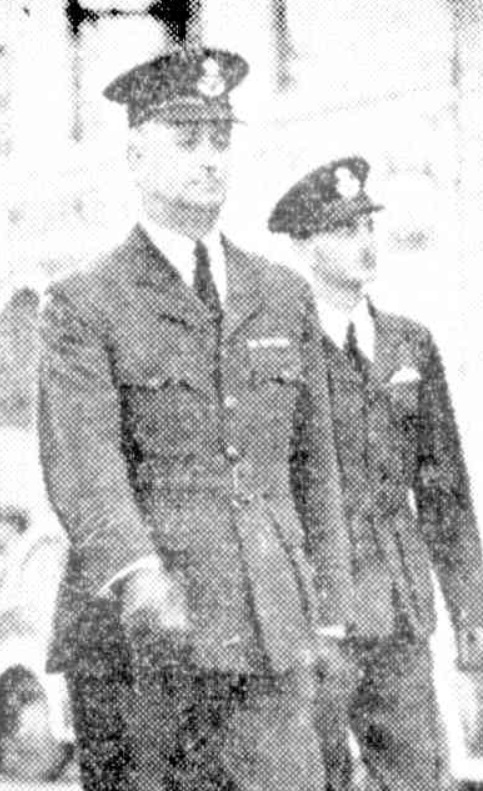
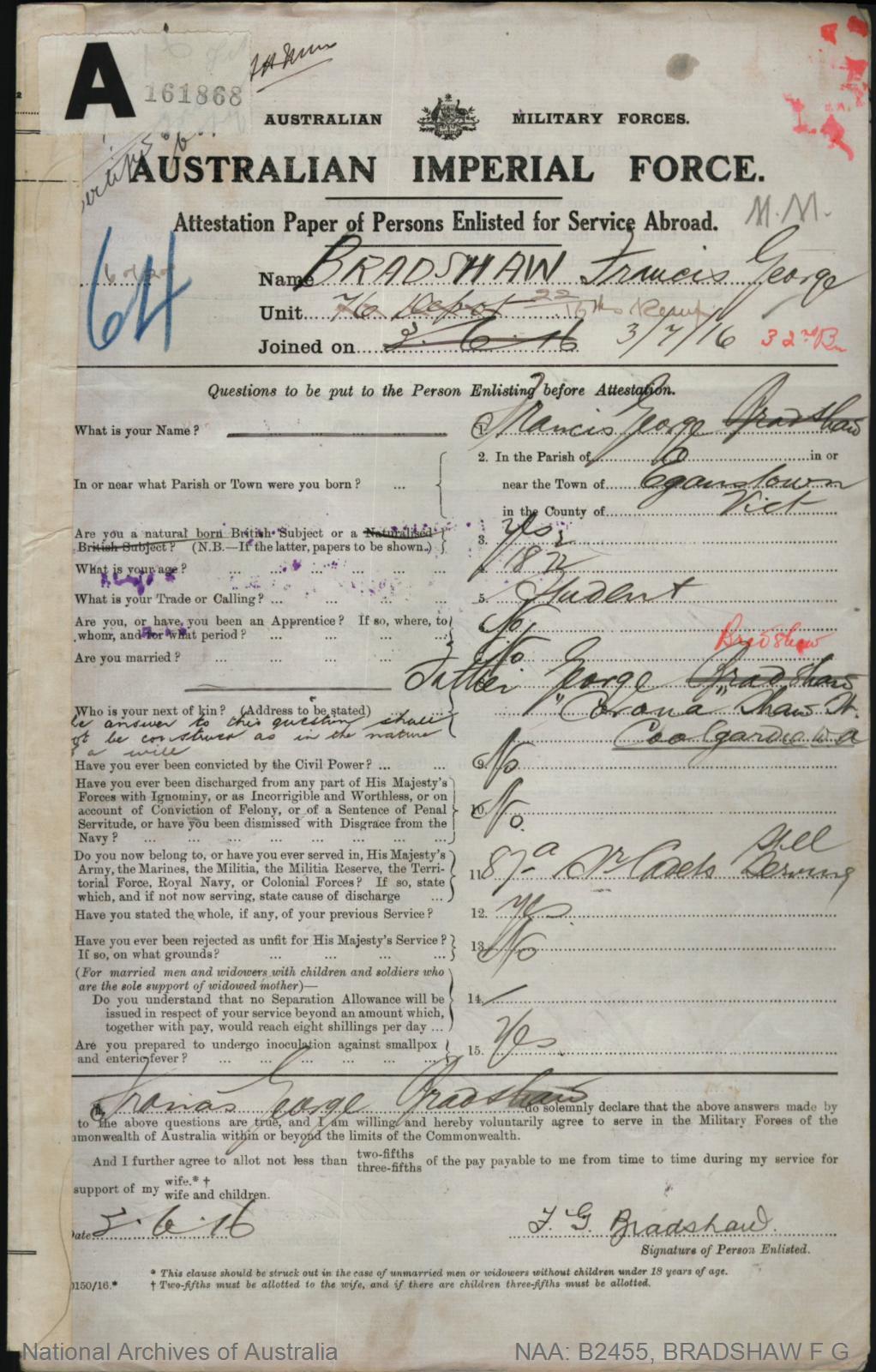
Francis George Bradshaw was born in 1898 in Eganstown, Victoria and moved with his family to Perth. The six-footer enlisted on 3 July 1916, at the age of 18, during a season in which he was playing well for Training College. Coincidentally this was only five days before his brother Raymond’s leg was amputated in England. Though it is possible that recent news of Raymond’s “illness” provided the spur.
Private Bradshaw was accidentally injured in a train accident in France in December 1917, two months after being promoted to Lance Corporal. Subsequently he was promoted to Lance Sergeant. In June 1918 he suffered phosphorous burns and rejoined his Battalion two months later. He was awarded a Military Medal for his actions described in the following citation:
During the operations near BELLICOURT between the 29th September/1st October 1918 Lance Sergeant BRADSHAW displayed the highest degree of gallantry, courage and initiative. He was the leader of a Lewis Gun team and by his coolness and cheery manner kept his men under good control and set a splendid example to them. Lance Sergeant BRADSHAW also gave his Platoon Commander most valuable assistance in retaining connection on the right of his Company. On the morning of the 29th September during the advance through fog and a very heavy shell fire he maintained his position exactly and rendered valuable services to his Company. He also greatly assisted a Company of the 30th Battalion on the 1st October while they were moving on JONCOURT by personally taking one of his Lewis Gun Crews out about 300 Yards in advance of our front line and engaging an enemy machine gun crew which was holding up some of the advancing troops. As a consequence of this action the advance immediately continued. Lance Sergeant BRADSHAW’s services were again very valuable the same night, when although very fatigued he took charge of a patrol and succeeded in regaining connection with English Troops on the right flank who had pushed forward about 200 Yards.
Upon returning he played once more for Teaching College, then Claremont and Ninghan in the Eastern Goldfields where he taught in the early 1930s, a stint in his long teaching career in Western Australia. He died on 7 December 1971 in Nedlands, at the age of 73.