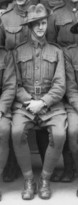
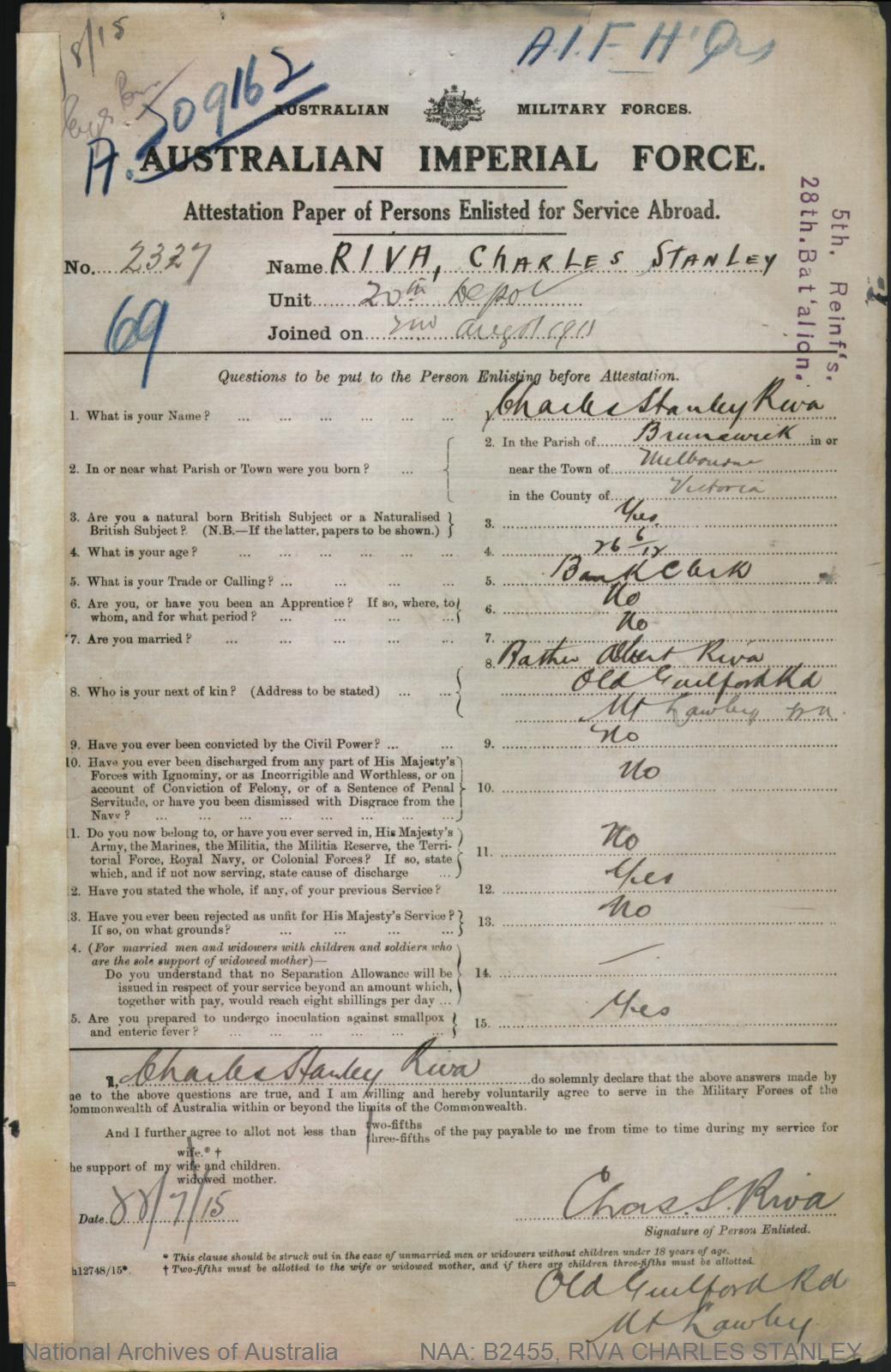
Charles Riva was born in Brunswick, Melbourne, on 21 December 1888. At some point during the 1890s his parents, Albert Riva and Mary Menzies, gathered up their three young children and moved to Western Australia where they set-up home on Guildford Road in Mt Lawley.
Chas attended Newcastle Street Government School and captained the school team in a difficult first season in the Schools League, collecting just two draws from eleven games. In mid-1903 he commenced a cadetship with the Western Australian Government Railways.
The following year he joined the Rangers club where, across eight winters, he rose from playing in the third tier to the top flight. Towards the end of the 1910 season he helped Division Two side Claremont No.1 win the Charity Cup. Twelve months later he was a regular fixture of the Rangers side that claimed the Division One championship.
Chas had given the railways away a few years earlier and was now employed by the National Bank. The offer of a position in the Wheatbelt town of Wagin meant he missed the 1912 football season, however, he played cricket in his downtime. On returning to Perth he joined Claremont Glebe and played a key midfield role in their 1914 Division Two championship success.
In August 1915, Chas enlisted as a Sergeant with the 28th Battalion. On completion of basic training at Blackboy Hill, he boarded a steamship in Fremantle bound for Egypt where he underwent further training with his unit in Tel-el-Kebir. During this period he spent a short time in hospital sick.
The 28th Battalion moved to France in March 1916, taking up positions in the Armentieres sector. Their first major battle was around the village of Pozieres where, in early August, Chas received a severe gun shot wound to the neck. After initial treatment at 26th General Hospital in Etaples, he was evacuated to England and admitted to Bulford Military Hospital on Salisbury Plain.
On returning to France, Chas took up an administrative post with the 2nd Australian Division’s base at Harfleur and was promoted to Acting Sergeant. In December he was attached to the ANZAC section of the 3rd Echelon General Headquarters, whose role was to manage discipline, records, promotions and organise reinforcements for units in the field.
Chas was promoted to temporary Corporal in March 1917 and again eight months later, gaining the rank of Staff Sergeant. A bout of influenza put him in a Rouen hospital in October 1918 after which he transferred to the Australian Imperial Forces’ Administrative Head Quarters in London. Granted four-months leave from April 1919, Chas was employed at the London Chartered Bank of Australia as part of the A.I.F. Education Scheme.
On returning to Perth Chas resumed employment with the National Bank, where he was appointed manager of their Manjimup branch. In 1922 he married Constance Murphy in Perth but within three years the newlyweds were residing in the Wheatbelt town of Moora where Chas, now in his mid-30s, kept fit by playing cricket and Australian Rules football.
Chas and Constance worked together in the Gnowangerup branch of the National Bank during a decade-long stint in the Great Southern town. A year in Geraldton preceded their move back to the metropolitan area in mid-1939 when Chas took over management of the Claremont branch. In retirement they lived in the leafy suburb of Lesmurdie, in the hills to the east of Perth.
Charles Riva was 72 years of age when he passed away on 3 August 1961, in Lesmurdie.