
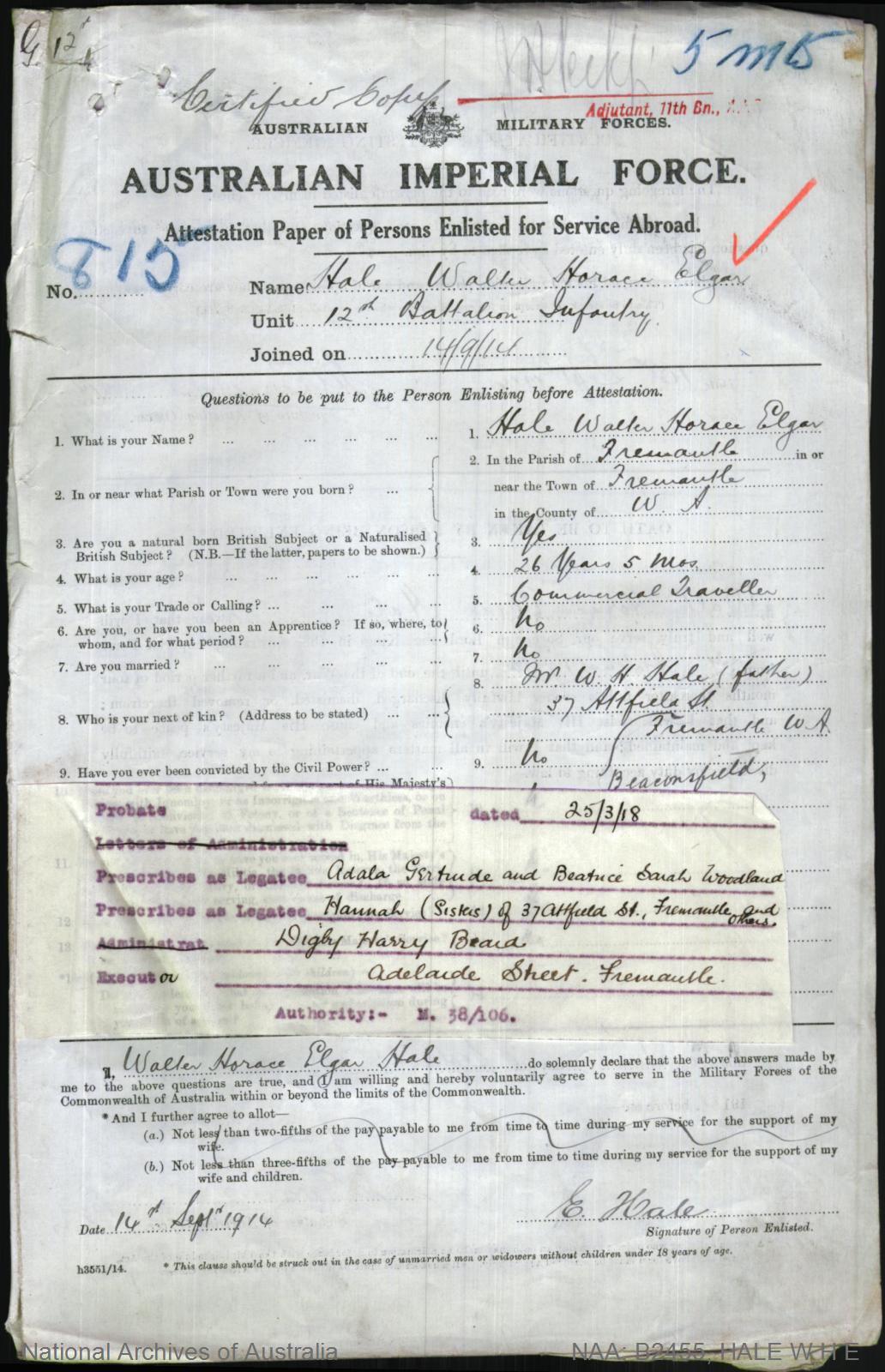
Walter Hale was born in Fremantle in about 1888, one of nine children to William Hale and Mary John. He grew up at the family home on Attfield Street, South Fremantle, and attended nearby Beaconsfield Primary before switching to Fremantle Boys School. On finishing his education Elgar found work as an ironmonger.
Elgar learnt how cruel life can be when Edith, his sister three years his elder, passed away in March 1907. And almost three years later to the day he would mourn the loss of his mother Mary. These came after his first experience of death, the passing of his brother Matthew in 1890, when Elgar was only 2.
Football in Western Australia was booming and it’s not unreasonable to assume that one, or both of the Hale’s who’d been playing for the Fremantle Reserves club were Elgar’s brothers. Whatever the case, in 1908 Elgar decided to throw his lot in with the newly formed Claremont club, who fielded teams in all three divisions under the WA British Football Association.
Playing for Claremont No.1 – the clubs ‘B’ team – Elgar won back-to-back Division Two championships in 1909 and 1910, when they became just the third team from outside the top flight to claim the prestigious Charity Cup by defeating Training College 1-0 in a replay. He collected a third Division Two league title in 1914, by which time the team was known as Claremont Glebe.
Elgar was 26 when he enlisted in the 12th Battalion on 31 August 1914, only 26 days after Australia entered World War 1. His unit was amongst the first ashore at Gallipoli in the early morning of 25 April, 1915. And although many men from the 12th Battalion were killed and wounded in the fighting that followed, the recently promoted Corporal Elgar survived unscathed.
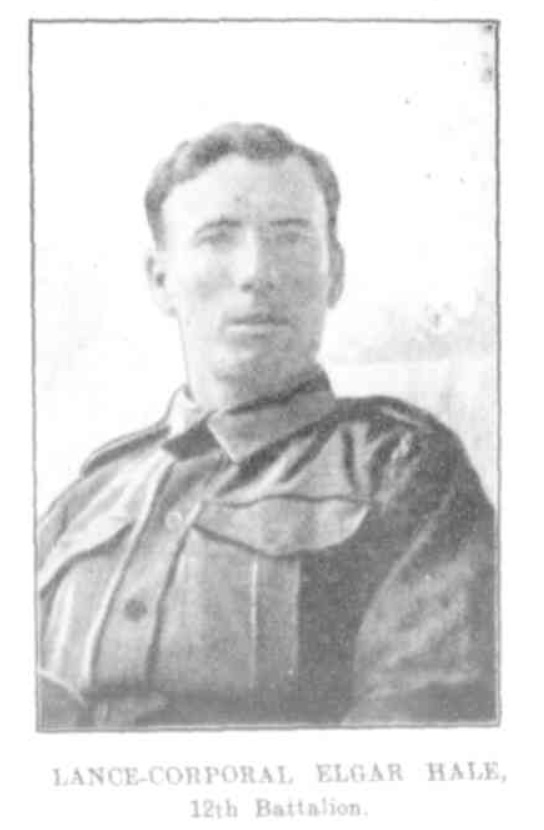
In early May Elgar was mistakenly reported as killed in action. The distressing news reached his family in Fremantle and his photo appeared in the newspapers as one of the fallen. Two months later the Western Mail reported
last week his relatives received a private cable to the effect that he was alive and well. As the result of further inquiries made by the military authorities, it has now been ascertained that he has been wounded, and is in hospital at Alexandria, doing well.
Elgar was in hospital with bronchitis but was soon back on Gallipoli Peninsula where the fighting had settled into trench warfare. The 12th Battalion were involved in trying to improve the trench system in anticipation of a heavy Turkish attack which arrived on 19 May and was repelled with very heavy Turkish casualties.
“I am in the trench writing this and got a smack just below the ankle of the left foot with a bit of stray shrapnel,” Elgar wrote in a letter home on the day of that attack. “It has only made a small bruise, my boot being a good protection. The shot and shell has been literally screaming over since very early this morning and is still going good. My word we do give the poor old Turks a terrible doing.”
Promoted to Sergeant in July, Elgar spent much of August hospitalised in Alexandria, Egypt, with concussion. “The beggars nearly got me with a bomb,” he wrote.
I had quite a nice job. Chasing bombs as they landed in the trench and dropping a bag of sand on them, so as to localise their explosion. I saw one coming through the air and was bending down picking up the bag to drop on it; but it exploded just behind my back and knocked me over… All I know is that I struggled out with my eyes and mouth full of sand and my ears buzzing and very deaf. About half an hour after I was as good as gold again.
The 12th Battalion were resting on the Greek island of Lemnos when the order to evacuate Gallipoli came through towards the end of the year. Elgar was made Company Quarter Master Sergeant and in April 1916 his unit moved to France where they saw their first major action in the brutal trench warfare of the Battle of Pozieres in the Somme Valley. He wrote of that experience in August –
We have had two very severe fights with Fritz this month, both of which were victories for us and both of which I was fortunate enough to live through. At present we are withdrawn from the Somme front and after a spell we expect to do a bit of trench warfare again. Certainly the latter is the safest warfare, but I much prefer the attacks for the best sport… Some good sport chasing the Huns as they run helter skelter after throwing down their rifles and discarding their equipment. When this war is over which I hope is not very far off, there will be very few Germans left, for the numbers we are killing off daily is enormous. One hasn’t the least idea of the thousands upon thousands of Germans being killed on the Somme front until they have seen it and I can say that I have seen it. No two ways about it, this war is a cruel war.
After a spell resting in Belgium, the freshly promoted Lieutenant Elgar transferred back to the Somme where, three days before Christmas, he was struck by shrapnel just above the left clavicle and through the neck. He was taken to the 38th Casualty Clearing Station where bullet fragments were removed before being evacuated to England for what would be a two-month stay in hospital at Wandsworth.
By now Elgar’s brothers Arthur and Daniel had enlisted, with the Field Artillery Brigade and the 11th Battalion respectively, and were also in France. All three brothers were resting out of line in May 1917 when they met up for what would be the final time. Arthur described the scene in a letter home to a sister –
I have some great news for you this mail, news which I have been waiting to write of for a long time and that is the meeting of we three boys. Yes! Last Saturday was the beautiful day on which I met Bosun & Squib. Can you imagine how delighted & pleased such a trio would be. Last Saturday I got news that the 11th & 12th were at a neighbouring village and of course next day I set out to find them. It was awfully wet and moreover I rode a bicycle. Curiously enough as I learnt afterwards, who should arrive at our camp looking for me some twenty minutes after my departure, but Elgar. Ha-ha. He was riding a bicycle too I believe and just about wet through. However my ride was much further than I anticipated. In fact I went quite a roundabout way following the directions of other 1st Div chaps.
Anyway after about three hours I landed quite excitedly in a little village and made enquiries for Elgar’s billet and in a typical old French farmhouse I met him. He was having dinner and this child received quite a cordial reception (& a jolly fine dinner) in the Officers Mess. They were a fine happy crowd of chaps and with very few exceptions original members of the Battalion. Of course Elgar and I could not talk quickly enough and what was more we had to find young Cyril. Another ride of about ten minutes took us to the vicinity of dear old Squib’s billets. I was riding a little ahead of Elgar and strolling some distance ahead were two of the lads of the 11th. One I instantly recognised as Squib, so I rode up and hopping off I said “Hello Squib”. Strike he nearly fell over with surprise.
Can you picture we three boys meeting after such a long time. I think we were too excitable to discuss things much. They are both in splendid condition. Elgar is just about as well as I am and has a splendid athletic build. Although outwardly he is thoroughly happy and contented I reckon he’s a well bit homesick. Of course his men can’t be beaten in his estimation and what is more he looks after them. Young Squib is well formed & inches taller than either of us two. He has not got any fatter but looks extremely well and fit and what is more he seems quite contented. We only had a few minutes together, but they were happy ones and if all goes well I hope to see them again soon.”
The 12th Battalion returned to the battlefield in September and were heavily involved in the capture of German positions along Menin Road at Glencourse Wood, Nonne Boschen and Polygon Wood. Elgar’s luck ran out on the evening of 5 October, 1917, when he and Corporals Hamilton and Henderson were killed by a bomb explosion while crossing a duckboard track in Belgium. Private Cowderoy of the 12th Battalion witnessed Elgar’s death –
He was up in the trench leading a party over when he was struck by a shell and wounded in the breast; and he died a few hours later. I saw this myself and helped to bury him 300 yards on the other side of Zonnebeke Gasometer. We went out of the line. On November 3rd we took a cross up and the Adjutant & Intelligence Officer were there. When we arrived at the grave we found that the body had been blown out and also those of two soldiers. The two officers and the party buried all three again and put up a cross for Lt Hale and the two soldiers.
Arthur had been seriously injured a few weeks earlier when a bomb landed next to his dugout while he was sleeping. He returned to Fremantle in June 1918. And three days after Elgar’s death, Daniel suffered a compound fracture of the left tibia and gun shot wounds to his left arm and leg. Evacuated to England, he returned home in March.